tony uljee

Rocket Scientist
+ Follow
since Jul 04, 2017
Merit badge: bb list bbv list
For More
Apples and Likes
Apples
Total received
In last 30 days
5
Forums and Threads

Recent posts by tony uljee

well you could always have a go at building your own solar panels ----check out missed history and low cost solar ---guy built them in 1905 ---and they were totally rebuildable---no use up and throw away---maybe not high performance---but diy---just thought i would perhaps add another project onto the list
5 days ago
can t say that i am an advocate of using copper , its just we do nt have much else to use ----the absorption of copper into water from  pipes is i think related more to the water property flowing through them ---filter and treatments before use plays a part---more so if the water source is contaminated----most of my pipework is black poly pipe ---and i wonder how good that is for us ---stainless steel is best some say ---in my case that would mean 120 meters down the bore---to the pump---a problem there with the rigid connection possibly  --then line the bore wall down some 40 meters with 180mm diameter---then another 80 meter to the house   ---thats before trying to bend it and all the connectors---so thats before investing in a pipe threader and cutter , hydraulic bender and dies ----so it becomes expensive---i am wondering if its possible to find  something to include in our diet that would clear the excess of metals out our bodies as an alternative----more reading up required
6 days ago
i like the sheer wackiness of it, its disturbing to watch it ---for me ---which means --it would freak out the neighbours ,the council, but at the same time generate power from homebrewed mix of salvaged parts ---great idea---but way down on my list of things to make
1 week ago
Samuel , the stove is experimental so the making of hot water with it is underway ----Matt of Walker Stoves ---has advised on some of it --- if my wallet could be persuaded to pay for his passage over and his labour input ---i am sure my problem would have been sorted---so i carry on ----making changes and trying it out ---conclusions that it has not worked out are too early to make---and i look for further ideas from other similar completed stove builds ---yes i will be remaking a heating coil ---in copper ---no it will not be in the firebox ---its going to be no longer than 80 cm ----using new waterline quality copper-----will it absorb copper ---theoretically ---yes---will it be drinking water ----no ---its for washing ---not cooking with---will my family s hair go green -------well i think some of them have done that already in the past ----and its quite common over here on paddy s day----i am more concerned with micro plastics ,herbicides ,heavy metals , fluorides and hormone contamination in our water sources supplied to our taps ----and now i must make a start at building in the oven side of the stove ----so onwards --forwards---backwards sometimes ---its off to work i go
2 weeks ago
the use of red clay brick in the firebox would not work for too long , the temperatures generated are above its rating , using fireclay in the mortar mix is also an non essential as the temperature generated do not reach the figures that fireclays are rated at ---a minimum of  about 1500 C ---its just added expense----but the amount required to build the stove is not that much ---say as compared to laying up several thousands of  brick in a russian /eastern european type stove. Its not going to give any advantage if used in either types of stove --- it would be generally used as its easier to source from building suppliers than ordinary clays which are common in the ground ----but not available in the trades---unless you can a approach a local clay brick maker or pit---or a pottery . The latest advice for the riserless core build and firebox ---if using the insulated firebrick or the heavy and hard fire brick --is not to mortar them ---they are dry stacked to cope with the way the stoves are used ---a quick hot burn and cool down ----as compared to large forges and furnaces where these bricks are designed for use in at much longer high temp firings and much slower cool down times. Its also recommended to keep the rest of the stoves build ---which is with common clay brick---using thinner layers over thick layers of joining mortar ---this reduces cracking ---makes a more stable build--- but i believe that all of the stoves will eventually have cracks after awhile---as long as the seam of mortar is good and covers the bricks width ---there wont be a problem -----we are not building a load bearing single  brick wall or a single width brick planter box or a brick water cistern---its a stove with a clay and sand joint that does not set up ---it dries out---its a softer type of joint meant to cope with movement and be easily repaired ---the formation of large cracks in a much bigger stove would be a problem.
2 weeks ago
sorry  delayed response , we had a storm --lots of bright light and big bangs---blew out the power for a day ---but the fibercable service was down for 4 days---we came damn close to total collapse of civilization ---as we know it and have become comfortably  accustomed to---on to the use of mortars and mixes of --which or what to use ---its all been said before and reasoned out ---traditional  russian /eastern european stoves and mortar mixes are a lot different ---those stove types are not riserless cores , or feature a secondary air combustion box---i stuck to mostly following the advise from Walker stoves , and other stove builds---i used builders sand as thats all my local supplier had at the time ---should have gone for a finer plastering sharp sand---no little pebbles ---so the joints can be made smaller/thinner----reduced/less chance of joints cracking ---i used fireclay ---but only because i could source it with out delays ---as in trying to find a local clay and digging it up and cleaning it and so on ----i should have sifted the dry fire clay as well ---mine had plenty of hard shards and pieces in it----its meant to be ball milled before use---to become a very fine powder. The stove does not really get up to the high heat temp that fireclay is used at in pottery firing ----so ordinary fine clay is just as good for this stove----i used some sifted out wood ash in my mix to just give some plasticity to it ---and a slight stickness to it as well---helps it stick to dry bricks ---important for beginers to brick work like me---
2 weeks ago
I have had to read up a lot more on heat exchangers and the materials they are made from and so on , also had to re think my ideas i had used ---the stainless steel jacket type i have used is not best suited to this type of stove ---its designed to be placed in the firebox of a cast iron wood burning stove---to be heated by the flames /coals of the fire its self. ----this would not work in the walker stove----it gets to a much higher temp due to the firebricks used---and would be degraded a lot quicker----but more importantly ---i think it would be a heat sink effect in the firebox ---cooling it down ----causing a smokier startup burn ---creosote ,soot from an incomplete combustion---not what the stove is designed for ----possibly also increased risk of flash boiling inside the jacket when the stove does get up to temp.So i am sticking with the concept of placing the heat exchanger after the riserless core .----but to remade in copper pipe as a squared off coil shape ----to fit into the brick box shaped chamber next to the core----copper has a much higher ability for heat absorbing from hot gases coming out down stream from the fire box ----than does stainless steel .
3 weeks ago
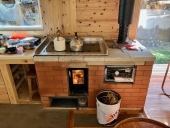
yes its finished in that i have been using it for a year or more for heating and occasional cooking, it was not situated in my main house so was only lit every 2nd or 3rd day , ---whilest i was working on the inside of the building ---but just over this past few weeks the building housing the stove has become our main house ----while i carry out a total refurbishment of our old cottage. ---the overall performance of the stove  has worked out good --the ceramic glass cooktop would leak out a few wisps of smoke---sometimes ---until i flatted and pinned down the fiberglass rope seal underneath it ---with the intense heat generated in the firebox and riserless core  these expand and contract with each firing----breaking the small contact area under the glass to the round shaped rope seal---this would not be a problem when i replace the  rope with some basalt fiber rectangular profile braided rope ----this would give a 25mm flat surface to make contact to the ceramic glass .My biggest problem has been to source very dry timber . ---my next plan is to build the oven side of the stove ---for some baking attempts ----the hot water system ----has not worked out ----but its not over yet ---lots more experimental work to be done---i have changed some parts of the first design build ---but that failed as well---only generating luke warm water even after 2 or 3 firings in one day.---- i am on my own path with this ---and will find a solution.
3 weeks ago
clear plastic sheeting --as from polytunnel material--its uv treated --transmits 80 percent or more of light--and use the clear repair tape to hold it down around the framework----would be the cheapest ---next would be the specialist sticky back stuff applied to windows turns them into safety glass
4 weeks ago
plug the chimney and make a nice sign to hang off the firebox door ---a reminder to remove seal before fire up
4 weeks ago