


Og Duzle

+ Follow
since Dec 26, 2022
Merit badge: bb list bbv list
For More
Apples and Likes
Apples
Total received
In last 30 days
1
Forums and Threads

Recent posts by Og Duzle

First off, do NOT buy a buzzbox. They are heavy, not really portable, AC only and not really cheap.

I taught myself from Youtube and I took an online "course". The online thing was to me mostly interesting because of the safety aspect. There are many ways to kill yourself welding or hurt yourself badly. Not just immediate stuff like burns, eyes and death from welding on parts you cleaned with a chlorinated brake cleaner spray or serious illness from welding galvanized steel (how do you know if a piece of steel is galvanized?) but also long term damage like cancer from UV ray exposure or serious accidents like starting fires because of flying sparks, hot slag etc. Finally, you can electrocute yourself as well if you are not careful.

So, step one would be to understand how things work, the dos and the don'ts. There are youtube videos and online courses that cover this

Then there is technique AFTER you chose your machine. My recommendation is to buy a cheap 3-in-1 welder on Amazon or from your local Harbor Freight - many of these are stick, TIG and flux core and you can experiment which one suits you best for your problem at hand. All methods have their advantages and disadvantages. For example, you would not weld very thin auto metal with stick (unless you were very, VERY good). Best for using outside in the wind on dirty/rusty metal? Stick. So on and so on.

Choose one to play with and give yourself real world projects. Start by running beads on scrap metal (just make sure it is NOT galvanized steel as inhaling the fumes will make you really sick). This will allow you to understand the relationship between angle, travel speed, temperature and distance between electrode and metal (if you are stick welding). Then progress to putting pieces together and then try to break them off or cut them off to see if you penetrated the metal enough to make a weld. Some welds are unimportant but if you get to welding tractor implements, a broken weld can make a difference between this year's planting or not planting at best or can even hurt you at worst...

"Making mistakes with Greg" Youtube channel has playlists where he teaches you each welding technique (stick, tig, mig...) - one series per each technique with plenty of videos. There are MANY others. There are also videos from others like "Top 5 ways to kill yourself welding".

Within two hours of me here in my state there are a few schools where you can pay $500 to spend two days (weekend) learning how to weld - the basics. They will not make you a pro but can get you started on the right path and teach you the difference between a good weld and a bad one. There is no substitute for someone with experience looking over your stuff.

Finally, welding does not happen in a vacuum. You will need to use tools to cut metal like angle grinders and those have their own ways to kill you. My first thing to learn was - RESPECT YOUR TOOLS. Do not be afraid of them but know the ways they can hurt/kill you. After that it is fun
2 weeks ago

Julie E. Johnson wrote:I have finally acquired two very small paw paw seedlings and I am wondering if you might have any tips on how to plant them and when to plant them?  I live in East TN. Which is zone 7 .  Any info would be appreciated.  


Paw-paws don't like direct sun/wind swept areas although I have 3 that are planted in just such a location and they survived to the point of two of them bearing fruit this year (but in a hot, dry summer - they will suffer - which will slow them down, sometimes considerably). In their natural form, paw-paws are usually found in partial shade near water such as creeks. Do note that to get fruit you will need two different paw-paw varieties. I am in Virginia (7a).
2 years ago

Eino Kenttä wrote:If they grow well, lingonberries would make a neat groundcover. Around here (northern Scandinavia) lingonberries, bilberries and a couple other acid-soil berries are so common in the wild that no one attempts to grow them. Where lingonberries do grow, they tend to form quite dense populations. Since they are evergreen, if you got them well established they might shade out the buttercups' new growth in spring? Don't know anything, just guessing.

Also, aren't buttercups a high-nitrogen indicator?


Buttercups inhibit other nitrogen fixers around them and are usually a sigh of low calcium / acidic soils. if you want to get rid of them - you can try simply liming the soil as the first step (which is not what the OP wants in their situation!). Buttercups will fix/store calcium themselves (which is why they appear in low calcium soils).

Well, at least this is what I know

B Permie wrote:

Greg B Smith wrote: The pics below are composted wood chips that were put down 2 plus years ago. Also pictured is the compacted clay.  Zone 8 Central Mississippi...


I know it's a long shot but is there an update to this situation? I am in almost the exact situation, north central MS, at least 4 ft of clay, and I've been working on a solid layer of organic on top. The area had zero top soil when I moved here. I've now got about 7 inches of leaf and crass clippings that have been breaking down for a year or two, and it seems like this year things are growing well enough in it..

There is still a very obvious divide between clay and organic, and I don't know if it is worth fighting or not. I feel like "punching through" the clay would be an excercise in futility due to the depth, and I wonder if my best bet is to just bring in some soil to mix in and just garden on top of the clay? Or just keep waiting as the crawdads and fireants keep bringing up mounds of clay into the compost.


I live on top of clay as well

Clays do not generally have a problem with fertility and organic matter - both of which they are rich in. The problem with clay is density, aeration and waterlogging. Adding organic compost on top of clay is in my humble opinion not necessary. What is necessary is to grow deep rooted plants (long term) / cover crops and in the interim - broadforking. It is OK to plow/till the clay ONCE - to bust it up and start the process of no-till growing the soil upwards - but long term you want root penetration by perennials. Clovers, docks dandelions etc. - are all perennials with deep roots that bust up / aerate the soil - mow them short, cover them with plastic (OK to do once just like plowing) or cardboard or thick straw/old hay and plant straight into it - the soil underneath is likely to be not so compacted. On the "short growth cycle" side to combat compaction - radishes (daikons) and various cover crop mixes that contain them. Working clay is a multi-year process (just like working sand) but IMHO "enriching" clay with more organic matter is like wearing a sweater on top of a jacket... IMHO a lot of people get on the "compost train" and that's OK but what you can also do is smart rotation of plots with cover crops grown year round in some of them while others are producing - and smartly terminating said cover crops or simply letting them die off naturally. For example, buckwheat does not survive cold weather so it is an ideal summer cover crop to scavenge phosphorus into the soil for the next crop - which could be wheat mixed with clover and trefoil (which will scavenge nitrogen) - followed by sunflowers after wheat harvest (sunflowers scavenge nutrients from deeper in the soil), followed by a period of 1-year long cover crop rest for the same plot.

p.s. the straw from your wheat harvest can be re-used as mulch, sunflower stalks can be used to build a honeybee hive box etc. etc.
3 years ago
There are apple varieties that are resistant to cedar rust and there is a supplier in North Carolina that sells at least one of them - the variety is "Liberty". I have also had luck with Arkansas black rome. Growing fruits on the east coast is not simple - stone fruits such as peaches, apricots etc. are susceptible to all sorts of fungal diseases and bacterial cankers etc. I have had much more luck with plums - they seem much hardier at least in my little corner of SW/central Virginia.
3 years ago
Every time you have a "fight" with some sort of "undesirable" plant ("weed") - ask yourself why the particular plant is where it is and what is it trying to tell you. If I were you, I would do a soil test to see what is missing. Is your soil poorly drained (likely)? Is it too low or too high in potassium? What does your "soil life" generally look like around your blueberry patch? Dig up a shovel load or two and take a look. IMHO, the whole acidic thing with the blueberries is a bit overstated but buttercups do like acidic soil so it is obvious at least part of the reason why they keep coming back
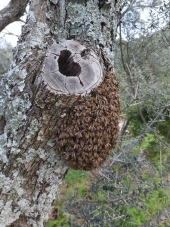
If you want it to be as simple and cheap as possible - look into a Kenyan top bar hive or a Sam Comfort hive. That looks like a very small swarm (likely a secondary swarm) so lower chances of survival. Your post is 4 days old, by now you have either caught them or they found a place to live on their own.
3 years ago
It is going to be a tough going producing off land in West Texas (I am speaking of the part I have experience with, which is Brewster county). Not to say impossible but be ready to not have a rigid mentality about things. What I mean by that is - when we started our journey (not in West Texas), I was adamant about not using external inputs - at all. Pretty quickly learned to pick my battles and that my end goal should be no external inputs but the journey to that goal may include them

Water rights in your area - are there any cattle ranches nearby? If you start digging canals and collecting ground runoff into ponds - is anyone legally entitled to that water or is it yours? If you are OK to dig canals and make ponds - make sure they are some distance from your abode. Otherwise your pond will attract everything that lives around - including a ton of rattlers...
3 years ago

David Baillie wrote:So much of this is local. if its on clay with no gravel layer yeah the tube wont do much. hunt cracks, ventilate from low down, maybe even redirect your cold air return a little higher. Good luck. Short of being there that about all I got.
Cheers, David


Thank you for all your help!
3 years ago
All of my colonies are in Lazutin hives and I have a very high survival rate (but all my hives are wild caught swarms and I don't rob them except for our own use, I also rarely disturb and do no treat/feed syrup). We live in an area of Virginia (USA) with a lot of rock in the clay soil and have plans to build stone hives using the slipforming technique. My worry is excess humidity in summer. We do get a lot of rain. I can totally see how these hives work in dry climates. In fact, if you have seen one of the best documentaries to come out of my homeland - "Honeyland", you will see that the main protagonist keeps bees in stone "hives"...
3 years ago