Vic Dupont

+ Follow
since Jul 29, 2023
Merit badge: bb list bbv list
For More
Apples and Likes
Apples
Total received
In last 30 days
0
Forums and Threads

Recent posts by Vic Dupont

Hi there!

I am writing to share my subsequent experience with this anvil, and also to get your thoughts on why I damaged it

First off, from my subsequent experience I am under the impression that one should align the edge of the blade with the middle of the anvil. At first I tried covering the whole anvil's width with the blade, but got bad results. I don't remember exactly what they were, but I think more or less nothing was happening. Conversely, with the edge of the blade aligned with the middle of the anvil, I was able to peen more or less.

However, big however, I damaged the anvil.

It now has big cracks, and some parts of it even fell off on the sides :''''''''(

See attached pictures.

I am super sad and I feel like a moron damaging this tool, which has been used for centuries by this house's farmers.

I would love to have your thoughts as to why that happened.

One important element is that I am new to peening. I had never peened before. So a lot is probably due to my inexperience.

Another important element is that right before peening, I filed a huge portion of the blade away, to remove a large tear. After doing so, I used the file to partly recreate a slight bevel, before finishing by peening.

I did strike hard with the hammer. I did so because I felt like unless I did that, nothing was happening.

Also it's very possible that at times the scythe slipped and I hit on the anvil directly.

I see two possible explanations:

1) Maybe I just should have done a first pass without expecting to see any results, just being patient, and then doing more passes? Could this be because I had a lot of bevel to recreate, and in such cases one should adopt such an approach?

2) Could it be that because I filed away a lot of the blade, I then reached a part of the body that is harder?

Any advice as to what I might have done wrong, or what I should correct, is most welcome.

Thanks again a lot for your past help!

1 week ago
Hi guys,


It's been a very long time, but I thought I'd give you an update on my scythe, which had previously been declared unusable.

After my last filing, I filed a bevel on the portion that had been dulled, and used it.

It works perfectly.

So a huge thanks for the help I received here, I learned a lot and it saved my scythe.

Right now I am moving forward with a second repair of it.

I don't know whether you noticed on the pictures, but elsewhere on the blade there was a pretty big tear.

I just filed a huge length of the blade away, to remove the tear, and I'll peen a bevel back into it afterwards, from scratch.

I'll share it with you once it's done.

Again a very huge thank you!
3 months ago
I am replying very late, but a huge thank you for all your explanations, they are incredibly helpful.

Last summer I tried peening with this anvil, and got my first successful peening ever. Mowing was so incredibly enjoyable after that!

Right now I am about to do a lot of peening with it, since I am filing half of my scythe's blade, to remove a tear. So I'll have to recreate the whole bevel from scratch on half of its length.

I'll let you know how it goes.

Again a very huge thank you!
3 months ago
I am replying very late, but thanks a lot for your answer.

I haven't tried your technique yet, but my partner, who comes from South-East Asia, told me that over there they have this problem with rice, whose husk always sticks to the kernel.

The way they used to go about it until machines arrived recently, is to place it in a kind of mortar made of wood, and pound it with a wood piece. That way the husk is removed but most of the seeds are not broken.

I might try that too.

I'll let you guys know.

Thanks a lot again for the help!
I am replying very late, but by "fertilizing", I included manure.

Your bending over might be due to over fertilization with everything you mentioned. From what I read, wheat should almost not be fertilized at all.
If your are "much closer", I would advise you to try what I did: sow in furrows, controlling the spacing, and trying 4 inches and 8 inches spacing in the furrows.

Mine was 4 inches, but I saw a very good presentation by a guy who sowed one seed every 8 inches, 20 cm.

Did you fertilize?
Thanks a lot for the replies guys!

In my case, I think the reason why the hulls are stuck to the seeds is because I harvested too late. I had read somewhere that this can happen.

It seems confirmed because this year I haven't threshed it yet, but it seems to not be the case, although it's the same variety. I harvested much earlier this year.

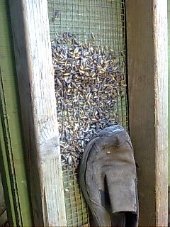
Joseph, your method with a screen and a shoe is interesting. I am surprised about the size of the screen. 1/2" isn't so wide that the seeds just fall through?
Hi there!


Just an update on where I am on this topic.

I have stopped looking for a roller solution, because I tried sowing in furrows, and I found it much easier.

Instead of broadcasting the seeds, I tilled the ground, then just traced small furrows, and dropped one seed every 10 cm, or 4 inches. After sowing one furrow, I close it with a rake, and start the next one. As I work on the next one, I simply step on the first furrow, and it compacts it naturally.

I found it a lot faster, a lot less tiring, it enabled me to control sowing density, and actually to save on seeds.

As always, if someone has any thoughts on this I'll be happy to read them!
Thanks a lot for the reply, and very sorry for my late answer.

I followed your link, and if I understand correctly, that could work, but would partly roast the grain, thus would make it suitable only for specific uses, right?

Apart from that I found videos about people attaching rubber on their mill for this task. I guess I could try that, but if anyone had another method I'd still be interested.

Cheers!
Thank you VERY MUCH for this SUPER INTERESTING answer.

I'm sorry that I am replying so late.

This is so interesting. Guess what? My family's house is literally 100 meters from the Swiss border, so it makes a lot of sense that you would have found this anvil in Switzerland. It's probably in the same region, same climatic conditions, same traditional economy, same tools.

Do you have any insights on how to use this anvil?

For example:
  • Should I use the flat or narrow face of the hammer? From your explanation I would tend to think the flat one, to cover the whole width of the anvil.
  • Anything to know on how to position the blade? From your explanation I would tend to think I should line the edge with the edge of the anvil closest to me.
  • Does it mean positioning the blade upside down?
  • Does it mean only one pass for each peening session?
  • Anything else different?


  • In case you're interested, people here tell me that the way this was used is that it was planted in the ground. I guess that's why it's taller. Also I found it in a bag, still hanging at the wall, with the hammer in it. So I guess people were taking the bag with them on the field for a day's mowing, and peening on site.

    Again, a huge thanks for this super interesting reply!
    1 year ago