|
|

|

|

|

|
|
|
|
|
|
|
|
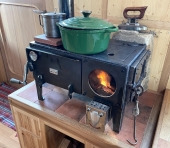
Rez Zircon wrote:Oh, that's lovely. Nicely done!
I cooked and heated with a little sheepherder's stove for about 12 years. Pretty similar, except its flue went all the way around the oven (there was a valve to control this) which not only captured significantly more heat into the room, it also made for nice even baking. (The bottom flue under the oven also had a cleanout access, since it tended to fill up with ash. If I were designing it from scratch, there'd be bigger access for that cleanout.)
I need to replace the woodstove that came with my present house (it doesn't draw worth a hoot and mostly smokes up the house) and now you've got me thinking... it only really needs to heat one room, and it would be nice to have that cooking capacity. So a tiny cookstove might be just the ticket.
Rémy LaCabaneFieutée wrote:Hi Larry, yes, I work with stick welding. It’s true that MIG welding is faster. I chose stick welding for its ruggedness and simplicity. Since we do repairs in the workshop, I sometimes have to weld different types of metals and a wide range of thicknesses.
Sometimes, when working on construction equipment, we have to weld outdoors. Stick welding is very practical in windy conditions because it provides good gas shielding for the weld, unlike MIG or TIG.
For the stoves, I use stick pulsed welding, it's very efficient and easiest than usual stick welding.
I think the chainsaw is an old Husqvarna or Shindaiwa. It’s a forested region, and I have quite a nice collection of them in for repair! Dolmar is pretty good too.

Cimarron Layne wrote:Hi, all,
I sold this farm in June 2025. Wishing now that I hadn't, but at the time it seemed like my best option. Couldn't find a way to delete the post, so it is still here on Permies. I drove all over the country (VA, TN, KY, AR, OK, MO, UT, NV, AZ, NM) looking at smaller homesteads and existing eco-communities but didn't find anything that met my 12 criteria.
I'm currently back in Maine where I have spent the winter re-rehabbing a house that I hope to sell this spring. I did an 18-month fix-and-flip on this house in 2018-19 before I moved to the 30-acres covered in this post. But the buyers defaulted on the seller-financed mortgage, and I had to foreclose last fall. Got it back completely wrecked. Most of the work I'd done on it had to be redone, plus more. I'd say those people lived like pigs, but I would be maligning pigs. Pigs ae much cleaner and less destructive.
Anyhoo, it's pending sale now and I'll be heading back to VA/TN/KY soon looking for another property to homestead with the intention of starting a small permaculture community to share the workload and development expenses. If anyone knows of an available property with at least 10 acres (preferably more), with livable house or trailer, well and septic, electric, about half open land and half wooded, and not too steep, please let me know.
Or if you have land in the southwest VA, east TN area and are looking for someone to buy in and share, please contact me. Thanks.
Also, if you are interested in joining up with me to share the land, labor, and livelihood, I'd love to hear from you.
Catie George wrote:Merriam Webster defines resilience as :
“an ability to recover from or adjust easily to misfortune or change”
Is there anything that you, personally, could do, with a $200 (or $1000) budget that would increase your long term resilience?
I’m interested in how you would spend it on yourself, in your current circumstances, rather than how you think someone else should spend that money.
More “personal reflection” than “general advice”. It’s is a “what remains on your wishlist/to do list” question.
It could be a physical item, hiring someone to do something, preventative maintenance, investing in learning.... or better yet, something I haven’t thought of.