
Revo Smith

+ Follow
since May 25, 2024
Merit badge: bb list bbv list
Biography
Planting everything and keeping what works. Draw and paint in the winter. Check out my website to see what im up to.
For More
Western Ma (5b)
Apples and Likes
Apples
Total received
In last 30 days
1
Forums and Threads

Recent posts by Revo Smith

Nancy Reading wrote:I rinse white rice, but usually don't bother with brown... It occurs to me too that the rinse water might be useful if you are into Korean Natural Farming - isn't rice water a starting point for essential microorganisms?


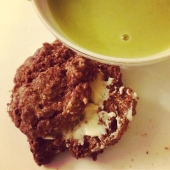
I was my rice every time. I will use the milky colored water from the wash to make LAB (lacto bacillus). Once the rice water cools, down I eyeball some amount of powdered milk (usually past the expiration date because this is all I really use it for) and mix it thoroughly into the rice water about the ratio as you would use powdered milk normally. Then I cover it with a cloth and let it sit at room temp for about 5 days. Once you have a cottage cheese like substance that floats on the top layer, I skim the cheese out (and feed it to my dog and sometimes me) and the remaining yellow liquid is used to help get compost piles going, help with lactose intolerance (take a shot of it a bit before having dairy), or diluted and uses as a foiler type amendment. I don't have animals but it has been used to help reduce smell in bedding and manure. The liquid itself is almost like a fermented coconut taste. It stores well in the fridge for a few months and is fun to make!
13 hours ago

M.K. Dorje Sr. wrote:

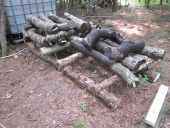
Revo Smith wrote:Im glad you shared this. I started logs last year that just started to fruit and have made another batch this year. I haven't gotten slugs yet, but I know once I start getting fruit in spring/ summer this info will save some mushrooms. I currently have logs Lincoln style and a lot in the low lean until they fruit next year. Hope you get piles of shrooms! Thanks again!


Revo, are those nameko mushrooms? What kind of logs are those? And if they are nameko, how do they taste? I'm thinking about growing nameko, but I'm wary of the slime factor...

No they are chestnut mushroom. Great for ramen! They stay crunchy in soups.
1 week ago

Taylor Cleveland wrote:Hello! I am new to growing mushrooms. I have purchased some lions mane, turkey tail, and reishi plug spawn and was hoping to inoculate some logs in a few weeks. But now I am reading that they can not be in cold conditions in the first 6 weeks after inoculation. Is this true? Or will they just not grow as fast/stop growing in the winter? Any advice would be great! We don’t have anywhere to keep the logs indoors, although we do have a barn they could go in.


    Hey there, just wondering if you ended up doing a late fall innoculation or did you wait for spring?
    I've started my mushroom journey in western MA and plan to spend the first few years trying many tree and fungi compatibilities to learn what and when for my context.
    I did chestnut in the late fall of 24' on birch (it was late October by the time I plugged and all ready snowing and cold out) I probably got lucky with that late innoculation because they fruited in September 25'. (About 40 bolts and most were successful)
    In the late summer of 25' I did another 100+ bolts of Norway Maple, Sugar Maple, and birch ( these were plugged with 3 variety of shitake and an oyster). When the big logs start to fruit I'll make a separate post about my results so far.
   
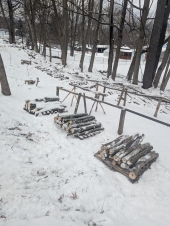
     I am going to do my first spring innoculation in the coming 3 months or so (whenever temps are above 30F consistently). I have already started cutting some trees and stacking bolts on pallets for spring. In previous summer and fall inoculations, I would only let the fresh cut bolts sit for a few weeks before innoculation. The spring innoculation will be done with logs that have been 2-12 weeks old. Im going to shovel snow on the bolts when I can and will tarp them if the show goes away. Hoping the cold and moisture will keep them fresh and ready until it warms a bit.
    I have cut Red Maple, Apple, Bitternut hickory, and black Walnut so far. I want to try lions maine in the walnuts and some maple and will try another shitake and oyster as well.
1 week ago

Inge Leonora-den Ouden wrote:I am looking for information on processing acorns, to make something edible or drinkable. That's why I read this thread.

Here in the Netherlands we only have those oaks with high-tannin-acorns (two European species and the American Red Oak). Probably that's why they were used only as a coffee substitute in the past.
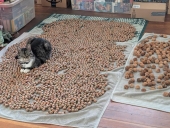


I'm in Western MA and am also using Red Oak acorns. I use a one size fits all nut cracker to crack off the shells, but Ive found that the skins on the nut meat don't come off easily and should be lightly smashed to loosen the skins. I use a stone mortar and pestol and kind of hammer the nuts until they are about oat size. Then the skins can be blown away with the breathe while you stir around the nut meat.
    I then boil the semi crushed nuts in many changes of water. This part took most of a day the last batch I did. I found that a small bowl of crushed red oak acorn takes about 10 changes of boiling water to really get the tannins out.
   After the tannins are out, I will dump them out on sheet trays and spread to a thin layer. Then I dry it in an oven with the door cracked for about 2 hours at 175, turning every 30 min.
   (If I was going to immediately use the acorns, I would only dry enough to grind or mash)
   Once dry, I will finish into a fine powder with a blender or mortar and pestol.
   I so far have only made breads and have been using wheat flour with the acorn flour, so I didn't miss the starch that was lost from the boiling. I just started another cold leaching experiment, using finely ground acorn flour wrapped in a silk cloth. Its sitting in a 2 gal sun tea jar and I am running water through it and changing it several times a day. I'm guessing it will take several weeks at least to get the tannins out this way. I may take some to a nearby stream for faster leeching.
   Anyways I think that some of the people that comment about the inedibly may not be leeching out enough of the tannins. The red oak has a lot and it takes a bunch of time to prepare, but once a desirable method is found, it can be done in advance schedule or in bulk to ease the use of these little wonders.
3 weeks ago
For bread and pudding use i will crack grind the acorns into flour and cold soak them in large buckets of water for several days with daily changes. For roasting, I'll just crack and boil them in several water changes. I've never processed them but have read a few things. I guess running water like a river or some equivalent might be better for leaching, but I don't have any close by to utilize.
3 months ago
    Last winter I purchased 2 acres adjacent to my back yard that has a dozen or so mature black walnut trees (among many others). While I was doing morning walks to collect the newly fallen walnuts, I kept hearing what I thought was a large animal moving in the woods up the hill from my property. After some investigation, I found that it was no animal, but a MASSIVE red oak tree and a few of it's offspring dropping hundreds of nuts at every gust of wind. I excitedly started collecting the acorns from these couple trees along side the chipmunk.
    As it appears to be a bumper year, It seems there is plenty for all of us (turkeys, deers, and jays included).
I bought a table top nutcracker and a bigger basalt mocajete to celebrate this bounty and am looking forward towards making breads, puddings and roasted/seasoned nuts.
    I have also filled my small hot house with acorns and will hopefully be planting a hundred or so more red oaks next year. I've walked the small mountain uphill of me and believe that the couple oaks I've found are the only ones left in a sea of maple. I have told the tree thanks and promised the big one (now called big papa) as well as the concerned chipmunks that I will do my best to ensure a nutty future for us all.
3 months ago
I've heard of a fruit orchard doing something similar with broken glass. More of a long term solution and might be easy to get piles of glass for free. I like your more natural alternative better to be honest. Id feel weird putting loads of broken glass in my soil.
I use little cylindrical cages made from 1/4" hardware cloth around all my trees buried so they are about 1" in the ground and as much above ground for winter protection when they tunnel the snow on the surface. I've got lots of voles and all of my cages trees have been fine for years.
4 months ago
Im glad you shared this. I started logs last year that just started to fruit and have made another batch this year. I haven't gotten slugs yet, but I know once I start getting fruit in spring/ summer this info will save some mushrooms. I currently have logs Lincoln style and a lot in the low lean until they fruit next year. Hope you get piles of shrooms! Thanks again!
4 months ago
I started with red and white chokes, but have mostly been spreading the white ones (they are larger and more vigorous in my area).
I plant mine in the sunniest areas available (I get late afternoon shade everywhere). Every fall after they all have made flowers (mine start to flower in September), I pull up everything by the stalks and collect roots to eat and replant somewhere else. The area that was pulled gets the stalks for mulch and will regrow again the next season (since I don't dig them and surely miss a lot of roots). I have noticed that if I don't pull the big roots out at the end of a season, the following years patch will be less vigorous and won't produce many new large roots.
I consider them a perennial cover crop and will use them as a chip and drop around young trees. After a few seasons of chopping, the chopped plants will eventually die. By then, they've served their purpose and the tree is well established.
7 months ago
After a winter of collecting seeds from apples and mixing them into my hot house cold frame thing, I've transplanted them into small fabric pots and will plant and repot some later.  Out of 100s of seeds, only 80 made it out of the bark mulch. Probably would have gotten twice as many if I had started with a mulch free seedbed.
I planted some of last year's trees that over wintered in the hot house and brought inside for early spring. They went into this year's fruit hedges.
8 months ago