
Sea Skinley

+ Follow
since Jan 14, 2025
Merit badge: bb list bbv list
Biography
NC native, settled between Triangle & Triad, was zone 7b recently recategorized to 8 (but I don't believe it). We live on a family farm (beef cattle, though) and I have a lot of microclimates not figured out yet. More woods than open spaces and more shade than you'd think. Fruit trees & bushes, gardening, medicinal natives, & various things I just like for no reason.
For More
Apples and Likes
Apples
Total received
In last 30 days
5
Forums and Threads

Recent posts by Sea Skinley

Carla Burke wrote:As a huge fan of both sourdough and tomato sandwiches, I understand the desire for a standard loaf, as opposed to a boulé.
This is my favorite recipe - and I only use it for the amounts. I do my own thing, for how it gets kneaded (I use stretch & fold), I don't use flour on the work surface, because I prefer using butter, or olive or avocado oil. I make a double batch, and loaf pans, instead of making a boulé - unless I want a different shape - or rolls - or pizza dough...
Honestly, I can't help wondering if you may be over thinking it.


Of course I'm overthinking it, you are absolutely right about that. I'm also mostly keto but my better half loves sandwiches, and loves really good bread. I never really *want* bread except when the tomatoes are rolling in, baconnaise in the fridge & spicy mustard at hand... the quest continues. Maybe by next year!

Thanks for the idea of butter/oil on the work surface, which hadn't occurred to me but I'll definitely be adopting, and for the recipe!
5 days ago

Tereza Okava wrote:keep on trying. [...]
I find with sourdough, like with beermaking, it is possible to get hyperfocused on details until it stops being fun. [...]
Personally, after trying all sorts of crazy things, my favorite sourdough is a half-whole-wheat tiny boule to make in the air fryer!! sometimes I screw it up (it gets baked in a 7 inch cake pan with a stainless steel bowl upturned over it, and often it ends up a bit too suntanned).... but it's always good.


Thanks! I think I overestimated the ease of sourdough at first, because I used to make beer and it was amazing if I do say so myself. My best beer was dark and hoppy with a small piece of habañero in each bottle... yum yum yum. Turned out a lot of the secret of My Great Beer was in the water where I lived at the time, or that's my guess since I've never been able to replicate anywhere else. You can't imagine how sad I was when I had the last bottle of existing stock.

Anyway, the air fryer idea is incredible and I will definitely be trying that!
5 days ago

Kara Ann wrote:Hey Sea - golly I have walked much the same path.  Both water kefir and sourdough starter have been uphill roads with many detours.
I have come to the conclusion that sourdough can be something to gradually sidle up to.... just getting the starter to be consistently happy, but not so exhuberant that it overflows, has been more like managing a bipolar lab creature than working with a reliable and welcome kitchen ingredient.  When it is unhappy, I end up refreshing it more often in my bumbling attempts to improve, and then I have sourdough discard, which can go to the chickens mixed in their fermented grains, but I like to make productive use of it.
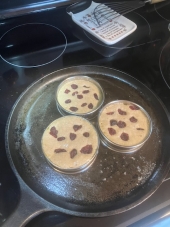
My favorite use of the discard is to make crumpets  (here is an example https://www.scotchandscones.com/sourdough-crumpets/ )


Wow, thanks, and I appreciate the links & pictures! Those crumpets look terrific. And I need to start my chicken adventures soon too!

Good luck with your tiny home, truly I can't imagine but some days it sounds amazing (like yesterday when I was clearing out a corner of a barn for more productive use...).
5 days ago

r ransom wrote:I've always been mean to my sourdough, demanding it change to fit my lifestyle.
[...] usually use a bread tin as the family likes "bread shape".  Make sure the oven is well preheated so I usually put it on when I punch the dough and as it's one of those new ovens that takes 45min to come up to temperature because it saves money or somethingsomething, I can put the bread on top of the oven to rise and they will be ready to bake at the same time.  
I also cook a lot of other things in the oven at the same time, as I'm too miserly to heat such a big space as an oven just to bake two loaves of bread.  They are usually in there before the bread, so it seems to hold the heat better when the bread goes in.
[...]You have permission to observe and experiment to see what works for you.

A person after my own heart, here; thanks! Neglectful was my first approach (and my natural style) so that's encouraging. We had to get a new fridge and it doesn't get warm on top the way other (probably inefficient) fridges have always seemed to do. I was using a seedling warmer mat thing under a spacer the last go-round until I gave up, and begrudged its size since I only needed that one small patch under the jar! I have two different ideas for localized warmth when I try again.

The second time I did splurge on a cast-iron loaf pan (but it's not big enough) and did the stove-top final rise while the oven preheated, and covered it with the (glass) loaf pan while cooking, all of which seemed to improve the crusts without really getting the overall outcome to be satisfactory. I'd do the rise on parchment in glass on top while the cast-iron heated with the oven, yeah about 45 mins I would say. So maybe all of that was on the right track!

Thanks for the tips and don't worry, experimentation is the only way I cook. The downside is I can never make exactly the same concoction twice, but we'll see if I can't get a little more consistent... Third time's the charm, right? Or is it the 33rd?
5 days ago
As noted elsewhere, although I refuse to believe pioneers on the frontier had graduated borosilicate cylinders, proofing boxes, climate-controlled log cabins, or digital wristwatches so they could stop milking cows and rush inside to feed their starters for perfect sourdough, it's also true that I've gone through two long spells (months each) of trial-and-error, look-and-feel, numerous approaches and recipes without once producing a loaf that really hit the spot.

Experimentation a la Sandor-Katz-Wild-Fermentation:
I successfully generated my own starter, focused first on rye, pumpernickel, and multigrain (use up your leftovers) bread. Pretty much everything I baked in this iteration was pretty tasty but very dense. My starter was healthy and smelled great, although I don't think it ever doubled as quickly as later reading told me it should do. Loaves also went brick-like very quickly. I really liked these breads but they were too dense for others in the household (who did like the taste). After putting several half-loaves in the freezer and spacing out the next loaves longer and longer, I finally let this effort die.

Experimentation a la Sourdough-Advice-Real-&-Online:
All the church ladies make incredible bread. One of my friends insisted I could do it too, giving me some of her starter, which she originally got from one of the other ladies. This time I fed it with whole wheat and bread flour instead of rye &c the 'wild' experiment. It stayed alive but not lively, so to speak. I thought our kitchen was too cold and tried different locations and sometimes a (plant) seedling warming mat to encourage it. Reading more and watching videos specifically on sourdough, I tried lifting and coiling and other techniques, tried to figure out what the dough should look like and respond at different stages, struggled with timing, tried a range of oven approaches, never got above "meh" results and was not having fun anymore.

I did at least figure out that my oven temp needs to be set higher (actual temp in the oven is not as high as the setting) and a few things about the baking itself for getting a decent crust.

I'd appreciate tips generally and especially from
  1. others who may have struggled through learning how to assess and manage their starters (especially from scratch), and
  2. others who want a LOAF not a boule.
My personal goal is tomato sandwiches, and I hate the boule with every slice a different size. Sorry, no offense; I realize I'm just weird!

Thanks for any suggestions, including "maybe sourdough is just not for you"...
6 days ago
I'm a sourdough failure, and it sounds like I could really use this book. A friend from church gave me some of her starter at the same time as a delicious loaf of bread, so I know it was not the starter this time. (I tried for a few months about a year ago, with a starter from scratch a la Sandor Katz instructions, which sorta worked for very dense pumpernickel but never resulted in sourdough.) This time, I knew I had good starter, which I kept going and tried to make bread at least weekly for about six months, and never could get the hang of it, at all. I was at the point of thinking I needed to buy special equipment to raise this and proof that or else to reorganize my entire life around exact feeding schedules and who-knows-what when I realized I was teetering on the brink of bonkers. Besides which, my dream was to have bread on which I could merrily eat tomato sandwiches this year, and as our tomatoes are about done... giving up.

I still have some starter in the fridge but honestly am so discouraged by the 600 million "easy sourdough for beginners" online instrux (all different and none helping me any), not to mention other sites that complexify my discouragement by demands that I measure hydration and balance exactly the right kinds of flours freshly ground from grain, even stipulating countertop versus fridge versus a special expensive box... or maybe I need a special course with an expert to show me secrets of the coil and fold!

I'm willing to learn any process that will work reliably, but I refuse to believe frontier pioneer women measured hydration or dropped everything to feed their starter on a schedule (likely not having a wristwatch out in the fields or barns). I believe it should be possible to add this skill but am losing confidence that it's going to happen for me. I've invested so much time effort and not inconsiderable (for me) money, yet I'm about to go back to not eating bread since I don't trust or care for storebought.

I see the testimonial that this book truly does explain helpful things; on the other hand, maybe I am untrainable. I'd appreciate pointers to anything that would help in the meanwhile, as well as I would of course like to win a free copy of this magical book! Thanks for reading.
1 week ago
Very timely revival of this thread! Recently retired from the day job and we are looking for diversified income streams so that paying property taxes (groan) can come out of income rather than savings, as well as looking into (legally-defined) "farm-related" income so we can qualify for various status categories with tax breaks that way.

In preparation for escaping wage-slavery, my method so far, the last 8 or so years, has been looking around at what others are doing (not great for finding a special niche but at least knowing there seem to be buyers for this or that), research online and in books, going to all of the events the Farm Bureau or County Extension agents offer, and testing what will grow here - although that has been mainly experiments I want to grow or do myself rather than 'commercial' potential, and a lot of our learning has been ruling things out!

Here are some things we are exploring but many not yet figured out completely:

* Hunting leases. Self-explanatory. This seems to be working out just lately. However we are likely going to barter with a young-ish local fellow who should be a great person to know for a lot of reasons, rather than for money.

* Essential oils. Various folks around here (three or four surrounding counties) sell essential oils off their farms and in farmers' markets. The markup is insane, but then I don't use them, so I guess the price is worth it to people who do. I know there are DIY ways to extract essential oils and on the other extreme, fairly expensive kit one can buy to do it. I'm not into this product myself so haven't tried extraction yet, but based on what I already know how to do I'm fairly confident I could make this work out financially. It seems lucrative for marginal effort. But, I don't value it myself so it will seem more like work-work than some other options.

* Mushrooms. We had a great demo at one of the local land-grant universities and definitely ought to be able to do this on our property. We have suitable trees that we consider weedy (too many volunteers) so happy to take some down for logs. Haven't taken the plunge yet, and I'm mainly wavering between food shrooms and medicinal besides considering the scale at which we'd need to do it to be 'worth it' for us.

* Hard lotion bars. I do make these already for myself and to give to friends. Not sure what would be 'marketable' or how much ROI in reality since I'd need to keep buying supplies if I were doing it at any scale. Same for any branching out along these lines, e.g., salves, lip balm, whatever. Our area has a fair amount of hipster population (more money than sense) for this kind of thing but if the economic cycle takes a turn I would certainly consider these unnecessary expenses. I'm probably not my target market, but still that gives me pause.

* Processed products. We probably have a dozen other things we could scale up beyond household / friends & family usage BUT there's a big leap in investment here to do anything that requires government oversight (intervention). For instance if we wanted to sell fig preserves instead of giving jars away, we'd need a food-grade kitchen or rent shared space and, I don't know, some classes & certifications and whatnot. Enough obvious hassle that I haven't looked into it that deeply.

* Tree fruits and nuts. Our apple trees are coming into maturity and some already producing more than we can use. Newer peaches will be in production soon-ish, which will also be when some of the pawpaws start bearing and hopefully other stuff (berries, passionfruit, We have pecans & give away black walnuts. I have always loved pecans so we can use a lot, but not as much as our trees generate. These aren't the most expensive nuts but since we will have them anyway... Also, I grow peanuts and for free I'll tell you that about 3/4 peanuts and1/4 pecans makes the best peanut butter you've ever had. (But see issues regarding processed products above.)

In short, we're not looking to make a living or build a fortune but to make best use of resources at hand in ways that can ease some cash needs. Oh, our other resource is a freeze dryer that we haven't used as much as we should.

Comments, thoughts, suggestions, queries, alternative points from any/all experiences, all welcome!
1 week ago

Sanna Heijnis wrote:

Lauren Ritz wrote:
[...] garlic puts out sulfur through its roots. [...]


This is interesting! Would this also mean that it might not be a good idea to plant beans where garlic was (garlic came out in June so beans could go right in after)? Or would the excess sulfur disappear as soon as the garlic does?


Can't answer about beans, and not sure sulfur is the only thing going on there. What I can attest is that garlic's unfriendly effect definitely can last at least six months, apparently longer for some 'followers'.

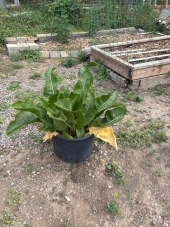
Source: Accidental experiment when I put garlic into a spare space in my main garden one fall, and tried easily a half-dozen things in that space mid-late summer after harvest. Dill died, cucumbers died, squash died, and I think I tried some flowers also. It's in kind of a bridge place between two sections, and this season I've lost a tomato there and a couple of peanuts. So, not an experiment I'll try again any time soon.
1 month ago
Thanks so much, Mark and Douglas. Exactly the kinds of info I was hoping to learn. My thought on 'friendly neighbors' was that less-deep-rooted plants would be better able to get along with it (a la strawberries, squash), if it's not truly allelopathic. We have lots of black walnut so I'm familiar. I love my garlic but other things I grow love it much less, so I was hoping if horseradish and garlic could get along...

A second thought is that trees with a far deeper taproot, even if they also have roots closer to the surface, could get along, but I'm not sure I want to risk any of my intentional trees to an experiment like that. And no doubt timing is everything, how well established the trees are. I might try a horseradish root on the edge of some scrubland we have out front, see how that does.

Thanks again!
Two questions for you experienced types:

1. How deep would a root barrier around a horseradish area need to be? More than 12"? More than 24"?

2. Does spreading kill other plants (what does it *not* kill?) or is it more of an annoyance, popping up where you don't want it (for whatever reason)?

For context, I have red clay and rock soil, so it sounds like aggressive spreading will be somewhat retarded by conditions. I planted some a few years ago in buried (large water bottle sized) containers and nothing came back the 2nd year. Now I have two in grow bags doing all right this year, and one in the ground that has kind-of died back in our driest weeks but seems to be surviving now.

We have several areas that we call "rock planters", where we build up on a slope for this or that. I'm thinking of creating something like that with root barrier, and using it for horseradish and whatever else. Can garlic grow with horseradish, for example?

More than 2 questions, really, but primarily interested in more specifics on requirements to contain it (to the extent feasible) and experience with plants it kills by proximity (if relevant).