
Ruth Eden

+ Follow
since Apr 08, 2025
Merit badge: bb list bbv list
For More
Apples and Likes
Apples
Total received
In last 30 days
1
Forums and Threads

Recent posts by Ruth Eden

Joao Winckler wrote:I grow chocolate mint under my apple trees and it works brilliantly as ground cover without being too aggressive. The shade keeps it from going totally mental, and it smells incredible when you walk through it or mow the edges. The one that really surprised me was Korean mint, technically Agastache not Mentha, but it behaves similarly and the bees absolutely lose their minds over it. Stays put better than most true mints too.


Chocolate mint is my favourite! It struggles in my harsh semi desert dry summers though and I have inadvertently killed off a few by not being vigilant about watering, or expecting it to be harder than it is.

Lemon balm on the other hand seems to have taken hod in all my pot plants all by itself..
5 hours ago

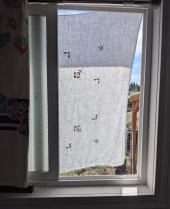
Mark Reed wrote:We use outdoor curtains made of shade cloth. Something called "coolaroo" shade cloth works very well. We bought it in a roll and made our own, lots cheaper than buying ready-made ones. I think it is made of recycled plastic bottles and is much more durable that I expected, we've used it for years. It really keeps the heat out, but some light gets through and you can see though it, a little bit.  A lot of things would probably work, old shower curtains or bed sheets, anything light in color and made of something like polyester although I guess cotton would work too.  If one layer not enough just double it up. Keeping the heat outside is much better than trapping it between the glass and an indoor curtain.


In South Africa, semi desert  with summer temps normal and regularly exceeding 40 odd celcius, we use coolaroo shade netting (we call them shade sails) with great success. Works for lower light plants, keeps kids from getting burnt in the pool (without leaves from shade trees making cleaning a challenge) and keeps summer sun off and high above all our north facing windows. About to install a few more as we head into spring and add rabbits to our garden, which doesn't have that many trees (or at least decent sized ones).
6 hours ago
I chanced upon this thread whilst browsing BBs and Skip related threads.

As a Homestead and village scale beekeeper in a semi desert area of South Africa, I find seeing how others keep bees differently very interesting.

Our African honeybees (not hybrid killer bees), are a lot more aggressive and full denim cover all suits are needed, which is one difference, as is the fact that our winter insulation generally involves a bit of cardboard padding under the lid and some tape over any extra gaps.

However, I from the way we do things, the idea of a skiddable structure seems like a lot of hard work. If you need a truck to tow it, why not just pick up the hive and put it in the back of the truck to move it to a better spot? We only ever move hives at night, otherwise we lose half the colony as they don't reset their orientation until the next day.  We don't have bears, but we do have honey badgers and in some sites human thieves - the most difficult to deal with! Interesting nonetheless.
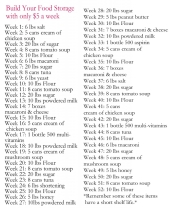
You are describing something very similar to what I do. Some things especially home canned things I like to make seasonally and stockpile to work through during the year, other things I buy enough for 1, 3 or 6 months depending on shelf life and just keep cycling through it. It has saved us quite literally from taking very long drives to resupply when certain normal routes to town are I passable or twice, when we have been totally cut off by flooding and wash aways in the last 3 years, we have just kept going. Wish I could store as much duration of animal feed as human food, but space and cash flow just aren't there yet.

It is definitely the most practical everyday type of prepping and serves the most likely scenarios of when you might need to use such a back up. Would I also like a bug out bunker with a freeze dried pantry, sure... But myy budget doesn't go that far.
4 days ago
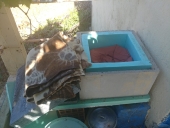
Here in South Africa we have a clever upliftment project that employs and upskills indigent people to sew "Wonder bags"

It's an all round winner. We have had years with not enough power being produced by the grid so constant rolling blackouts frustrate all but those with solar power systems which is now pretty common, at least as a back up. Many remote rural households don't have electricity, and for  those that do, the cost increases exponentially every year as the national power utility tries to gain capital to repair is ailing poorly maintained infrastructure.

The project is funded largely through selling international carbon credits.


All that said, they are a nice addition to a permie kitchen, light on resources and effort. I love using them both for slow cooking and keeping food warm.
https://wonderbag.co.za/ for inspiration.


4 weeks ago

Lawren Richards wrote:Wrote a longer post and lost it ‘cause I wasn’t logged in, but in short: what’s so great about sunchokes? Mine were knobby, small, tasteless, and died off in a season or two. Why do sunchokes instead of, say, potatoes?


I am with you on sunchokes. I love the yellow flowers at the end of summer, but no one in my family, including me is happy to consume them as a general rule. I consider them a last resort survival food for the "what ifs", and or a future source of fodder should we ever be able to afford a pig or two. However, growing potatoes, which we do annually, seems to pose a storage problem for us without a root cellar, in a hot summer environment, they resprout or rot in only a few weeks. (we are in the semi desert succulent Karoo in South Africa, where summer temps daytime temps never drop below 30 deg C and are over 40 deg C, about 35-40% of summer).
Our winters are mild, frost, snow on the mountains etc, and we do manage to keep a small patch of potatoes growing/overwintering in a more sheltered frost protected spot, but they only produce again come spring. Either I find a better storage option, or we focus on other staples to get us through winter...
I live on the edge of a small historic village in the Cape Winelands of South Africa. Roughly 2-3km in diameter.

We have many retired folk, weirdos and not so weird and many alternative religious types too alongside many people who sit in front of their pcs all day and work remotely (my husband included)

However we do also have a ton of awesome skills
Sheep farmer (us and another guy)
I'm hoping to add spinning and fibre to what we offer in future, but I'm only just learning to spin.
Cattle farmer
Chicken (meat) farmer
We do egg farming
Horse livery and riding
Sheep shearer (leaves much to be desired, we get outside professionals in)
A traditional clay brick works
A number of builders
2 plumbers
2 electricians
A computer/network and tech guy who makes sure all the old retired folk can use their smartphones and computers (amongst other things)
An African traditional healer and herbalist
A number of tai chi, yoga, reiki and other teachers and practitioners
Many artists
2 potters
A natural pool and water system designer and builder (also a permie)
A permaculture designer & consultant
15 architects (!)
An Austrian baker
2 different caterers who make and deliver ready made home cooked meals day/weekly
A small scale market gardener
A beekeeper (also me)
A snake remover
A number of teachers (small waldorf school)
An elderly knife sharpener
An elderly welder who is somewhat unhinged but eventually gets the job done
A beeswax candle maker
A seamstress
An artistic shoemaker
A musician who runs a theatre venue bistro and is married to the most incredible chef
A few baristas who work at the coffee shop
Some very knowledgeable gardeners and tree pruners
A personal trainer
A fuel station owner who operates the 2 pump filling station)
A couple of millionaires who saunter in and out and a home or two elsewhere but like to support all the local charities working with the lower socio economic seasonal farm labourers
And we are surrounded by olive farmers, stone fruit farmers, wine grape farmers and tomato farmers and lots of guesthouses.

I do wish we had a blacksmith and a better welder...
The mechanic is on a farm 30 min drive away, but enjoys a good drive to work on site if needed.
The butcher immigrated and now lives in Canada, so we drive 20 min to the nearest one if needed.

The most  incredible carpenter lives about 45 mins away but spends a lot of time camping on our farm (she rents workshop space from us) when working on local projects, as she is well known and sought after in the village. Eventually we are hoping she can build herself a cabin on our farm.

Not too shabby I'd say... We've got ourselves a good little spot here.

4 months ago
"Other"... My 70 something mom is the official owner, but I will inherit with my sister when she passes.
9 months ago
South African here, from a very hot in summer semi desert region where temps are above 35-45 deg C most days through summer.

I have successfully lime preserved eggs in this climate, stored in a dark but I don't imagine particularly cool place, although it would certainly be a good 5-8 deg cooler than outside.

I've only ever had this happen to one 3litre jar and it was jostling that did it. I bumped the jar as I put the last egg or two in and thought at the time that I hoped I hadn't cracked any. Well that jar stank and had a handful cracked eggs near the top. We opened it a year later. The eggs that weren't cracked were most certainly still fine, in the usual lime egg state of slightly more fragile with runny-ish insides.

We use reverse osmosis water, as we get very little rainwater and rely on a rather mineral rich groundwater supply.

Hope that helps pinpoint your possible issue. Also might be a good idea to make sure your hens are getting enough calcium while they're laying up a storm so that the eggs you preserve have good strong shells.

9 months ago
This has been an interesting read. I often don't give enough consideration to the science behind things, so it's good to have my thoughts venture off down this road.

We have rather sandy acidic soil, definitely lacking Ca and K. River floodplain in a semi arid environment. We also have a dense stand of invasive acacia trees. Nitrogen fixers, not bad firewood, but way more than we need and would love to manage and utilise them better, and use the much better quality soil underneath them that they've helped create.

We've chopped down a lot, sell and use firewood and chip the small branches. Chips cover roads and pathways, random bare patches left over from flood damage, and also the floors of our animal night shelters, along with straw.

We have refrained from burning a lot of dry biomass from previous felling (before our time) as we have slowly been chipping it and because fires can get pretty risky in our climate/environment, and also because in my mind it's not the best way to clear land if you're trying to build soil.

But, in our situation, perhaps there is value to adding a good amount of ash to the sandy fields we use for pasture, rather than trying to chip it all, even though chips can slowly build pretty good soil, as we've seen on the forest floor under the trees themselves. I'm all for amending things faster if possible!

What would you all do in this situation? Maybe I should start a new thread?
1 year ago