s ritter

+ Follow
since Nov 12, 2025
Merit badge: bb list bbv list
For More
Apples and Likes
Apples
Total received
In last 30 days
6
Forums and Threads

Recent posts by s ritter


I love Earth Pigments! I've used it to make milk paint and watercolors in the past (I literally just made some watercolors with it a few hours ago), but I've never made oil paints. How did you mix yours up?


I just used a little whisk and a cup! It mixed up pretty easily, I think you might even be able to do it with just your brush... I was making 8-10 oz batches at a time just refilling my cup and mixing in some new pigment as it emptied.

& I totally agree - my paint wasn't professional grade, but worked beautifully for my purposes and I thoroughly enjoyed the process of creating it!
1 week ago
art
Hey! I just posted a similar response on this page. I made a clay paint with linseed oil and natural pigment, mixed up, and applied directly to sanded plywood with no primer. I did 2 coats, and sanded in between as well. It's held up for a year and a half (so far) with heavy wear and tear from being a camper van that I was living in full time (dogs, chickens, people, bikes - constantly moving in and out)

The mix with clay worked pretty well for me, but I ended up just mixing the pigment and linseed oil to create a paint in subsequent projects. Its still non-toxic, and a little easier to work with in my experience.
1 week ago
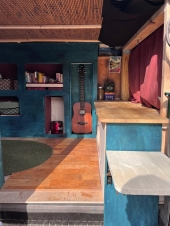
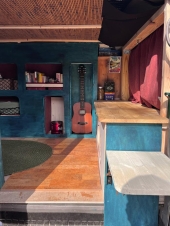
I was having similar questions while building out my van... I wanted something non-toxic, easy to work with and affordable. I ended up purchasing 100g of concentrated pigment from Earth Pigments and mixing it with linseed oil and river clay that I sifted, dried and sieved. The color came out as a rich deep teal, and the application was super easy. You can adjust the color by adding more or less pigment, but I found it was forgiving enough that I just eyeballed my proportions when making subsequent batches. I also found that the river clay wasn't necessary, so for the simplest approach you could just mix pigment and linseed oil and start painting! Also - 100g was more than enough to cover a large wall and some cabinetry in my van (~40sq ft) at a pretty rich ratio of pigment to linseed oil.

Attached is a picture of the final product - you can kinda see the striations of the wood beneath the paint, but I find that I like that look!
1 week ago
art
Hi Ean,

I think you're hitting on some really valuable foundational pieces here - namely being debt free and starting small/within your means.

I have some skepticism about vacation rentals... I've seen them destroy the housing market for locals in towns like Moab and the place I'm living now. I've also seen some innovative models like this one https://yurtsatponchapass.com/sustainable-building-community-workshops/ in Salida, CO where the owner uses summertime yurt vacation rentals to subsidize affordable rates for locals over the winter. He bookends the season with four weeks in the spring and fall where people stay for free, work on his earthship/permaculture property and get to learn and have shelter in exchange for a few hours of labor. I think its a strong model (& would recommend folks looking to get some building experience check it out!).

Paul's Bootcamp program is along similar lines, and I really appreciate the focus on the exchange of shelter for learning and labor, as well as the fact that it's operating mostly outside of the dominant economic system. He could probably rent out his structures on AirBNB and make a good bit of money from it - ecotourism or something - but has chosen instead to focus on impact and creating opportunity to learn. It's of great value to all of us youngsters to have models like these as we go out and start to build homes and cultivate land!

I like your idea of starting small... ideally I think I would build a house "module by module", as I had the money to pay for the full cost of construction of each piece, avoiding a mortgage if at all possible and doing as much work myself as I could. I think this serves you incredibly well in cost of ownership over time too... If you built it in the first place, you probably know how to fix it!

It seems as though steep interest rates keep people stuck in a cycle of stretching to make payments most of their adult lives. It's interesting to to see the trends in the housing market where first time home buyers are getting older and older... I think the number is sitting around 40 now, up from mid-twenties when our parents were growing up. The means paying on your mortgage into your 70s, making financial independence that much harder to attain. The start-small-and-grow-your-house-as-needed approach feels like a good antidote to that. Bring back the culture of families starting small and taking ownership of building additions to their house as the family grows!
2 weeks ago

Harmony Simpson wrote:Hey Sophia! I'm 24F, from SoCal anticipating a move to Colorado, Summer 2026. Would love to connect and talk more about your insight and experience!


Hey Harmony! It'd be great to connect this summer - jut sent you a private message!
4 weeks ago

John C Daley wrote:I believe we need to remove the cost of actual land from any project.
This can be done by using public or common land, managed by a 'housing society'.
Then create smaller homes that suit the needs of people, even perhaps built with the help of the occupants.
Rents to be managed by the Housing group with allowance for adequate maintenance which is not usually catered for.
The smaller homes can be built with materials that are energy efficient, durable and hardwearing, maybe with a little artwork on the exteriors.
The design of roads etc to be completely different from the usual method, I suggest a Dutch system where the garages and road access is from a rear court with home blocks radiating outwards in a spoke like fashion of a wheel.
The front gardens to face a footpath and an exterior circular park around the whole of the subdivision and only the single road into the rear of the housing.


Agree with all of this! Shared equity housing projects seem like the way to go. Katie McCamant and Charles Durrett have created some really great resources around co-housing as a development process, I'd highly recommend their book "Creating Cohousing" as well as taking a look at their websites.

I think the homeowner contribution is also a critical piece... One thought would be to prefab the envelope of the home, but leave all the finish work to the homeowner. This would allow for a degree of customization, even with a standardized design, as well as enhanced affordability and homeowner empowerment. When I worked in Moab, we used a sweat equity model to help lower the construction cost. I believe it was a USDA Rural Self-Help program that created lower interest rates for participants. We'd also build 4-8 homes at a time, and neighbors would spread their sweat equity hours between all the active projects. A great strategy for building community, not just houses!

The same could apply with a mobile home park replacement program: residents could help each other build/finish their houses in turn, strengthening community, enhancing efficiency and empowering residents in the process.
2 months ago

Ben Brownell wrote:I think there will be more efforts to increase acceptance of small/mobile dwellings in rural areas facing housing crises, with growing appeal of tiny houses that often escape the dated mobile home stigma. But taking that to the next level of dense multi-family development (parks) is challenging. Can be done, but will take coordinated campaigning and lots of $$ to create an opening.


Great point. Zoning and Land Development Codes vary soo greatly from place to place, and the process of changing them usually requires multiple years and lots of funding. Its nearly impossible to zone a new mobile home park anywhere in the country because they're being de-incentivized. That said, there are some promising frontiers of modern LDCs. For example, where I live we have a "Cottage Cluster" designation within in residential and residential mixed-use areas. This "Cottage Cluster" allows for up to 36 units/acre of density, requires the orientation of front doors and porches toward a central, shared greenspace, and mandates parking on the perimeter. Really great way to encourage small footprint, pedestrian and community oriented development. It would be really cool to see this kind of policy spread through the country and open doors to a more holistic approach to development.

Couple it with co-housing principles and shared equity in the land like John mentioned above, and something really interesting begins to form!


2 months ago
I originally posted this to my fellow young folks on the Gen Z Thread, but after typing the whole thing out I decided it would be cool to open up the conversation to the broader Permies community. If you want to know a little more about my background, you can go look there, but what I want to post here is an idea I've been developing as a 20-something growing up in a world where home/land ownership feels unattainable, and where most people are starved for community and connection...

...This brings me to my current scheme, which is *truly* affordable housing. I've just purchased an 470sq ft, 1966 Mobile Home in a little park in the town where I live. It cost 40k, plus $400 in lot rent each month. Mind you, median home prices in this town are currently 670k and climbing every year... The mobile home has two bedrooms, and I'm able to rent out the second one to cover all of my ownership costs (lot rent, insurance, utilities).  For a low price, I'm able to have warm, reliable shelter in a walkable community (5 mins to downtown, less to the nearest grocery store). Not to mention, 'open space' requirements means there's an empty grass lot right out my front door, where I'm working to start a community garden.

I'm wondering why more people aren't tapping into the aging housing stock of mobile home parks as a solution for affordable housing, skill building and living in community. I see and interact with my neighbors frequently. I have a huge project list that's going to expand my construction skillset massively (lots of natural material retrofits, starting with clay on the interior walls). And I am not bleeding out money on rent each month, which dovetails perfectly into my financial independence/early retirement plans... I understand that there's a stigma around 'trailer parks' and the people in them being 'trailer trash', but what if our generation started to see this as an opportunity to create affordable community housing and redefined what trailer park living means?

There's also a big push to convert trailer parks to "Resident Owned Communities" [ROCs] which basically entails the residents of the park getting together, applying for a loan (entities like ROC USA have funding pools specifically for this) and then purchasing the park from the current owner, after which they use the monthly lot rent payments to pay off the mortgage on the land (rather than to provide a profit to the owner, as before). After purchase, residents become responsible for park maintenance, but the land beneath them is owned by them and there's no risk of it being purchased by a developer, who hikes up their lot rent and pushes people out of their homes. There are many moving success stories about this conversion process, I'd highly recommend googling ROCs, as well as watching the documentary "A Decent Home" (available for free on Youtube).

The company I work for is beginning to do prefabricated straw structural insulated panels (similar to those made by New Frameworks in Vermont). I want to develop a design for a HUD-certified manufactured home (which just the official term for mobile homes/trailers), that's energy efficient and carbon-storing. Interior and exterior walls could be clay plastered. The whole thing can be flat packed on a truck and shipped anywhere in the country (although a network of regional hubs would be ideal) and assembled in under a week. To make the deal even sweeter, many states have funded 'mobile home replacement' programs. Here in Colorado, the department of local affairs (DOLA) administers a program offering up to 55k per-unit for mobile home replacement.

What if we developed a network of builders who could share plans, obtain funding, build the panels off site, and then work in small crews to assemble replacement housing in mobile home parks. We could learn and teach the necessary skills quickly and work with local trades people to do the technical/permitted work... We could also then have a framework for teaching natural building skills and building science that would be highly replicable, and best of all, we'd be building community and creating healthy, energy and resource efficient homes.

Apologies for the length of my ramble, but I'd love to hear thoughts from my fellow Permies who feel like homeownership is unattainable, but are yearning for community and secure housing. What am I missing? How can we come together and make this happen? Any other ideas to build off of this?
2 months ago
Hi Ean & others!

I'm 23, living in SW Colorado and thought I'd share a little about my permaculture-life strategy (so far) and hopefully revive this thread!

I studied environmental science in college. As you can imagine, it was a bit of a depressing course of study, but through my learning I came to the understanding that changing our food systems, and changing our built environment had to be two of the most powerful levers in creating solutions for this climate-humanitarian polycrisis we're facing.

I spent a lot of time during college working with aquaponic systems, which got my foot in the door with sustainable agriculture. I was also into natural building, making a pilgrimage out to Taos to see the earthship biotecture community (they have their downsides, but are eye catching and useful I think as an entry point for many natural builders). I was lucky to be in school on a scholarship, and graduated early with no debt. From there, I set out to live on my bike for the summer and plan next moves.  [the lesson here: take time, if you can, and think strategically so you don't get trapped in employment that's out of alignment with your values]

Next steps turned out to be a strawbale building internship with Community Rebuilds in Moab, UT where I lived in a strawbale bunkhouse and learned to build affordable housing for local folks. Beginning to gain skills was exciting and I made many connections while there that I still maintain. It was from that point that I moved to a little town in SW Colorado, and went back to farming. First hydroponics, then organic regenerative market gardening. I invested in a Permaculture Design Certification and bought an old van to live in. Parked it out on the farm where I worked and got to live for cheapppp while learning tons. [Farming while actively in a PDC - mine was 8 months long - was huge. I was able to actively apply my learning each month and think more critically about what I was doing]

The farm season ended, and it was too cold to stay in my van for the winter, so I decided to use a bit of the money I'd saved and go to India to study vernacular architecture (mud building, bamboo framing, stone building etc.) and practice my permaculture design skills. I spent several months at a school in the foothills of the Himalayas called Dharmalaya (check out their website, and sister-school in Durango, CO) learning to manually pug adobe, and plaster with cow manure slurries.

This past summer, I returned to CO and leveraged a connection from my time in Moab to get a job at a local design + build firm that specializes in affordable housing, resource conscious construction methods, and education. It's a dream, and I'm delighted to work with visionary people who prioritize our community and planet, not just profit. I run a little pottery and earth building business on the side, with sporadic projects and community markets to make a little extra income, while cultivating creative skills.

This brings me to my current scheme, which is *truly* affordable housing, specifically for Gen Z folks. I've just purchased an 470sq ft, 1966 Mobile Home in a little park in the town where I live. It cost 40k, plus $400 in lot rent each month. Mind you, median home prices in this town are currently 670k and climbing every year... The mobile home has two bedrooms, and I'm able to rent out the second one to cover all of my ownership costs (lot rent, insurance, utilities).  For a low price, I'm able to have warm, reliable shelter in a walkable community (5 mins to downtown, less to the nearest grocery store). Not to mention, 'open space' requirements means there's an empty grass lot right out my front door, on which I'm planning to start a community garden.

I'm wondering why more people our age aren't tapping into the aging housing stock of mobile home parks as a solution for affordable housing, skill building and living in community. I see and interact with my neighbors frequently. I have a huge project list that's going to expand my construction skillset massively (lots of natural material retrofits, starting with clay on the interior walls). And I am not bleeding out money on rent each month... I understand that there's a stigma around 'trailer parks' and the people in them being 'trailer trash', but what if our generation started to see this as an opportunity to create affordable community housing and redefined what trailer park living means?

There's also a big push to convert trailer parks to "Resident Owned Communities" [ROCs] which basically entails the residents of the park getting together, applying for a loan (entities like ROC USA have funding pools specifically for this) and then purchasing the park from the current owner, after which they use all lot rent payments going forward to pay off the mortgage on the land. After purchase, residents become responsible for park maintenance, but the land beneath them is owned by them and there's no risk of it being purchased by a developer, who hikes up their lot rent and pushes people out of their homes. There are many moving success stories about this conversion process, I'd highly recommend googling ROCs, as well as watching the documentary "A Decent Home" (available for free on Youtube).

The company I work for is beginning to do prefabricated straw structural insulated panels (like those made by New Frameworks in Vermont). I want to develop a design for a HUD-certified manufactured home, that's energy efficient and carbon-storing. Interior and exterior walls could be clay plastered. The whole thing can be flat packed on a truck and shipped anywhere in the country (although regionally is best) and built in under a week. To make the deal even sweeter, many states have funded 'mobile home replacement' programs. Here in Colorado, the department of local affairs (DOLA) administers a program offering up to 55k per-unit for mobile home replacement.

What if we developed a network of builders who could share plans, obtain funding, build the panels off site, and then work in small crews to assemble replacement housing in mobile home parks. We could learn the necessary skills quickly and work with local trades people to do the technical/permitted work, we could have a framework for teaching natural building skills and building science that would be highly replicable, and best of all, we'd be building community and creating healthy, energy and resource efficient homes.

Apologies for the ramble, but I'd love to hear thoughts from my fellow young folks who feel like homeownership is unattainable, but are yearning for community and secure housing. What am I missing? How can we come together and make this happen?

2 months ago