
gift
Native Bee Guide by Crown Bees
will be released to subscribers in: soon!

Reo Wallace Hoffelt

+ Follow
since Oct 24, 2026
Merit badge: bb list bbv list
For More
Apples and Likes
Apples
Total received
In last 30 days
10
Forums and Threads

Recent posts by Reo Wallace Hoffelt

Thekla McDaniels wrote:I would love a chance at the hybrid, but we’re 6-8 months out on seed production…

It might be fun to try for a stable hybrid, but also fun to see how much variation we see in the F1 and beyond…

Or, if rooted cuttings are easy, you could name and patent your best cross.

It would be good to preserve native genetics in a disease resistant cross, like the big ones you have.


At this point I am mainly waiting for leaf drop to try root cuttings off the big ones. I have 3 hybrid seedlings from the single trunk tree as well. I do think growing out a bunch of seed could reveal some interesting traits. Notably, I've read the offspring  of the F1 often leans toward siberian, but that has not been the case in my limited trials. If I get rooted cuttings this winter I can send you some rooted cuttings, if not I can provide heavy amounts of seed in the spring. This tree unironically buried the ground in seed this year, 2-6 inches deep under the whole canopy. I think the ability to preserve some slippery elm traits and form and visual characteristics but produce a disease resistant, long lived canopy trees that can be legimitately invested in and not worry about DED killing them in a decade. I would love to preserve and name the phenotype of the large single trunk tree, as it is absolutely beautiful. I will go take some more pics now.
22 hours ago

Thekla McDaniels wrote:And I think they would coppice.  I had a couple huge trees removed fromma row of them and they stump sprouted with great vigor.


This is awesome! I really do think you would like the hybrid, similar growth rate and vigor to the Siberian but larger foliage and more native genetics
1 day ago

Thekla McDaniels wrote:We’re in elm germination research mode…..!

Have you scoured the internet?


Yes, but elm propagation isn’t as popular as other trees. It is known that elms can sometimes have dormancy issues, and the seeds are supposed to survive drying out, but can be unviable or pest killed. I know fresh American elm seed germinates extremely well and reliably. Otherwise the best thing I’ve read and tried is the 30 day wet cold stratification. If you pull that off, you could have 6-8 inch tall seedlings in 1-2 months, ready to plant before the summer is fully hot and dry yet
1 day ago

Thekla McDaniels wrote:Thanks Reo!

It was only this summer that I gathered seed.  I put huge amounts of seeds in a few places.  I wasn’t aware they needed cold stratification.  I was thinking they might need to be planted fresh!🤣, and that I had missed their window!  I will have to keep my eye out on them in the springtime.


It could be they dried out too! I gathered all my seed in late May this year, it may drop off majorly in viability after that.
1 day ago

Thekla McDaniels wrote:Does any of your hybrid elms produce viable seed?

I have siberian elm in my region.  I have been trying to get some to grow on my 6 acres.

I have collected more than a 5 gallon bucket of seeds, put them in various places I thought quite likely, and have not had a single seedling appear.

Judging from when I used to have a few big trees in my garden, I thought they would germinate in abundance.  

I’m starting to think I have more to learn about them.

Can you give me any hints?


I have gotten the hybrids, slipperys and Americans to grow from seed, though the hybrids and slipperys were harder. They required about a month of wet cold stratification in my fridge and still had a lethargic germination rate. I would try cold stratifying and collecting way more than you want to counter the poor germination. The large single trunk hybrid produced vigorous seedlings this summer, 2-3 feet in growing season 1 in half gallon pots.
2 days ago

Thekla McDaniels wrote:Great!
Will you post a link here so we can all find it?


Here it is! https://permies.com/t/391681/Hybrid-Slippery-Siberian-Elms-Ulmus
2 days ago
Hello all!

I work as a teacher and land manager for my school district. Managing hundreds of acres of land as well as a functioning arboretum, I think I have a lot to offer this community and I am so excited to participate and learn from you all. The first topic I would like to bring to all of your attention are the presence of several large elms under my management. Across about 200 acres, we have about  dozen elms over 18 inches DBH. I have had the largest specimens genetically tested, and some of our larger 24+ inch trees are pure American elms, which warrants its own post. Intriguingly, 2 very large elms in the collection came back as Siberian/Slippery Elm hybrids.

This combination is typically called Ulmus rubra x pumila or Ulmus x intermedia. The parent species are from Eurasia (Siberian Elm) and Eastern North America (Slippery Elm). The slippery elm is a similar elm to the American Elm, but with more medicinal properties in the bark. It is similarly ravaged by Dutch Elm Disease and Elm Yellows and is therefore relegated mostly to small scrubby ditch and edge trees these days. Siberian elm is an introduced species, and a very effective pioneer. It grows fast, is very cold tolerant, can grow in bad soil, is almost fully Dutch Elm Disease resistant, and leafs out early and drops its leaves later than almost any other hardwood, giving it a longer growing season. It also seeds prolifically, something the slippery elm doesn’t do.

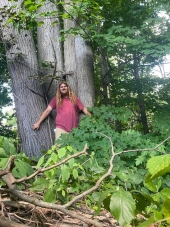
Both large trees in the collection have large, broad leaves more typical of the native North American elms. They also have existed for a long time in a landscape with active and aggressive Dutch elm disease. I think these two large trees (especially the massive single trunk one) can be extremely valuable in a permaculture and displays perspective, because they provide the massive architecture, shade casting and general features of a native elm with the longer growing season, disease resistance and seed production of the Siberian elm. I am very interested in sharing seeds and propagation material
2 days ago

Thekla McDaniels wrote:Reo, I am intrigued by the idea of a hybrid.  Is American elm the same as slippery elm?  

The only things I know about slippery elm are its medicinal value and that it’s in danger of being over harvested.

I am very interested in learning more about an elm hybrid.  

Do you have enough information on it to make its own thread so we don’t highjack this one?


Yes, I will do that now
2 days ago

Thekla McDaniels wrote:This is a great thread.  Thanks to OP and all contributors.

I see there was only one mention of  siberian elm.  I have posted on other threads what I think are its many advantages.  Very fast growing hardwood, it stump sprouts, so I guess that makes it good for coppicing.  It’s excellent firewood.  

It can be used for lumber, turning, and furniture building.  Quite beautiful grain.

Chips well for mulch and mushroom culture and foundation layer of deep bedding.

Goats love the leaves, small branches and bark.

It flowers early (before dandelion) long before winter ends.  Inconspicuous flowers, but important bee fodder in lean times.  

As seeds are developing they go through a stage that is good people food.

I have access to a tree that I have identified as Ulmus x intermedia, a hybrid between Slippery and Siberian elm. It’s has advantages of both species. It is a huge towering shade tree, with the broad leaves of a native elm but the massive seed productive, fast growth rate and DED resistance of a Siberian elm. It also holds its leaves longer than native hardwoods, giving it a longer growing season. I am very interested in experimenting with and sharing the seeds and cuttings if you are a fan of siberians and wanted some material
3 days ago