

|

|
|
|
|
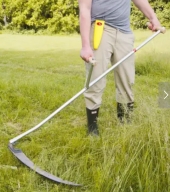
Douglas Alpenstock wrote:Following up:
I am now the proud owner of two American style scythes.
The first was free, from a family member's junk shed. Great blade, but someone had cut the snath down to three feet! Needs some work (an extension) but otherwise it's solid.
The second I got at a garage sale for $10. The snath to blade connection is a bit wobbly but I'll figure out a way to reinforce it. The guy threw in a second broken snath that had two good handles on it.
Looking forward to tuning these up and cutting some stuff.
Brian White wrote:I got a lee valley scythe as a present for a friend and I think it is great. Probably ok for pencil sized brush. Definitely works well on Himalayan blackberries. But if you want to do something cheaper and more tough, you might try to search old heavy scythes on the online markets, craigslist, etc. Get one in half decent condition and cut 1/3 to 1/2 of the blade off , make a point on it like usual, and it should be fine for rough cutting. I had a very heavy scythe in Ireland, and I did that to it, and the same in Canada, I had a heavy old scythe, cut it down to more manageable and it was way easier to use. This was like the shorter scythes that I used in Norway. And both of them were easier to use for rough work than when they were long. I just used the angle grinder to sharpen at the start of the season and a scythe stone the rest of the time. I tried piening once but didn't get the hang of it.
Brian White wrote:Where I live, there is an agricultural supply place called Borden Merchentile that also has scythes, probably more heavy duty than Lee Valley. There might be still the "Austrian Scythe guy" who made custom scythes. I used scythes for a summer in Norway as actual work, and in Ireland, a lot to keep the weeds on the side of the road clean. There are a lot of different types. Even a one handed "lady's scythe" that was very lightweight in Norway. I just tried it for a few minutes. When I was working in the orchard in the Fjord, the scythe was a little bit heavy with a short blade. We had the scythe stones and we would sharpen them every 10 to 15 minutes. My co-worker was a city boy from Holland and he couldn't keep up. But he sure tried! So yeah, scything is an acquired skill, and some people will never get it. And there are lots of types, perhaps you need to go to an agricultural fair and try some to see what works.

r ranson wrote:Great suggestion.
I find early morning mowing before chores or sunrise works well. But we get morning dew here.
One thing I was worried about is a spark. We have a rocky area I want to chop and drop, but it got too dry and I don't know if sparks are a possibility with a scythe. We are on the no-mower stage of summer drought because if a blade hits a rock, the grass will ignite so fast. I was hoping a scythe would have less risk.
T Blankinship wrote:
Benjamin Bouchard wrote:
Coarse scratch pattern, extra-crisp apex. Use a coarse stone to set the scratch pattern, then jump to a very fine stone. This will help eliminate any burr at the apex by cutting it off without actually erasing the "serration" of the coarse scratch pattern. Then finish with a wooden "whipping stick" to strop the blade. No polishing compound is needed -- just the bare wood. I like to make my whipping sticks from 1/2" x 2" pine or spruce, though any wood will do, and shape a grip on one end then sand the broad faces so they have a slight convex shape to them. The wood will grab any microscopic folds or unevenness in the apex at that stage and draw it straight.
This would make the blade sharper right?