Jamie Chevalier

pollinator
+ Follow
since Nov 12, 2015
Merit badge: bb list bbv list
For More
Apples and Likes
Apples
Total received
In last 30 days
7
Forums and Threads

Recent posts by Jamie Chevalier

There are hundreds--thousands in some countries--of native bees. Some have long tongues, and some have short tongues. Of course, the smaller, shallower  flowers suit both. All pollinators have an easy time with umbell flowers, which have umbrella-like flower clusters, with many small flowers in a flat cluster. Yarrow, carrots, parsley, and cilantro are all members of that family.

A wide variety of bees and beneficial insects are attracted to these, and butterflies also appreciate the flat secure landing space. I always suggest yarrow as a perennial and cilantro as a quick-blooming annual. Alyssum is another suitable flower, and attracts predator insects that eat thrips, mites, and other small pests.

Cruciferous flowers, the cabbage family, are also bee favorites. Perennial arugula attracts so many bees that you can hear them across the garden. Kale and othe brassicas that bolt to flower are bee magnets as well.Phacelia tanecetifolia "Bee's Friend" is similar.
3 days ago
Re: using indigenous plants.
Know what kind of ecosystem you're in. California, where I live, and much of the Mediterranean are fire-dependent or fire-climax ecosystems. That means they evolved over millennia with fire as the main disturbance or regenerator of the landscape.

That means the plants have evolved to use fire to regenerate their species. Sometimes that means surviving fire, but more often it means burning very rapidly, with seeds that require high temperatures for dispersal (like pines with their cones closed tight until fire opens them and releases the seeds.) Or with roots that resprout readily after fire, or with seeds that require alkaline ash to germinate. The maquis of France, the chapparal of California, and the cork oak woodlands of Spain are such fire-adapted ecosystems. So while cork oaks and redwoods grow fire-resistant bark to protect themselves, smaller, shorter-lived species like rosemary, manzanita, and sage explode into flame, fed by the resins and oils in their leaves. Most broadleaf evergreens in dry-summer climates burn readily. The same waxes and oils that protect them from losing water to evaporation in a dry landscape act as fuel for the flames.

As someone else said, decidulous small trees are much more  resistant. I remember in the fire that burned large parts of Santa Rosa, California a few years ago, deciduous street trees often survived. It was an eerie sight to see a Trader Joe's store burnt into a mass of twisted steel and crumbled masonry while next to it a tree was putting out new greenery to replace what the fire had scorched.
1 week ago
Rather than suggesting specific plants, I think the best advice is to talk to a local experts about local or easily-bought-in-bulk plants for that niche in your particular area. Ask the county ag department about plants for very poor soil. They will probably direct you to something like meliot (sweetclover) which has naturalized on a sandbar near me.

Best of all, contact a university botanist, conservation organization, forester, etc and ask about "pioneer plants" for your area.  That's the ecological niche we're talking about--plants that can grow in poor soil, and whose presence gradually makes the soil hospitable for other species that need more fertility, better texture, etc. Many of these are nitrogen fixers, like lupines and trefoils, but they will be in association with grasses and other plants too. Gradually, as the nitrogen fixers do their work, and the pioneer plants shed leaves, die, or experience seasonal root dieback, the soil gets enough richer that other plants can out-compete the pioneers, and they disappear. A classic example is lupine or clover giving way to grasses. It's sometimes referred to as "self toxicity" but it's not that the pioneers poison themselves, it's that their competitive edge was their abilty to use poorer sites. Once the site is no longer so poor, other plants will out-compete them.

Pioneers will vary greatly depending on the availability of moisture, the soil texture, soil pH, absence or overabundance of specific minerals (like the serpentine soils of California, with near-toxic levels of magnesium and their own specially-adapted plants.) So there's no point telling you what to grow--your soil and climate will do that.
3 weeks ago
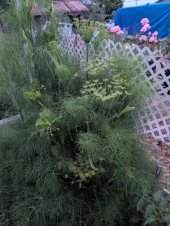
Whether fennel is perennial for you depends on location, and on the strain. Varieties that are bred for the large edible stem base ("bulb") are more annual, though some older heirlooms have perennializing tendencies https://www.quailseeds.com/store/p553/Selma_Fino_Fennel.html More might be found to survive the winter if you can master the trick of where to cut when you harvest the bulbing types. Too low and the crown is killed, too high and the "bulb" falls apart. Harvesting stem-by-stem would give the plant a chance to show whether it can overwinter or not.

Usually the reason you see bronze fennel listed as a perennial and the others as annuals is that they are bulbing types--it's the non-bulbing, wilder plant that is perennial, whether it's tinted bronze or green. It dies back to the root and re-sprouts in spring in my zone. I suspect that the determining factor in whether it survives the winter is whether the ground freezes or not, but that's conjecture.
2 months ago
This is something that I have looked into before, and found a fairly definitive explanation.
Fennel, like many other plants in the parsley/carrot family, originated in summer-dry climates. In order to prevent the seeds from sprouting when there is not enough water for the plants to get well-established before the soil dries, their seeds are coated with natural germination inhibitors. Ever wonder why carrots and parsnips take so long to germinate? It's because the inhibitors must be washed off or biodegraded before the seed can sprout. If you soak and rinse them, they sprout much faster. In germination testing, seed companies routinely soak these seeds before trying to sprout them. In nature, the equivalent of soaking and rinsing is heavy rainfall or seasonal flooding.

Planting a few fennel seeds has little or no effect on neighboring plants. Nor does the presence of the plant itself poison other plants nearby (unlike black walnuts or wormwood, which both secrete poisons from their roots and foliage.) However, unlike carrots and parsnips, fennel is often grown to full maturity and allowed to set seed, which it does prolifically. It also can be perennial in mild climates, and turn into large plants that produce thousands of seeds year after year in the same location. A shower of fennel seeds can leach enough inhibitors into the soil to produce an effect on the germination of crops planted nearby.

You can remove the flower stalks as they start to form (and use them while soft and immature as a vegetable, as is done in Italy) or you can clip the seedheads before the seeds start to fall. Or you can grow fennel among other perennials, since existing plants are unlikely to be affected. I don't know about transplanting crop seedlings into soil where lots of fennel seed has fallen. I doubt that it would do more than slow them slightly; that's a topic for experiment. But as long as you realize that the culprit is a chemical that's found on the surface of the seeds, that the seeds need to be in the soil in fairly large quantities to have an effect, and that the poison is water-soluble, you have the tools to cope with it.

Interestingly, grasses (and other monocots like onions and lilies) tend to be immune to the inhibiting effect of this type of compound. So in climates like mine where fennel is an invasive weed along the roadside, you will see grasses around it, but not most wildflowers, which like many other broadleaf plants, are more sensitive to germination-inhibiting compounds. (Grasses and onions are even immune to juglone, and can grow directly under black walnut trees.)

2 months ago
Perennial Arugula, Diplotaxis tenuifolia, is a wild green from Mediterranean climates that is extremely deep-rooted and drought-tolerant. It's so easy to grow that it is more or less self-tending, even on rocky banks and other less-fertile places, and it volunteers often enough outside of the garden beds that we don't need to worry about sowing it anymore. https://www.quailseeds.com/store/p295/Perennial_Arugula%2C_Rucola_selvatica%2C_Wild_Rocket_%22Sylvetta.html Of course it's lusher when there's water or nutrients, and we have massive clumps around our compost piles and near the chicken run. I've discovered that it's good cooked in pasta and soups, so I get a lot of use out of something I don't really have to tend.

Perpetual Spinach is  easy to grow, and higher-yielding than other leafy greens like kale. It's a type of chard that is milder-flavored, more tender, and more resistant to both heat and cold than regular "Swiss" type chard. Unlike many other perennials, it's also easy and quick to sprout, about the same as regular annual chard. The leaves regrow so quickly after picking that I find I get more meals per square foot than I do from other veg. https://www.quailseeds.com/store/p9/Perpetual_Spinach_%28Leafbeet%29_Chard.html


Collards are also extremely easy in my climate, and the Old Timey Blue variety has proven perennial for me as well as providing food both summer and winter. https://www.quailseeds.com/store/p337/Old-Timey_Blue_Collards.html


For green onions, we have the best luck with perennial walking onions. They make fat juicy leaves, seem immune to heat, and have a complex, onion/garlic flavor we love.

For fresh vegetables, I concentrate on leaves rather than flower buds or stems (e.i., kale or collards instead of broccoli) both for ease of growing and for high, continuous yields. Leaves are also higher in many nutrients than other parts of the plant.  Perpetual Spinach (a type of perennial chard) https://www.quailseeds.com/store/p9/Perpetual_Spinach_%28Leafbeet%29_Chard.html  gives us more meals over the course of the year than pretty much any other greens we've found. It's more heat-tolerant than kale, and very drought-tolerant for a vegetable. During the winter when it is dormant, collards https://www.quailseeds.com/store/p337/Old-Timey_Blue_Collards.html and turnip greens https://www.quailseeds.com/store/p503/Seven_Top_Turnip_Greens_%28Cima_di_Rapa%29.html  give us greens all winter and luscious budding stalks in spring.

In spring and fall, nothing grows faster and is more versatile than Asian greens. I like Mizuna and Bekana for spring salads, and Tatsoi all winter. Nappa cabbage is easy in fall, and made into kim-chee, it's a staple for us. Korean peppers mature early and have the perfect amount of heat for kim-chee. Both are easier for us to grow seasonally than the long-season European sauerkraut cabbages would be.

Of course, greens are not high in either calories (energy) or protein. That lack is easily filled by growing beans, peas, or other legumes. In our hot-summer climate, dry beans are an easy win. We especially like the King City Pink Bean, a California heirloom bean that is adapted to both short season and high temperatures. https://www.quailseeds.com/store/p483/KIng_City_Pink_Bean.html  The flavor and texture are just superb. It feels like a real bonus that our favorite dry bean for flavor is also so easy to grow.  

Corn has been adopted by subsistence farmers all over the world because it gives a lot of easily-processed food without the need for elaborate soil prep, harvesting, or threshing. For rock-solid dependability, we like Carol Deppe's short-season polenta corn https://www.quailseeds.com/store/p111/Cascade_Ruby-Gold_Flint_Corn.html  For bigger yields, or for three-sisters planting, we've found an open-pollinated corn bred by a farmer who saw in the 1970's that corporate hybrids were taking over. He pooled many surviving o-p dent corns and came up with a superb variety he called Wapsie Valley Dent https://www.quailseeds.com/store/p396/Wapsie_Valley_Dent_Corn.html It seems more vigorous than most of the surviving heirloom corns.

To round out the staples, we grow winter squash. It takes a lot of space, but not all that space needs to be garden soil. We grow it at the edge of the garden and let it romp down a dry hillside. Our winter squash of choice is an heirloom from Idaho called Lower Salmon River, a very sweet, very long-storing squash https://www.quailseeds.com/store/p34/Lower_Salmon_River_Squash.html that is again easy to grow and adapted to short seasons.

As far as root crops, we grow beets and carrots. For flavor, size, and keeping qualities, we like Lutz, a beet that is no longer easy to find because it's appearance isn't up to supermarket standard. https://www.quailseeds.com/store/p258/Lutz_Green_Leaf_Beet%2C_Winter_Keeper%2C_Longkeeper.html  But until we are able to provide a bed with metal screening on the bottom and sides, the risk of losing the crop to gophers is high. When we grow potatoes, we put them in tubs for that reason. Peppers do best for us in tubs as well, and can be moved under cover in fall to keep ripening.
Not sure if this is the right thread for this, but here goes--
Here in California, it's good practice to mow the dead grass around our place to prevent fire from spreading in the neighborhood. We have several homes along a grassy slope, and should fire start anywhere along the slope, it would spread to the other homes in short order. So we all agree to cut the meadow grasses once they're dry.

We had a pile of straw from scything the hillside. The idea was that it could be kept there all summer until needed for either mulching or composting. We put down cardboard and piled the straw on it. Then the really unusual happened. We got rain in July. Never happens in our Mediterranean climate--but it did.

We didn't think anything about it. Until the straw pile burst into flame.
Turns out the rain started microbial activity, and in the 100-degree heat the pile got so hot it spontaneously combusted.

I'd seen wood chips start to smoke, and I'd read about coal ships burning when the coal got wet in the hold. But I never expected a small pile of straw to burst into actual flame. It spread quickly, melted part of the greenhouse, and ran through what grass was left. Luckily, a neighbor happened to be looking right at the spot when it burst into flame, so the alarm went up immediately and while neighbors were stamping on it, we ran a hose to it and got out shovels and hoes. When the fire department got here, it was out--but only because someone happened to see it as it happened. We are 16 miles from town, on mostly dirt road. It takes quite a while for help to arrive.

We only have an acre, but were working on the other side of the house and would not have seen it in time to stop a disaster. It was already licking at the base of a large tree when stopped, and that tree touched another tree, all through our neighborhood. The wind was blowing in the direction of that chain or trees and houses.

So that is another downside of concentrating organic matter in a pile, especially if you are not actively managing it daily.

4 months ago