L Cho

+ Follow
since Feb 03, 2016
Merit badge: bb list bbv list
For More
Apples and Likes
Apples
Total received
In last 30 days
0
Forums and Threads

Recent posts by L Cho

I salvaged a tub sink with dual foot-pedal valves from a utility room being converted to office space. Installed it in my laundry room. It was great. Later I got a Delta Touch2O pull-down faucet for my kitchen sink, and added a capacitive touch pad, on the floor right in front of the kick-plate, so I could activate with my feet. Bare feet or socks only.

I have since moved, but I would replicate that setup when I am given the chance.
21 hours ago
I have a saved search on Marketplace looking for a free garbage disposal. I want to set it up in my backyard next to my compost pile, and use it to macerate my kitchen waste. My hope is this will speed up the composting process.
1 day ago

Anne Miller wrote:I once thought using water as a component with a rocket mass heater was a win, win.

then I found out that water a rocket mas heat are a dangerous combinations.  

I don't know ...

https://permies.com/t/224383/rocket-mass-heater-hot-water


I had not seen Geoff's video before. Thank you for that link. His design looks exactly like what I was thinking of, and it answered a number of my questions.
1 month ago

Benjamin Dinkel wrote:Hi L,
you say a large thermal mass might be problematic. To me that means I would also dissuade you from using under floor heating, as that uses all the floor as thermal mass and is usually a system with a lot of inertia.
You could supply hot water heaters or the heat exchanger of an HVAC with the hot water.


I do believe I have seen underfloor heating systems that have low inertia. Such a system could be suitable for Florida weather, but I could also see running a water/air heat exchanger for forced air heating. Underfloor appeals to me simply because it can create comfort without heating the air as much, meaning my sinuses would be a lot less dry compared to forced air.

Before I started thinking about heating water, I had pondered the idea of adding tubing to my thermal mass, which would allow me to circulate water through the mass to get hot water, and I could also valve in a diversion loop, which would let me circulate the water to a ground loop, so if the weather warmed, I could dump the excess heat into the ground. But I would have to know how fast I could cool the mass to room temperature, in order to know if the idea was practical. That led me to a rethink, and the idea of heating water outside.
1 month ago
I want to build a rocket water heater.

Background.

I live in Florida where the weather tends to be warmer. Winter here is an on and off thing. We normally have lots of pleasant weather in the 60 or 70s (Fahrenheit) with the occasional cold snap that can go anywhere down to freezing. Usually the cold only stays a few days at a time. The longest cold snap I have ever experienced here was 3 weeks. It was memorable because it killed off a lot of the non-native parrots. They are social nesters and can huddle together for warmth, but after a couple weeks without being able to forage, they starve. Anyways the fluctuations mean that a large warm thermal mass in my home could be a liability if the temps suddenly go back to 70 or more.

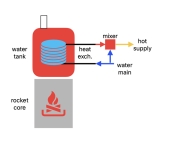
My proposed solution would be to built an external water heater, and use piping to transfer the heat into the house, with the bonus of hot water for the taps as well. The boom-squish problem dictates an unpressurized water tank, but my thought was a tank with a built in heat exchanger, that lets me transfer the heat to my municipal feed. The water in the unpressurized tank can't go above 212F, and since no heat exchanger is perfect, the water coming out of the exchanger would, by definition, be less than 212F. This could then be mixed down to get the temp needed in the house, say 140F for the taps, and lower for radiant floor, or possibly more for space heating.

Has anyone done something like this?

Incomplete diagram attached
1 month ago
And I forgot to add, vacuuming some spices that come in plastic jars, keeps them from caking up.

Some companies sell spices and other things in plastic containers. This is bad faith by design, because plastic containers do not seal well, and any hygroscopic contents will create their own vacuum, by absorbing all the available water vapor, which in turn, pulls in more air containing water vapor, leading to a vicious cycle that fully cakes the contents. Their goal is to force you to buy a replacement, because you can't use it when it has solidified.

So your garlic or onion powder, instant coffee, anything that cakes up and is sold with a plastic lid, should be vacuum sealed, to keep it dry. Some companies use the tried and true glass jars with gasket lids, which most perishable foods come in. Those are the companies who you should give your business, because they are not selling you a purposefully leaky container.
2 months ago

Sandy Stacey wrote:I second the glass jars and vacuum seals.


I also store dry goods in vacuum jars. For anything that would oxidize, such as nuts, or get stale or soggy, such as crackers, a vacuum acts like a stasis field, preserving it almost indefinitely. No air means no oxygen, moisture, bugs, or mold.

When I first got a vacuum sealer, I used it for packaging meats for the freezer. Used properly, it does a really great job at this, and I have not dealt with freezer burn ever since. Eventually I got some mason jars, and then realized what a game changer vacuum storage is. All of the dry goods that I used to date code and store in the freezer, only to eventually throw out the remainder after a year or so, could now be stored indefinitely in vacuum jars. And now I just write the year, only for reference, because I don't have to throw any of it out.

Any dry good that goes bad over time can benefit from this. Powdered milk stays pristine white, instead of yellowing through oxidation. Nuts never go bad. Coffee smells the same as when you first cut open the vacuum package. Spices last forever. Baking powder does not lose its efficacy. Any seldom used ingredients can be kept in like new condition.

Some soup recipes involve pouring all the dry ingredients into a pot, adding water and then simmering. You can premix the dry ingredients, and vacuum seal them in a jar, for when you are in a hurry for some soup.

Flour mixes for pancakes or biscuits can be premixed, and vacuumed.

Any dry good, with a true expiration date can benefit from vacuum storage.

There are tricks I have learned or come up with over the years.

Tapping on lids tells you the state of the vacuum. A dull thud means you seal was lost. A clear note means everything is good. I check my jars periodically for vacuum.

A good vacuum negates the need for lid rings. I just buy the lids now, as I have excess rings.

Lids can be reused many times, but gaskets will wear out eventually, although I have some I have been reusing since I first started. The newer ones don't seem to last as long.

Foodsaver makes mason jar sealer attachments. Their regular mouth sealer needs to be shimmed to work reliably. Put a lid on the jar and then stack another upside down, over it. Then seal the jar. The shim keeps the lid pressed down so that it seals properly when you release the vacuum.

The jar rim and lid gasket must be scrupulously clean. Even the tiniest bit of dust can cause a very slow leak. This can  be a big problem when sealing flours, as drawing the air out, creates dust clouds that get under the gasket. I solved this problem by poking a vent shaft, down the center of the flour with a chopstick. Air gets out through the vent shaft, and no clouds of flour rise up to foul the seal. My vacuum sealed flours no longer leak.

Breaking the seal on a mason jar can be difficult, because you don't want to damage the lid. The easiest method I found is using a chopstick, specifically the square handled cooking chopsticks. I put the chopstick tangential to the jar, with the square end underneath the rim of the lid, and spin the jar around until the chopstick is wedged between the rim and the jar thread, and lever the chopstick to lift the lid enough to break the vacuum. No lids are harmed doing this.

Non mason jars can be vacuum sealed through one of two methods. Chamber sealing, or punch and tape:

Chamber sealing involves using a larger container to vacuum a jar or jars inside. Wash and reuse any food jars that have gasketed lids, lightly close the lids, and vacuum them. Tap on the lid to be sure.

Pump -N- Seal sells a kit for vacuum sealing any food jar. It comes with punch, pre-cut squares of sealing tape, and a vacuum pump that goes over the tape covered hole. The pump is operated until the air is evacuated, and the tape seals the hole as the air tries to rush back in. Their kit is handy because it is hand powered, and works anywhere, but you can roll your own if you like. A metal push pin acts as your punch. Electrical tape is thick enough to create a hermetic seal. Any adapter for reusable zip lock vacuum bags can cover a taped hole, so one of those can vacuum your jar.

Vacuum storage, either in bags or jars, can be great for preserving almost anything that oxidizes or hydrates when exposed to air. Metal parts will not rust. Fabrics and leathers will not mold or mildew, and moths cannot get to them. Books will stay pristine, and silverfish can't survive without air. Matches will stay forever dry, and your first aid kit items can be individually waterproofed.

You still need to periodically check for leaks.

2 months ago

Thekla McDaniels wrote:To me, the discussion of medical benefits is germane…. if you are washing your rice to rid it of “contaminants” that also have medical applications, to me it speaks to the idea that tiny amounts are negligible, sometimes beneficial.  Wash if you prefer, but for those who stress over such things… it says “don’t worry” there’s probably no harm in it.


The problem is that the amount of arsenic in rice can be quite variable, based on where it is grown. Some areas have higher amounts naturally occurring in the soil, and some places have it from pollution. Some governments monitor arsenic levels in rice, but it varies worldwide. If your rice comes with high levels of arsenic, then washing is advised, because it can reduce the dosage by a measurable amount.

And it is a similar problem to fluoride in water. Your dosage depends on how much you consume, compared to your body weight. Small children can get comparatively much higher dosages because of their much lighter body weight.
2 months ago

Anne Miller wrote:
Did you know that there are medically approved benefits?  I have heard it is used for treating certain cancers,  leukemia  for one.


I don’t see how those medical uses apply here. We are talking about consuming rice, where any reduction in arsenic content, is a good thing.
2 months ago