


Mart Hale

pollinator
+ Follow
since Feb 21, 2010
Merit badge: bb list bbv list
Biography
Florida, zone 9a.
For More
Apples and Likes
Apples
Total received
In last 30 days
17
Forums and Threads

Recent posts by Mart Hale

Annie Collins wrote:I just want to point out that the mimosa tree is non-native and considered highly invasive in the SE US, and likely other places as well.
https://triangleland.org/stewardship/the-invasive-mimosa


Oranges are non native to Florida, but they do very well here and provide excellent orange juice.

It is good to know mimosa is invasive, but invasive can be manged well with a good grounds manager, can be used for wood chips and chop and drop.    Invasive to me means excellent survivor, but needs to be managed.
4 days ago
For me it is prayer and exercise to help with stress.


I also ask myself questions when I am stressed....

1)   How much control do I have over this thing I am angry about?

    Sadly many of the major things I am angry about I have little input on, so yes I am angry, but I can't change this and my blood
    pressure going up is not helping.


2)   What things do I have control over that can bring benefit?    
     
    I want to focus my energy on things I do control,  how I spend the money I have,  how I use the time that I have,   how do I use food / energy    
    I generate.        These things I have control over and can change and how I effectively use these things can give me more options,  help a
    neighbor,  and make a difference.


Often when I am stressed I reach for the wrong foods to cope with the stress...     Much better to grab a hoe and walk out to the garden.
6 days ago

Danny Post wrote:Open-Source Concept: Modular Off-Grid "All-Weather" Sand Battery for Home Heating
Hi everyone,
I want to share a low-tech, modular product concept I've been working on to tackle energy poverty and grid dependency. I'm putting this out here fully open-source for anyone in the maker and permaculture community to build, test, and improve upon like some of you already been doing.
The Core Concept:
It is a mobile, stacked off-grid thermal buffer designed for any home or apartment. The shell can be built using modular terracotta rings, concrete blocks, cast iron, or even an upcycled metal oil drum. Inside, it is filled with cheap, locally sourced construction sand.
The Hybrid "All-Weather" Energy Mix:
Instead of relying on the grid, the system uses a direct DC connection powered by whatever nature provides at that moment:
1. Plug-and-play balcony solar panels (Solar)
2. A micro wind turbine (Wind)
3. An inline micro-hydro turbine placed inside the rainwater downspout (Water power from heavy winter rains or rivers)
On dark, freezing winter days when solar is non-existent, the wind turbine and rainwater downspout turbine pick up the slack.
How it works & Benefits:
• The generated DC power goes straight into a heating element buried in the sand.
• The sand absorbs the high-temperature heat (up to +-300°C) completely pressure-free and leak-free.
• The outer shell slowly and safely radiates comfortable, steady heat into the room for hours. No inverter losses, no complex electronics, and zero grid load.
• In the summer, you can easily plug the solar/wind output directly into a DC-powered fridge or small AC for free cooling.
High-Temperature Wood Stove Synergy:
For those with a wood or pellet stove, the modular shell can be built around or right next to the stove's exhaust pipe. It acts as a thermal sponge, soaking up the intense 200°C+ waste heat that normally escapes through the chimney, preventing the room from overheating and creating a massive radiant night buffer.
I uploaded the 3D visualizations and the technical cross-section diagram here so you can see exactly how it's structured:
• Design Concept: https://ibb.co/DP7N6xqL
https://ibb.co/zhjtyvDW

Feel free to copy this, build a prototype in your workshop, or share it with local energy coaches and community workshops to help folks get through the winter safely without relying on dangerous candle heaters or expensive utilities.
I'd love to hear your thoughts on material choices (concrete vs. terracotta) and how to optimize the DC element setup or other input or ideas. And also want to show some appreciation for the info already shared.
Cheers from The Netherlands,


Hi Danny,

I have found many people have experimented with using solar panels to store energy in a thermal mass...       I have posted several links in this thread, and my own experiments.        

So far the best I have done is to run the solar direct to my hot water heater.      After my batteries are charged a relay is tripped and a circuit is completed that goes direct from my solar panels to my hot water heater.      So the excess energy is stored as hot water.  

But your concept  has been pretty much so put into practice with Mike's work ->


For your Terra cotta idea I believe it should be in an insulated box then when you need the heat one could use a fan and remove the top cover...


Open source is the way to go.     I love seeing people take concepts and going out there and making it happen.

 
Peace.

1 week ago

Cindy Mortera wrote:

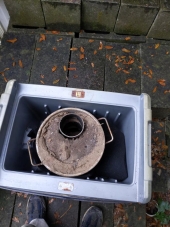
Mart Hale wrote:Today I decided to test out making a sand battery. I had this old pot with a hole in the bottom, I then took two cans cut out the bottom on those and put inside the pot over the hole then filled the pot with sand fir the first layer. Second layer I cut down the can a bit so it would fit in the pot and I laid in another layer of sand. For this first go around I had temps at the bottom at 325 degrees and at the top at 165 degrees.... After this I brought is inside put a welding blanket inside the cooler and put the pot inside.... I noticed a large amount of moisture building up inside the cooler, which figures as the sand I used was from outside. I am formulating how I could improve the heating of the sand was a fun experiment.


That’s a really interesting experiment! It’s great that you’re testing and learning from the first attempt. The temperature difference between the bottom and top layers is pretty impressive, and the moisture buildup makes sense since the sand likely held a lot of water from being outside. It would be interesting to see how much better it performs after drying the sand completely and improving the insulation around the pot. I like the idea of using what you have on hand and refining the design through trial and error. Looking forward to seeing what improvements you come up with on the next version!


Hi Cindy, sorry I have not replied sooner, but i just found your post.        Indeed  I did progress from wet sand to dry sand, and I found the need for insulation.        I did post further results later in this thread of using solar and a hot water heater element.      Others have also posted in this thread of their use of this tech to cook food.       There are many things one can do with thermal mass, some are already products that one can buy.

Cheers,
1 week ago

Robert Ray wrote:Has anyone combined a solar sand/mass battery with a RMH?  During construction the addition of a heating element in the mass of the RMH would be an easy addition.


I just saw this video on solar with water and as I watched it,   I was thinking  what if the water was pumped into the ground for when you wanted to warm the water on cloudy days,  or release the heat on hot days......

The use of insulation sure makes sense to me, starting to think what if the water was in pipes in the floor as well.....

But thermal mass sure has been combined with rocket stoves for some time,   I believe we just need to find the best systems with thermal mass already in place and take notes of how to build it the best way for the climate we are in.
1 week ago
With the advent of having youtube to show you how to do the repair,   I have found it faster than getting in my car going to the store and finding they don't have the part I am looking for....     Instead I leverage  youtube videos to see if:

1)   Where to get the part to do the repair.
2)   Ask myself the question,  is it worth repairing?     Some things are so poorly manufactured that it is better to buy a quality model and that may be talking to repair shops to find out what does not break...        Products today are engineered to break for the most part....

https://www.youtube.com/shorts/49NikeBCzWo

3)   Sometimes it is a calculated risk.       I was given a laptop with a bad power connector.      This connector was on the motherboard, so it is a tricky repair.       I risked my time, and about 30$ in part to see if I could repair this laptop,   I gambled, and I won using a heat gun ( not the right tool to do this operation )    So I gained a skill that I did not have before, so it is what I call an educational risk.        I have greatly failed at this in repairing the bearing in my car, but in replacing break pad I am way way ahead.         I do weight the risk of the repair and take risks if it makes sense to me.

I believe we do need to get off the subscription plan.....    Not only the contract subscriptions, but the replacing of poorly made items that we have to buy again and again and again.

https://youtu.be/UCSld7Lbpsc


Being able to repair is a great skill to have to barter, and trade, you can buy items that are broken, then fix and resale.


1 week ago
Both rye, and wheat flour do not rise very well by themselves.

Some things that might be at issue:

The right amount of yeast critical.

Quality of yeast, ( I store mine in freezer to preserve quality )

Amount of gluten in the flour...  gluten helps to rise.

( added later   )   Salt is also important for the rise in the right amount.


My solution was to just use white unbleached flour for my bread,  rye flour is hard to get to rise so I added the caraway seeds to my white flour bread and I get the taste of rye combined  with flour that rises very well.
2 weeks ago
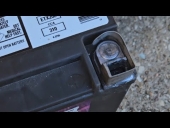
Is this a battle born battery by chance ?

If so look up Will Prowse on youtube, he has demonstrated that this is a danager that these batteries have, and what to do about it.

Cheers,

Mart
2 weeks ago
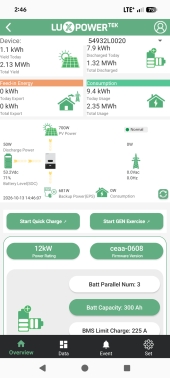
I don't  do capacity tests other than I know what loads I put on the battery and can refer to how much I can know from my past loads how the batteries respond.      If they do the loads they need to do, for me that is good enough, I run lithium batteries, and I have created my own wifi battery device that I can record on an open source program domoticz  the data.

2 weeks ago