Elise Villemaire

+ Follow
since Sep 24, 2022
Merit badge: bb list bbv list
For More
Apples and Likes
Apples
Total received
In last 30 days
0
Forums and Threads

Recent posts by Elise Villemaire

S.A.D. is from lack of any UVB rays in temperate or arctic winters, dropping our D blood level, destroying our microbiome and deep reparative sleep. 20 minutes in high summer gives palest folks around 20,000IU (2hours for darkest) but depending on latitute, no UVB at all reaches us for varying lengths of winter, even in California/Northern Florida. Food sources are never enough unless eating ancestrally high summer-pastured/D-laden fatty meats or sea blubber *back before we poisoned the seas with mercury! (D is a preHORMONE we make in the cholesterol layer in our skin, though we can also get it from food and  supplements but can overshoot if not producing it ourselves from UVB! Our skin/metabolism is very smart, but not so much our gut for oral D since we evolved into brainy humans under copius year round Tropical African UVB!

Blood level, not dosage is the critical number. It is critical to get your D level measured regularly Winter & Summer and take a high enough dose to maintain over 50ng/ml, though above 60 will improve deep reparative NREM sleep cycles by hitting our sleep paralysis switch in our brains that depends on D to function. Yes, we must be paralyzed while our brain is being cleaned by our GLYMPHATIC system. If you've never been low in D (tropical zones and outside carefully non-burning unprotected UVB doses year round or supplementing), this will function with a level around 50ng/ml, too. Winter's solar spectrum, lacking any tiny UVB, is still quite healthy, but unlike for UVB, stripping is not needed to absorb the healthy infrared parts of the spectrum that predominate at dawn & dusk. *Fauci, when younger, was taking 6,000IU in Summer, 8,000IU in Winter, but as our bodies age (or especially fatten!) we need more. Obese people who are not sufficiently supplementing are almost always deficient! When obese, we cannot ever get enough from the sun.

D needs a critical team for effectiveness and safety. Magnesium is critical for building more D-receptors in all our organs & systems, but it is not vitamin K1 from green veggies (which thins the blood and is contraindicated for many common medications), but K2 (bacterial fermented foods) which pairs with D. One of D's powers is to dramaticallly improve our microbiome and general gut health, allowing us to absorb far more calcium from the exact same food. But without K2 that calcium can become dangerous and even cause hypercalcemia with solid deposits in every unhealthy and/or painful place. K2 (I've read 400mcg of MK7 form is great daily dose to protect against atherosclerosis.)  K2's main job is to direct all that extra calcium safely into bones and teeth where we want it!

Early in Covid, when I finally got my severe D deficiency of only 6ng/ml (where people were at highest risk of dying of Covid) up above 50ng/ml, my long severe depression lifted and my arthritis and backpain disappeared completely. In new hope and painlessness, I started a Keto lifestyle and finally began to lose a whole lot of weight fairly quickly. But quick fatloss is a D danger timezone! If the blood level has been raised like mine was, that fatburning will dump all the burned fat's D into the blood and I did shoot over 100ng/ml! (Hypercalcemia is exceedingly rare, but very common D deficiency is causing far more health issues.) Easy to solve as long as testing is regular enough to catch it, I just took a pause on dosing, then started up again at a lower dose, as a lower D3 dose is needed the less fat we are carrying around. D & K2 are fat-soluble, so take these supplements with a fatty meal. Magnesium is water soluble, so scheduling time of day for that dose is much freer. Most Americans are far too low in all three of these nutrients/hormones.

(I also managed to encourage my elderly PhD of Nursing mother with COPD to take D3, K2 & Mg, and her constant coughing and breathlessness has disappeared! At her age of 85, she takes 10,000IU of D3 with 200mcg K2 along with Mg glycinate 4oomg? Her D blood level is now around a sleep healthy 60ng/ml and she sleeps through the nights again. But everyone is different, so NEEDS TO TITRATE DOSE TO OWN BODY/BRAIN NEEDS. Please test D blood level regularly and take the dose you need to get to your target LEVEL. It is so important for so many conditions.)
4 hours ago

r ransom wrote:Why is there no E-sharp?
Was he a bad little letter and didn't eat all his vegetables?

Why are there so many sounds missing kn European music?


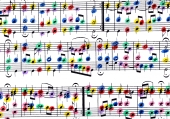
Scales (major, minor or any of the other "modes") are a standard sequence of full and half tones. Starting with only C MAJOR will help with orientation, but thinking mathematically, E# is just an F natural. Same with B# = C natural & vice-versa with Fb & Cb. In some complicated pieces, composers may even use double flats and double sharps to keep the key relationships clear??? (Stay in C Major so all natural pitches and just play/SING! (keyboards helpful here for visual relationship too) starting on each of the other pitches without adding sharps/flats will give you all the natural modes including our modern "minor" starting on A natural which used to be called Aeolian mode.) Singing note names helps move the learning much faster.

I got credentialed and taught music in California public schools, but no one ever taught me the colored letters for dyslexics when I was at University! What a magical solution for brain diversity!

Other cultures have even fewer tones (5-tone Chinese folk music) or many more with QUARTER TONES in the Arabic/Near Eastern cultures. Earlier European music and a lot of American jazz or other styles of modern composers use the other "modes" that early Euro music used all the time in Gregorian Chants & folk styles that were seldom written down, since trained musicians worked in religion, not peasantry. The modes were established before/during the Ancient Greeks! (Educated classes have always been trained to look down on the masses!)

Music is intensely connected to mathematics through the physics/geometry/proportions heard within any single pitch, even before it is further organized into a structured piece with just one solo or many coordinated voices. The base/fundamental of the pitch is its letter name/frequency & octave, then as you hear that natural pitch, the "color" of the tone is the infinite array of rising overtone "partial" frequencies: fundamental, octave, fifth, octave, third, fifth, *seventh, octave, 2nd, 3rd, *4th, 5th, 6th *7th, 8ve and then half-tones, then even quarter & smaller tones tones far, far above our ability to hear them! (Not remembering perfectly, but the asterisks indicate frequencies far from the "tempered" or equalized scale we use today for fretted ukuleles or keyboards.) You can recognize instruments by the over-emphasis of various partials, so a voice does not sound like a ukulele. Because of this physics, musicians tend to excel in hard maths/sciences.
2 days ago
I made an extensive comment listing ways I dealt with the munchies, based on science. Why it was quickly hidden is a mystery to me. No indication other than a polite general suggestion that if it were "edited" it might regain publication? Is this really as propagandistically censorious a platform as the rest of our society???

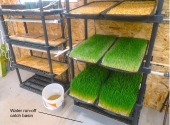
Jen Fulkerson wrote:I started out growing fodder. My system was much smaller, and not as nice, but it did the job, and didn't cost me anything. Then I discovered fermented grains, and it was so much easier, and used a lot less water, and the chickens seem to like it just as much. I thought about doing both, but I decided since they get so much form the garden I would stop growing fodder.
I would like to grow the in ground fodder. I built the frames, (2x4 square or rectangle with chicken wire, or hardwire cloth over the top so they can only eat the top, and the plants keep growing) and tried it, but it didn't work for me. I have  wood chips in the chicken yard, and they kept covering the top with wood chips. I don't have a much wood chips right now. I was also thinking of adding a board around the top to make it harder to kick stuff  on the top.  I my try wheat this fall. Maybe sprout it first, then plant it. Maybe put it closer to the coop so it's easier to water. We will see. I always have to many projects, but the boxes are made, so it easy enough.
On a side note, the boxes have come in handy. We have used them to sift worm castings, and to help grow clover and grass in the front yard where the dogs are. It allows the seeds to germinate, and get established so they can handle the dogs.


You could try what I am planning. a 1 - 2 foot high raised bed box filled highish, then planted. Too high to scratch much into! Then wire & frame protected. Chickens can easily jump up or you could make steps if elders, or less flight capable. I am always amazed at how much straw & hay my flock can get into my 8" high food troughs!
5 months ago

Rachel Lindsay wrote:I always heard everyone say that life with newborns was hard, and then it got easier.

Nope. Not how I see it. The newborn phase is the easy one, and they only need more from there.

I have found it to be the same with these chicks, who turn four weeks old tomorrow. The first week was the easy one!


Mine are just reaching the beginning of their 3rd week, but with a very fiercely protective virginal broody that I successfully put them under (with cover of night), she is taking care of much of the important business!
1 year ago

Cd Greier wrote:

Bruce Alan wrote:
No reference to Brussel Sprouts.
Am I the only one left in the world that likes them ?

I like Brussels Sprouts every once in a while: maybe several times one month but skip 'em for two or three!
My search for the perfect companion garden plan suggested that Brussels Sprouts are the grumpy uncle of the Brassica family: they dislike everything the other members dislike but they are none-too-fond of family, either. Apparently they do tolerate beets, Swiss chard, lettuce and spinach so I'm putting those between the BS's and virtually anything else.  


I detested the adorably beautiful Brussels for their intensely bitter cores. Once my gourmet-cook mom went to all lengths for a specific recipe that had her peel every single leaf and discard the cores, which I truly enjoyed, first time ever around 50 years old.

Then, early during Covid, after I got my dangerously (medically/causing massive obesity/MetabolicSyndrome!) low D raised from only 6ng/ml up above 50ng/ml, I began Keto/IF and wow did my tastes change, likely due to a new & much healthier microbiome (which I've read controls what foods we love or hate). I now love BS but still have yet to grow any.

1 year ago

Rachel Lindsay wrote:Also, do I need to go buy grit today? How do I "serve" it to them?


I don't believe 'all' starter blends have grit in them, but my feedstore is out of the organic Scratch & Peck, so I don't have their ingredients list in front of me, yet,  and Livvie disdains to accept their substitute, so scrambled eggs + millet, chia, flax & lemon balm for 2 more days? As a bare 2-year newbie, I succeeded in putting all of my 6 new hatchery chicks (under cover of their 1st night's darkness with a dim red headlamp) under my very insistently but quite virginal broody Olive Egger and she is ferociously protecting them from everyone! I included one (up to possible s-r three, but was gifted an extra straight-run, so now four???) cockerels in the order to provide some rooster protection in their free ranging pasture. I don't think the substitute starter had any grit, since they all clearly wanted some.
Just offer the chick grit, they will take what they need and it is cheap! And my original hens never demanded I go to the full size version, either, so it won't likely be wasted.

Sprinkle it over their starter, then you can sprinkle on the floor to scratch & peck, and later put in its own server. Offering too much will not hurt them, but not having it can quickly cause illness.
1 year ago

Pearl Sutton wrote:When you are willing to risk your tech because some things are IMPORTANT!


Tragically I sacrificed my inherited phone just carrying way too much (ferment & treats & basket & coffee) to my morning chicken chores! Poor phone died of drowning in my barely warm coffee! Still haven't got it replaced months later. All my chicken photos of their chickdom two years ago lost!
1 year ago