
Cedric Noussan

pollinator
+ Follow
since Dec 09, 2022
Merit badge: bb list bbv list
For More
North italy
Apples and Likes
Apples
Total received
In last 30 days
0
Forums and Threads

Recent posts by Cedric Noussan

Hi kabouter,
I'm answering you based on my current knowledge and constructive experiences.


I tried to upscale to a 7"/175mm size.  
Using a Base value of 12.66mm, Internal Surface Area (ISA) ideally 7,2m².
My current design has 8,24 m² ISA (excluding the sides that face interior house walls), but by playing with the main bell height I will hope to come closer to the 7,2m².


I think it's a bit too much, 7.2m2 is the maximum value considering all the internal surfaces excluding the floor and the core


Questions
#1 Foundation and floor construction:
Do I need an extra slab of concrete and insulation as a base for the RMH?

I guess the primary need would be insulation, since the foundation is already suited for the heavy weight.
As a precaution I will definitely provide extra support in the basement beneath the main bell.

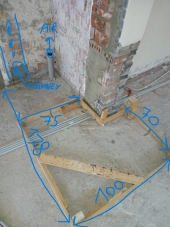
The floor construction (see sketchup) consists of concrete slabs. (steel reinforced), a layer of 6 cm PUR (polyurethane) and finally a layer of 6-8 cm cement base-floor with a ceramic tile as finish.  
All floor has this construction except for the odd-shaped area where I planned my RMH, where I now planned my main bell. that area has no PUR, and 12-14cm of cement base-floor that should be well capable of holding the weight.

The rest of the floor contains heat-piping. except for the part below and between the RMH and the chimney.

Should I insulate between the bench bell and the floor? The heat-pipes are about 5 cm deep (1cm tile, 4cm cement basefloor). What temperatures will reach the pipes, could this be an issue without insulating? I I'm not mistaken they can handle 95°C.


The floor isn't usually considered in the ISA calculation, so I don't think there will be much heat there. In my latest project, I didn't insulate the floor; I built directly on the reinforced concrete floor.
As for the heating pipes, I don't know...


#2 Chimney:
2a) The existing chimney is a brick and mortar, lined with cement. internal dimensions are 24x29cm/9,5x11,4”, length 5.5m/18ft. (rough estimate) useful as is for a 7" system? I know a flue pipe would be better but this may be fine? The previous fireplace had a 200mm flue pipe of 1m into this chimney.
2b) Do I need a bypass for cold starts?


Here you'll find a perfect answer to these questions: https://permies.com/t/280600/Wooden-ladder-rmh#2981470
In your case, you get a useful circular cross-section of 26.26 cm. I think that's a bit too much for a 17 cm system


#3 Interior wall Insulation
The main bell will be as close as possible up against a interior wall of plastered brick and mortar.
Do i need to insulate between the bell and this wall or just consider it as extra mass?
Perhaps leave a small air gap, place a metal heat shield or insulate some way.

In the design I left a small air gap of 1 cm. I don’t mind some heat to go into this wall since it’s an interior wall and it’s basically a brick and mortar pillar supporting the ceiling. I don’t expect much heat loss here.


If they're internal walls, I'd consider them extra mass.
In my latest build, I left 5 cm of space between the bell tower and a pillar. I didn't like the idea of ​​overheating the load-bearing structure of the house.

#5 Core And Bell
If anyone could check, are the dimensions of the core and bench ok for proper "air/gas" flow to the chimney?


from the latest constructions it seems that the double skin is necessary only for the front wall at the exit of the core.

I'm not entirely convinced by the current layout, especially the connection between the bench and the main bell. Maybe I would try to consider it all as a single bell but I don't have enough experience to recommend a solution.
The only thing I would try is raising the core off the ground for easier use (one of the best advantages of Shorty) and perhaps rotating it 90 degrees.

I hope I've been helpful. I wish you the best for this new project of yours.
Cedric

2 weeks ago

Cristobal Cristo wrote:
Is it an open space or just one floor of the house with interior walls?


mainly an open space, just a few walls here and there, the rmh is in the center of the space
2 months ago

thomas rubino wrote:Excellent Job, Cedric!
In one photo, you show a plate blocking off the riser port?
Why? What was its purpose?  


if you mean photo 178, it's just the bypass, the perspective is deceiving
2 months ago
Work resumed a month later, when everything was completely dry.
An additional coat of lime plaster, a covering of the chimney flue outside the bell, and some metal decorations completed the job.
After a few months of use, I can only be satisfied. The house stays warm all day using half the wood! Incredible! You can't understand until you experience it for yourself.
What are you waiting for? Upgrade to an RMH!
2 months ago
Finally, the bell was closed with T-bars, superwhool, and firebrick, followed by a layer of superwhool and one of clinker (an excellent way to use up offcuts).
Plastering and first lighting: what a marvel!
https://youtube.com/shorts/3t2ybOkbe3E
2 months ago
Once we reached the right height, I positioned the core support and assembled and insulated it with superwhool.
The masonry work continued with a single skin up to the height of the combustion chamber. Subsequently, the inner layer will be firebrick while the outer layer will be clinker, the two layers separated by superwhool.
A bypass was installed above the riser
2 months ago
And here we are at the first part of work, seven days of hard work...
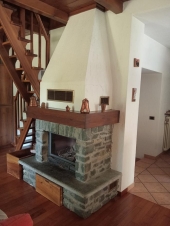
The first day was dedicated to wrapping the house and furniture in tarps to protect them from dust and demolishing the fireplace.
The work continued by tracing the perimeter of the bell and moving up the layers, cement clinker bonded with sand, lime, and Portland cement mortar.

2 months ago
After that, I have the procedure for cutting the bricks for the combustion unit
here the first burn: https://youtube.com/shorts/Ow7tqGgOBzw
2 months ago
The first part is dedicated to preparing the metal parts, cutting and welding of metal:  T-bar,inspection, by pass, door  and combustion unit support


2 months ago
After finding the final project I started to find the materials
for the refractory bricks and mortars, here unistara
For the iron, , here easy iron
I found the cement clinker, sand, and putty lime and the rest near my house.


2 months ago