• Post Reply Bookmark Topic Watch Topic
  • New Topic
permaculture forums growies critters building homesteading energy monies kitchen purity ungarbage community wilderness fiber arts art permaculture artisans regional education skip experiences global resources cider press projects digital market permies.com pie forums private forums all forums
this forum made possible by our volunteer staff, including ...
master stewards:
  • Carla Burke
  • Nancy Reading
  • r ransom
  • John F Dean
  • paul wheaton
  • Jay Angler
stewards:
  • Timothy Norton
  • Pearl Sutton
  • Tereza Okava
master gardeners:
  • Christopher Weeks
  • M Ljin
gardeners:
  • Jeremy VanGelder
  • Matt McSpadden
  • thomas rubino

Designing My First RMH 7" Batch Box

 
Posts: 5
1
  • Likes 6
  • Mark post as helpful
  • send pies
    Number of slices to send:
    Optional 'thank-you' note:
  • Quote
  • Report post to moderator
Hi everyone, greetings from Belgium.

After reading about batch RMH’s over the past years,
I am finally starting this long desired project of building a rocket mass heater in my house.
I would very much appreciate any input on my design and hopefully soon start building and reporting my results.

My house
A ground floor house with basement. Built in 1983, recently renovated.
The previous fireplace was 10kW, before any insulation on the house.
Now it has improved insulation with new windows. Roof, floor and wall insulation.

I assume the insulation factor to be somewhere between 1,2 and 1,4.
The main 2 rooms (kitchen + living room) to be heated are 150m³ in volume and represent 75% of the heated volume. Total house volume is 375m³.
Taking into consideration these 2 rooms for heating requirement, I believe I need somewhere between 4,5 and 5,3 kW. A 7” batch rocket should be enough and not too big for my house, I don’t want to go bigger due to the size of the bell.

I recently renovated the floor and added underfloor radiant heating pipes. Skipping a small area in my living room with a future RMH in the back of my mind. Now that I am busy designing, this area seems a bit small, but hopefully sufficient. I assume it's best not to install the RMH in proximity to the underfloor heating pipes as they are at shallow depth +- 40 mm/1,57”.
Leaving me with an area of approximately 750 x 1800 mm/ 2,3 x 5,9 feet.


I intended to provide external air supply coming from outside thru the basement, but it I gave up on trying to fit this pipe into my bell leading to the firebox. Instead I will just let the air supply enter the room right behind the bench bell. (80mm/3,15” in diameter)

What I want from this RMH
Primarily, an efficient heating solution.

I’m unsure whether a functional cook-top or oven is possible with this core, if not. I can do with the firebox I guess. Adding an oven probably complicates the design I think. But I wonder if I could place one on top of the firebox right before the riser exit port.

A small heated bench is desired.

The Design
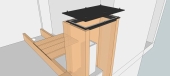
see sketchup file in attachment.

A double brick bell is not possible due to size restrictions. I may add a layer of loam to the brick bell as finish, not sure yet.

I based my design on the 150mm shorty core, found here on this forum. Thanks to Peter van den Berg.
I tried to upscale to a 7"/175mm size.  
Using a Base value of 12.66mm, Internal Surface Area (ISA) ideally 7,2m².
My current design has 8,24 m² ISA (excluding the sides that face interior house walls), but by playing with the main bell height I will hope to come closer to the 7,2m².

Questions
#1 Foundation and floor construction:
Do I need an extra slab of concrete and insulation as a base for the RMH?

I guess the primary need would be insulation, since the foundation is already suited for the heavy weight.
As a precaution I will definitely provide extra support in the basement beneath the main bell.

The floor construction (see sketchup) consists of concrete slabs. (steel reinforced), a layer of 6 cm PUR (polyurethane) and finally a layer of 6-8 cm cement base-floor with a ceramic tile as finish.  
All floor has this construction except for the odd-shaped area where I planned my RMH, where I now planned my main bell. that area has no PUR, and 12-14cm of cement base-floor that should be well capable of holding the weight.

The rest of the floor contains heat-piping. except for the part below and between the RMH and the chimney.

Should I insulate between the bench bell and the floor? The heat-pipes are about 5 cm deep (1cm tile, 4cm cement basefloor). What temperatures will reach the pipes, could this be an issue without insulating? I I'm not mistaken they can handle 95°C.

#2 Chimney:
2a) The existing chimney is a brick and mortar, lined with cement. internal dimensions are 24x29cm/9,5x11,4”, length 5.5m/18ft. (rough estimate) useful as is for a 7" system? I know a flue pipe would be better but this may be fine? The previous fireplace had a 200mm flue pipe of 1m into this chimney.

2b) Do I need a bypass for cold starts?

#3 Interior wall Insulation
The main bell will be as close as possible up against a interior wall of plastered brick and mortar.
Do i need to insulate between the bell and this wall or just consider it as extra mass?
Perhaps leave a small air gap, place a metal heat shield or insulate some way.

In the design I left a small air gap of 1 cm. I don’t mind some heat to go into this wall since it’s an interior wall and it’s basically a brick and mortar pillar supporting the ceiling. I don’t expect much heat loss here.

#4 Door frame air intake
I increased the air intake slits left and right in the door frame but have no idea how to calculate the correct air intake volume. I just increased by ratio from a 5" to 7" system. What’s the formula for this please?

#5 Core And Bell
If anyone could check, are the dimensions of the core and bench ok for proper "air/gas" flow to the chimney?

Thanks in advance for any input. I really appreciate the help.
Filename: RMH.skp
File size: 854 Kbytes
stove.jpg
[Thumbnail for stove.jpg]
stove3.jpg
[Thumbnail for stove3.jpg]
stove4.jpg
[Thumbnail for stove4.jpg]
 
pollinator
Posts: 80
Location: North italy
54
bike wood heat rocket stoves
  • Likes 4
  • Mark post as helpful
  • send pies
    Number of slices to send:
    Optional 'thank-you' note:
  • Quote
  • Report post to moderator
Hi kabouter,
I'm answering you based on my current knowledge and constructive experiences.


I tried to upscale to a 7"/175mm size.  
Using a Base value of 12.66mm, Internal Surface Area (ISA) ideally 7,2m².
My current design has 8,24 m² ISA (excluding the sides that face interior house walls), but by playing with the main bell height I will hope to come closer to the 7,2m².


I think it's a bit too much, 7.2m2 is the maximum value considering all the internal surfaces excluding the floor and the core


Questions
#1 Foundation and floor construction:
Do I need an extra slab of concrete and insulation as a base for the RMH?

I guess the primary need would be insulation, since the foundation is already suited for the heavy weight.
As a precaution I will definitely provide extra support in the basement beneath the main bell.

The floor construction (see sketchup) consists of concrete slabs. (steel reinforced), a layer of 6 cm PUR (polyurethane) and finally a layer of 6-8 cm cement base-floor with a ceramic tile as finish.  
All floor has this construction except for the odd-shaped area where I planned my RMH, where I now planned my main bell. that area has no PUR, and 12-14cm of cement base-floor that should be well capable of holding the weight.

The rest of the floor contains heat-piping. except for the part below and between the RMH and the chimney.

Should I insulate between the bench bell and the floor? The heat-pipes are about 5 cm deep (1cm tile, 4cm cement basefloor). What temperatures will reach the pipes, could this be an issue without insulating? I I'm not mistaken they can handle 95°C.


The floor isn't usually considered in the ISA calculation, so I don't think there will be much heat there. In my latest project, I didn't insulate the floor; I built directly on the reinforced concrete floor.
As for the heating pipes, I don't know...


#2 Chimney:
2a) The existing chimney is a brick and mortar, lined with cement. internal dimensions are 24x29cm/9,5x11,4”, length 5.5m/18ft. (rough estimate) useful as is for a 7" system? I know a flue pipe would be better but this may be fine? The previous fireplace had a 200mm flue pipe of 1m into this chimney.
2b) Do I need a bypass for cold starts?


Here you'll find a perfect answer to these questions: https://permies.com/t/280600/Wooden-ladder-rmh#2981470
In your case, you get a useful circular cross-section of 26.26 cm. I think that's a bit too much for a 17 cm system


#3 Interior wall Insulation
The main bell will be as close as possible up against a interior wall of plastered brick and mortar.
Do i need to insulate between the bell and this wall or just consider it as extra mass?
Perhaps leave a small air gap, place a metal heat shield or insulate some way.

In the design I left a small air gap of 1 cm. I don’t mind some heat to go into this wall since it’s an interior wall and it’s basically a brick and mortar pillar supporting the ceiling. I don’t expect much heat loss here.


If they're internal walls, I'd consider them extra mass.
In my latest build, I left 5 cm of space between the bell tower and a pillar. I didn't like the idea of ​​overheating the load-bearing structure of the house.

#5 Core And Bell
If anyone could check, are the dimensions of the core and bench ok for proper "air/gas" flow to the chimney?


from the latest constructions it seems that the double skin is necessary only for the front wall at the exit of the core.

I'm not entirely convinced by the current layout, especially the connection between the bench and the main bell. Maybe I would try to consider it all as a single bell but I don't have enough experience to recommend a solution.
The only thing I would try is raising the core off the ground for easier use (one of the best advantages of Shorty) and perhaps rotating it 90 degrees.

I hope I've been helpful. I wish you the best for this new project of yours.
Cedric

 
Posts: 84
13
  • Likes 2
  • Mark post as helpful
  • send pies
    Number of slices to send:
    Optional 'thank-you' note:
  • Quote
  • Report post to moderator

Kabouter Klus wrote: Hi everyone, greetings from Belgium.


Dag Klus. Van welke provincie ben je?

Kabouter Klus wrote:
I assume it's best not to install the RMH in proximity to the underfloor heating pipes as they are at shallow depth +- 40 mm/1,57”.


I don't believe the multilayer pipe will get that hot. The bottom of the bell will be the coldest + the screed (chape) should help dissipate any heat. What i did was put 10 cm Ytong below my bell walls to insulate. Possibly even better, would be to put down foamglass insulation and build on top of that. Personally I would have left out the 12 cm of screed and built the heater immediately on the concrete vaults, but now that it's there, it will probably be fine. For your first layer (ytong/foamglass), you could lay down a mortar bed and press a 'chapenetje' (steel screed webbing) into it for some extra strength.

I am doing something similar as you with the external air supply. Peter has mentioned multiple times that adding external air immediately into the stove is creates more problems than it solves. 80 mm is too small in any case, for your stove.


Cook top - then you are looking at a Shorty core.
Oven: I believe I've seen a post passing by saying it's very hard to get them to work properly (usually they stay too cold). There is an article by Yasin Gach somewhere. Firebox = better solution to use this as oven.
I cannot open your skp file apparently, if you are building a heated bench, you should make the hole to it from your main bell as high and wide as the bench itself.

Lining and insulating the chimney is best for good chimney pull and to avoid this surface must be counted in the ISA.
Bypass - not strictly necessary if you are building a 1st gen batchrocket but I've read it can be helpful. Required for shorty core.

Kabouter Klus wrote:
[b]#5 Core And Bell

If anyone could check, are the dimensions of the core and bench ok for proper "air/gas" flow to the chimney?


Do you have a screenshot of the heater, cross-section from top view, where the gases are flowing past the core, including dimensions?
 
J Broekx
Posts: 5
1
  • Likes 3
  • Mark post as helpful
  • send pies
    Number of slices to send:
    Optional 'thank-you' note:
  • Quote
  • Report post to moderator


I think it's a bit too much, 7.2m2 is the maximum value considering all the internal surfaces excluding the floor and the core


Okay, so that ISA value of 7,2m² is a maximum. And all surfaces count, except for the floor and core.
That means I have to include the surfaces facing the interior walls from bell and bench making the total even larger than 8,24m².

Here you'll find a perfect answer to these questions: https://permies.com/t/280600/Wooden-ladder-rmh#2981470
In your case, you get a useful circular cross-section of 26.26 cm. I think that's a bit too much for a 17 cm system


Thanks for the link. I will have a look.


from the latest constructions it seems that the double skin is necessary only for the front wall at the exit of the core.


I didn't know that. It makes sense, that the greatest heat is hitting of the front wall and the top of the bell.


I'm not entirely convinced by the current layout, especially the connection between the bench and the main bell. Maybe I would try to consider it all as a single bell but I don't have enough experience to recommend a solution.
The only thing I would try is raising the core off the ground for easier use (one of the best advantages of Shorty) and perhaps rotating it 90 degrees.

I hope I've been helpful. I wish you the best for this new project of yours.
Cedric


Thank you Cedric, very helpful input.
 
gardener
Posts: 1201
Location: +52° 1' 47.40", +4° 22' 57.80"
662
woodworking rocket stoves wood heat
  • Likes 7
  • Mark post as helpful
  • send pies
    Number of slices to send:
    Optional 'thank-you' note:
  • Quote
  • Report post to moderator
J. Broekx (Jan?), I've had a look at your drawing. The core isn't correct, most of the details inside the riser are missing, the liner in the lower part as the obvious one. It won't work like drawn, sorry about that. I could provide you with a correct drawing of the core, although times are very busy now.

The opening between the bell and the bench is not large enough and not in the correct place. It's obvious you are thinking in guiding the gas stream, not the right way when trying to build a properly working bell system. It's a pity the space for the heater itself is already fixed, other possibilties are excluded by this.

A solution to this painting-yourself-in-the-corner problem could be this: place the entire sides of the bell that are facing the bench on pillars, as high as the internal height of the bench. This will provide for a lot of openings for the hot gases to stream into the bench freely. The top of each opening should be flush with the ceiling of the bench, no thresholds or obstructions there, please.

The exit to the chimney should be in the lower half of the bench, preferably shaped as a funnel. Wide at the side of the bench and narrower at the side of the chimney. To complicate matters, the possibilities for a bypass are very limited, to say the least. This could be (partly) solved by having a bypass valve in the upper part of the bench, making a second opening to the chimney necessary, including a sliding(?) valve to open and close it.
Or a purpose-built channel from the upper part of the bell to the chimney, that would be the ideal solution, although not the best for looks.

The entire bell could be built out of the same bricks on flat, only right opposite the core's exit it would be wise to install a liner with firebricks on edge. Even the bell ceiling could be done in the simplest way: steel T-bars, ceramic paper and dry laid bricks on edge. On top of that, a layer of 25 mm superwool OR two layers of 12 mm superwool, finished off with a layer of dry laid bricks on flat.

In my opinion, the chimney shouldn't be trusted as it is, a flexible stainless steel lining would be in order, the entire height of of the vertical chimney. And, in order to transform it into the best, filled around with perlite or vermiculite.
 
J Broekx
Posts: 5
1
  • Likes 6
  • Mark post as helpful
  • send pies
    Number of slices to send:
    Optional 'thank-you' note:
  • Quote
  • Report post to moderator
Thank you Julian, Peter.
My name is Joris.
Provincie Limburg.

Nothing to hide here. Just didn't realise a Nickname wasn't allowed.
Even a funny one.

I will make some adjustments to the design today.

I already assumend that a bypass would have to be placed in the upper bell part to be functional. Best that i use a 175mm diameter lining for the chimney than i guess?

No cooktop/oven is fine, the firebox will have to do on the odd occasion.


J Broekx
Posts: 5
1
  • Likes 4
  • Mark post as helpful
  • send pies
    Number of slices to send:
    Optional 'thank-you' note:
  • Quote
  • Report post to moderator
I corrected the core design. That took more time than anticipated. lol  The other adjustments will be for another day.
Now the core is pretty ok i think.

I'm unsure about height of the riser and the position of the exit port.

All other dimensions are as should be I believe.
Maybe not the port height. that's a bit larger than calculated.

Base value B = 12,66 cm

Firebox:
Width 25.3 (2B)
Height 37.8 (3B=37,98)
Depth 55.1 (4B to 5,5B; 50,6 -> 69,9)

Port:
Height 27 (2,1B=26,6)
Width 6,3 (B/2)
Depth 12,6 (B)

Riser:
sides 25.3 (2B)
Height (5B=63,3) ?
where is this measured. At exit port or at ceiling of riser?
exit port starts at 54 and ends at 62
riser ceiling is at 70


Filename: Shorty_7_Core.skp
File size: 297 Kbytes
 
J Broekx
Posts: 5
1
  • Likes 3
  • Mark post as helpful
  • send pies
    Number of slices to send:
    Optional 'thank-you' note:
  • Quote
  • Report post to moderator
Hi, a small update.

I'm still playing around with possible designs that fit best in the designated location.

Currently I'm sketching with a sidewinder core that has doors/window on both ends.
Question, is there a margin where the riser can be placed relative to the firebox. Or is the only option at the total rear-end of the firebox?
If so, how far can i go from the rear-end with the riser port entry;

I took a closer look at my chimney. There are 2 chimneys next to each other
1. an old, out of use, lined with a single flue pipe of roughly 150mm, starts at basement level => so i could potentially use this if I build a smaller size core.
2. the one i described above earlier. The top part of the chimney seems to become more narrow to about 220x220 square.
It could be lined with a 180mm flexible flue pipe I believe.

greets.
 
Julian Adam
Posts: 84
13
  • Likes 4
  • Mark post as helpful
  • send pies
    Number of slices to send:
    Optional 'thank-you' note:
  • Quote
  • Report post to moderator
Hi, see-through sidewinders have been built. I believe they are usually executed by putting the port in the middle of the firebox depth and splitting the total air amount over the two air inlets. If you are fabricating a door and airframe yourself, this means twice the work, though
https://youtu.be/cly0VlIBcS0?si=0GH_ougJbp-t4vkS
 
Julian Adam
Posts: 84
13
  • Likes 4
  • Mark post as helpful
  • send pies
    Number of slices to send:
    Optional 'thank-you' note:
  • Quote
  • Report post to moderator
Another beautiful implementation to be found on Peter's file-sharing platform:
https://pberg0.home.xs4all.nl/pictures/Vrijlemerij/DSR3%20sidewinder/
It shows the same message: a lot of extra work but can give an amazing result.
 
I found some pretty shells, some sea glass and this lovely tiny ad:
Looking for cold-climate growers to join a GOOF livestream panel (Missoula)
https://permies.com/t/369111/cold-climate-growers-join-GOOF
reply
    Bookmark Topic Watch Topic
  • New Topic