Josh Warfield

+ Follow
since Sep 26, 2023
Merit badge: bb list bbv list
Biography
long time van dweller, excited new landowner, absolute beginner gardener
For More
Egnar, CO -- zone 5ish, semi-arid, high elevation
Apples and Likes
Apples
Total received
In last 30 days
13
Forums and Threads

Recent posts by Josh Warfield

I have too much time on my hands so I've read more than most beginners ever will (and to be clear I still count myself as a beginner), and Lofthouse's "Landrace Gardening" is by far the most readable summary of / introduction to how I have come to think about gardening. To be honest, I read it after I had already learned the majority of the concepts that it introduces, but I thought it described most everything I'd learned up to that point in a far more succinct manner than anything I'd come across previously. I know Joseph is on these forums, so hey there if you see this, thanks for putting in the work to write something easy to read and also clear and helpful.
2 weeks ago
For reference, here's some of the structures I was talking about that have lasted 8 centuries after being abandoned: https://www.nps.gov/meve/planyourvisit/cliff_dwelling_tours.htm

One thing these all have in common is that they're kinda "cheating" by being built beneath a natural rock overhang, so they will only ever see water if it's raining sideways. Which only happens maybe once every year or two in this region.

But if you look closely (and I have gone on one of these tours and looked closely in person), you'll see no bond beams, no foundations, just stacks of flat-ish rocks with nothing but mud as mortar. I don't want to oversell this, because again, the natural rock overhang is kinda cheating. On the other hand, the people who built these couldn't just go to Home Depot and get galvanized steel roof panels for 20 bucks apiece, so of course they were limited to using the natural terrain.
2 weeks ago
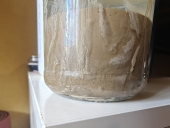
Okay one more thing to add. If I really had to, I would look at your jar and say that the bottom 1/3 or so has sand particles in it, and above there it's mostly clay. The sand stands out because you can see black specks and shiny specks, whereas the clay particles are microscopic so it all blends into one averaged-out color. Silt is somewhere in the middle and not as easy for me to distinguish based on a photo.
2 weeks ago

Cristobal Cristo wrote:if such things lasted, people would be glad to eliminate it long time ago, because foundations are costly, but the reality is different.


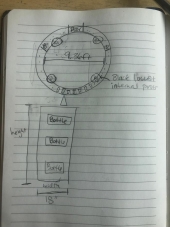
For sure, this would be true if there were no such thing as building codes. My main contention is that the actual logistical requirements of making a durable structure is highly context-dependent, and US building codes are meant to cover about a third of an entire continent, so they're almost guaranteed to be overly broad. The structure I build in Southwest Colorado might last my lifetime, but fall apart in a couple years if I built the exact same thing on the coast in Oregon.

Cristobal Cristo wrote:It has to be supported by something, because it will sink unevenly and it will crack, especially in loose//not compacted/clay soils.


Loose and not compacted, I have no clue about. My subsoil may as well be adobe brick. I've never dug into the ground in Wisconsin so absolutely the OP's context may be completely different. On the other hand, my clay soil definitely absorbs a huge amount of water, and therefore freeze/though ought to be a concern. But I have not so far seen any winter damage on the small foundations I've built, and the sketch from OP is not much larger than those. My theory is that a 6x8 foot rectangle of 10 inch thick cob is sufficiently strong as a unit, that it's not likely to crack no matter how much the dirt might shift underneath it.
2 weeks ago

Cristobal Cristo wrote:For such test I was using 3 times more water than soil. Shaking for 10 minutes and left for 3 weeks.

Based on my experience with my local dirt, and a good amount of reading about the general topic, 3 weeks is way longer than you need to get a general idea. After a few minutes, sand will settle out. After a few hours, silt will settle out. If it's been more than a day, and there are still clay particles in suspension, then you've got an unusually fine clay but the final ratio probably won't change significantly if you leave it longer.

Some say that adding soap will make things settle out faster. I have not noticed a difference with my local dirt.

All that said, I generally think that the jar test is a bit over-sold. Different particle sizes settle out at different rates, yes, but any given dirt is composed of a broad gradient of particle sizes. It's not like it's 30% particles of exactly 50 nanometers, and 40% exactly 10 micrometers, etc. So there's no good reason to expect sharp distinctions between sand/silt/clay which will be obvious to someone who's never looked at this sort of thing before.

In my opinion, it's more useful to do tests that are more specific to what you're actually trying to do with this dirt. If you're trying to make adobe bricks, for example, just go ahead and make two or three of them, and after they're completely dry, drop them from hip height onto the ground. If they don't break, then they're strong enough to build a wall out of them.
2 weeks ago
I've been living for nearly a decade in a van (Ford Transit) which I built out myself. The main reason I would never want to live in a commercially manufactured RV is that much of the interior tends to be made with oddly specific custom components. The sink drain isn't just a regular sink drain, it's a special RV sink drain. Likewise for the breaker box, and the propane connections, and the door hinges and handles. If anything ever breaks, you probably can't just go to the nearest Ace Hardware or Home Depot and get a one-for-one replacement. You need to find a special RV parts store, and even then there's a good chance that they'll have to order the part and you'll need to wait for it to ship. And it will likely cost twice what the equivalent thing would cost that isn't the "RV version" of the thing. I strongly prefer my house to be built with components that are as easily replaceable as possible.
2 weeks ago
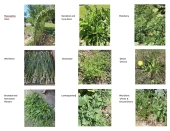
I choose to let most "weeds" grow, as if they were a cover crop, because in my climate having anything green putting roots into the ground is better than nothing. Before I make the decision to pull them out or let them be, I try to find all the information I can about whether that species has been utilized by anyone for food or some other useful purpose. In North America, http://naeb.brit.org/ is an excellent resource for this sort of information.

But my gods, I really wish my local species/subspecies of lambsquarters tasted better than it does. I haven't tried cooking it yet, because cooked greens in general aren't really a part of my cooking repertoire. But compared to raw spinach or lettuce or kale, the raw lambsquarters has an unpleasant astringency that I just can't get over. I guess some people like that in their food, but it's not for me.

Like Thom said, I'm more interested in verified tasty plants that have the potential to survive without me babying them. For example this spring I have arugula that self-seeded and is growing like a weed, so I'm 100% going to lean into that and see how much free salad I can generate next spring.
2 weeks ago

Mark Reed wrote:That sounds sensible to me except I don't know what processing oats and barley means.


I think what people are referring to with this is that there are several steps, some of which are potentially finicky, to turn grass seeds into food. Versus a squash or a potato which you can just cook and eat immediately after harvesting the plant. And the degree of finicky-ness scales up with the size of your harvest. In my current stage of experimentation, I don't mind spending 20 minutes separating seed from chaff just to get seeds to plant for next year. If I were actually trying to survive off of this for multiple years, it wouldn't be a matter of hours, it would be a matter of days or weeks, or maybe even months in the extreme case. So if I had a choice, in the context of my climate, between growing a million calories of potatoes and a million calories of oats or barley, then the potatoes would hands-down take less total work.

Christopher Weeks wrote:

Josh Warfield wrote:Does [corn] have less micronutrients than broccoli or carrots or something? I dunno, probably.


My impression is that there are something like 10,000 phytonutrients and we know a little about how 130 of them work in the body. This is probably genuinely unknown. But if you're into corn and into micronutrients, start your journey by selecting for a mix of deep colors.


Yep, varied colors is one of the few selection criteria I have, if I ever have the opportunity to select for anything other than "does it survive and produce seed." It kind of pains me how un-scientific it sounds, but I don't have the tools (or, let's be honest, the attention span) to actually scientifically evaluate the nutritional content of a given fruit or seed. But from what I've read, it does seem that there is a legit correlation between varied colors and varied micronutrients. And even if that turns out to not be true for whatever specific plant I'm growing, who doesn't like colorful food? At worst, varied colors are a pretty strong indicator of genetic diversity.