
Peter Alewine

+ Follow
since Dec 27, 2024
Merit badge: bb list bbv list
For More
Apples and Likes
Apples
Total received
In last 30 days
0
Forums and Threads

Recent posts by Peter Alewine

UPDATE v2.5:

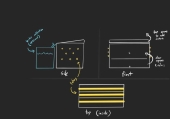
Instead of doing flat partitions to slow and guide the water, I'm now planning to use trays. This will actually hold on to water longer term, kind of like Ollas would have. They will be tilted so that after one tray fills, it runs over into the next one, then the next one, and so on. I bought some aluminum food trays from the store tonight to use in my test run. May just keep them for the real thing, not sure.

Also figured out how I want to join the sides. Initially I put some 90* metal pieces and screwed those in, from the inside. But I didn't like how that was turning out. So I changed gears and used thin wood at the corners, and joined those with screws from the outside. I think that's the winning strategy. Allows me to use variegated wood colors too, which is always a nice effect.

Here's a picture of how a tray would be tipped. Then, if you can imagine, below it, there would be another tray, starting on the left and tipped downward to the right. To make a stair-step effect.

QUESTION: do you think having a small pool of water in those trays is good or bad?

-- Possible reason for it being bad: having pools of water could lead to root rot.

-- Possible reason for it being good: the biggest problem I should worry about with these towers is drying out. This will help prevent that.
3 days ago

Tony Hawkins wrote:My techniques are pretty lazy, we just have a large stainless steel mixing bowl on the counter that generally gets emptied every day.


Do fruit flies not multiply and swarm around? They do in our house, even when we cover the kitchen compost bin.

I'm out here looking for a better way to do the "accumulate until it's time to take it out to the pile" step...
4 days ago

Hayley Stewart wrote:Hey! It's been a LONG while but I am here to report that winter sowing is my new favourite thing.... winter sow all the things.


Can you elaborate on how you winter sow? Also, what have you learned / changed since this comment was made 3 years ago?
I did a bunch of research on whether to use soil blocks or traditional seed trays. The ideal would be something that has the "good parts" of both:

- air pruning (from soil blocks)
- ease of filling, watering, and using  (from seed trays)

And none of the downsides:
- having to make a specific soil consistency (soil blocks)
- doing the same mechanical motion over and over many times (soil blocks)
- worrying about the block falling apart if you don't water it correctly (soil blocks)
- plastic (trays)
- trays breaking after a few seasons (trays)
- root bound plants (trays)

I didn't see something that met these ideals. So I decided to invent it! At least, I'm going to try. Here's what I'm thinking:

I want something that will:
- hold soil in place (like a traditional tray), but
- allows air to permeate on all sides (like soil blocks), and
- is not plastic (I'm trying to get away from plastic near my food as much as feasible). Bonus if it
- allows water to wick up for bottom watering.

My idea is to use food-grade stainless steel mesh to form the "pouches" to hold soil. With some solid stainless steel rings at the top to help hold their form, and join them to neighboring cells/pouches.

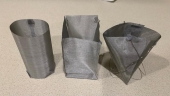
I bought some 400 mesh to test the idea. It might end up being too fine (too fine = not enough airflow). Still playing with shape and size. I made 3 possibilities (warning: ugly prototype incoming). Cylinder, square, and a pouch. None have solid rings yet, but that can come later. Pictures attached.

Feedback welcome.
1 week ago

William Bronson wrote:
Water at the base would need to wick a long way up through the separate pieces of terracotta in order to keep the top of the tower moist.
Maybe a terracotta sewer pipe or a sewer pipe cast from mortar mix would work as a single  seamless tower olla.


I actually had previously thought about a terracotta pipe, going down into a large olla at the bottom. But after reading a bit more about these towers, it seems the top is actually the part that dries out fastest, and thus would need the olla. So maybe a thin pipe going only about halfway down could help with that.

But I can't find anywhere to buy a terra cotta pipe. Do you know of a place?

Also I had thought that terra cotta would help with vertical wicking, but an internet search tells me it will only wick a few inches upward. So it won't solve that problem of mine. The current design just tries to slow down the water as much as possible on the way down, and not worry about upward wicking. But I would love to get upward wicking on the order of 5-6ft.
1 week ago

Mike Barkley wrote:I like the V2.0 concept. It would probably help to use some sort of wicking or drip irrigation.


Yes, drip irrigation is on my to-do list of garden improvements to add! Not sure when I'll get to it, but I definitely want to do it.

Your hugelkulture mound was interesting to read about!
1 week ago

Michael Cox wrote:I've built a couple of these and they work well. They do need regular watering through the summer, and good soil. I initially didn't use good enough soil and the plants struggled. This year I'm getting a few good strawberries each day from 2 barrels.


That's an interesting approach. I like how he puts the Olla in there. I may do that too if I have room in my newly-skinnified design.

For my own stuff, I'm trying to stay away from plastic as much as I can. It's a challenge! Currently for the body I'm using White Oak with Tung oil coating. Researching to decide what to use, and then obtaining the wood, cutting it, staining it... has all been a lot of work. But I've learned a lot in the process, so that's good. Still, it would be so much easier to just use plastic!   Hoping my wood setup will have good longevity, but we'll see.

Can you elaborate on your soil comment? What about it was not good enough? And what did you change to improve things?
1 week ago

Nynke Muller wrote:
However, the dowels are wood without bark. I think you need the bark, because the part between the bark and the wood, is where the water is transported.


That's a great point, one I had not considered. I just always assumed the entire body of the wood would be transporting water and nutrients. But upon further research, it looks like there's an outer band that is lighter in color and called the "sapwood" and this does the transporting. The inner ring, which is darker, does not, and is called "heartwood". So I may need to find a piece of wood that has sapwood intact and try again!

For the record, the bark itself does not seem to actually be important in transporting. It only serves as an outer protective layer. Sapwood is a region beneath the bark - this link has a good illustration of it. https://www.britannica.com/science/sapwood

Can you tell me about your own experiment?
1 week ago
UPDATE:

I put together the shell of v1 (the initial drawing) and put it out in the yard to see how I liked it... but it didn't look good in the space I wanted to put it. So I went back to the drawing board.

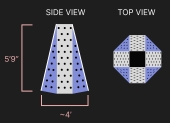
I'm now thinking of doing 3 skinnier towers. Based on feedback about  watering and soil compaction, I'm thinking about putting in "shelves" for each plant. This would slow the water down as it flows through the tower, hopefully allowing the soil to hold onto more. If I make the shelves sturdy enough (like screwed in on 3 sides), it would also help with soil compaction because each section of dirt would be supported by its shelf.

Here's an image of Strawbelisk v.2 (below)

As before, I appreciate feedback! Always better to hear about things that can go wrong before I actually make the thing and stick a bunch of plants in it
1 week ago
Yeah, this is way bigger than anything I'll probably ever do, but I'm interested in the process you're doing; give us updates! Maybe make a video or two about it and put it on Youtube.
1 month ago