
ross. mckay

+ Follow
since Mar 04, 2026
Merit badge: bb list bbv list
Biography
Building a hemp house and a permaculture gardens on a 2700m2 block with degraded soil, poor aspect, 1:4 slope in a bushfire zone
For More
Surf Beach NSW Australia - Mild temperate historically
Apples and Likes
Apples
Total received
In last 30 days
1
Forums and Threads

Recent posts by ross. mckay

I spoke to the contractor who is doing the earth works on my block prior to building and his estimation is 30m3 of topsoil and vegetation to be stockpiled. So I have to do this at scale.

I’m thinking about three Jean Pain style compost heater piles. Layer branches at the bottom to allow air in. A layer of brown as spoil, layer of green - food waste, manure & coffee. Sprinkle of charged biochar, a layer of seaweed for minerals, layer of soil - repeat except for branches.

Run a few stakes from base to top while building to allow for airflow.

All layers appropriately moist.

I haven’t figured out what to use as an outside buffer, straw isn’t cheap here.

This will run over winter and should be ready to use by next summer.

Any suggestions or critiques welcome
1 week ago
I’m going to try this on spotted gum posts that are great above ground but less so in. Thanks
1 week ago

Joao Winckler wrote:The seaweed is a massive advantage if you can get enough of it. Sandy soil eats organic matter fast though so don't expect it to hold onto improvements the way clay does. Honestly the best thing I ever did with poor soil was just keep mulching and let the worms do the work, trying to mix stuff in properly was a waste of time compared to just piling it on top.


That’s interesting. I have a seam of clay down on the lowest corner but haven’t looked at the rest of the block. I’d assume that the infiltrated water would follow along that seam.

What can I do with that information? Is there a blend I could make?

What about accessing the water that follows the seam?
2 weeks ago


Thanks John, excellent advice. I’m looking for a slow and small solution at scale. I maybe also be wildly over optimistic about the amount of time I’ll be able to spend on this project while building a house.

We’ve had some pretty decent storms and I’ve seen the surface runoff is minimal so the droughty advice is so what we want. We’re capturing water with our site works but there’s also a band of clay on one part of the site so it might be elsewhere Planting the tree in holes works too.

I’m contacting local horsey people to see what they have available. I’m not sure about the local zoo which has mixed carnivores and herbivore waste. Biochar feedstock won’t be a problem. We can burn from April to October so that will be making it frequently in a cone kiln.

Probably will get a little loader to do the mixing and I’m looking for a hot pile in sections so we can manage that fast process. I’ll add the char with the manure as adjacent.
Water is a must I agree.

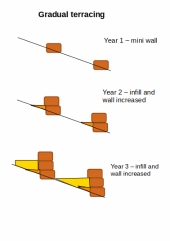
I can get one 70m swale and a couple other shorter ones, plus a mulch detention pond and some Vetiver grass for around the driplines of the 3 trees they allowed me to keep. we’re at 1:4 slope so our terraces are going to be 1500 across.
2 weeks ago
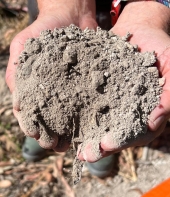
I’m building a house on an infill suburban block. The soil as shown in the photo is pretty degraded and is sandy with very little organic material.

When we excavate the first thing is to remove the top layer which will be 50/50 existing organics and this soil. Organics are grass and shrubs and leaf matter from the eucalypts.

I plan to windrow this outside the building zone and use the 12 months or so I’ll be building to improve the soil.

I’ll have access to seaweed, waste organic material such as coffee grounds and fruit and veg. I’m spending the cooler months to make biochar from the tree tops as well.

My thoughts are that I can have a couple of windrows and put the organics and biochar into the space between the rows. I can then mix from either side to make a mix and hopefully hot compost mounds.

Is this a valid plan? Anything else I should be adding, not adding or doing?

Edit: I should have said I’m building a Jean Pain style compost heater for the first 5 years or so and that’s going to produce about 10m3 of humus each year.
2 weeks ago
I’m felling 22 mature eucalypts on my block as soon as I start clearing.

My plan in no particular order is
Stumps removed off site where out of the ground
Left in and turned into mushroom stumps otherwise
- Trunks milled for construction
- Heavy branches down to 125mm gifted to neighbour for firewood
- 125-75 dia cut to 1m and used as mushroom logs
- 75 down to 20 used for check terraces and backfilling à la hugelculture
- Tops - dried for biochar ie 50mm down to leaves

Oops, sorry I went off the topic at hand while I was waffling about my own situation. The hugelculture beds I’ve made last spring use eucalyptus and black wattle. I haven’t noticed any issues with it. Should I keep an eye out?

2 weeks ago

Nancy Reading wrote:

ross. mckay wrote:If it's shallow just do swales.


That is a great suggestion for sinking and slowing the water - welcome to permies ross!


Thank you Nancy. Looking forward to being part of the community instead of just an observer
2 weeks ago

Christopher Weeks wrote:How steep does a slope have to be to realize benefits of terracing? If my field drops six feet of elevation over 100 linear feet, does that merit intervention for any reason? It seems fine undisturbed, but I could be missing something. I've even been trying to decide if I should create a flat terrace for a high tunnel or just let be slightly sloped.


If it's shallow just do swales.  The terrace occupies less space on a steep slope. I wish I could do swales instead of building check terraces, it would be a lot easier
3 weeks ago