

|

|
|
|
|
Jeff Peter wrote:Howdy~
Thanks to y'all, I have a grasp on how legumes use nodules on their roots to work with soil life to convert atmospheric nitrogen into nitrogen available in the soil that other plants can use.
Read something intriguing, though that leads to my question. What I read, in a description of fieldpeas, stated that harvesting the peas, for eating or planting later, removes much of the nitrogen produced by the plant.
Are they differentiating between the nitrogen fixed in the soil by the roots, and nitrogen carried in the above ground plant?
In other words, where is the greatest benefit in available nitrogen from legumes coming from? The roots, or the above ground biomass? Both?
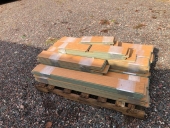
Pearl Sutton wrote:My neighbor is replacing the flooring, dumpster being filled with that fake wood laminate plank stuff. I don't need any right now or I'd be snagging a bunch.
If you take 3 or 4 pieces of it, laminate them together by running screws through the stack from both top and bottom, it makes excellent shelving boards. I have a lot of them in use in my pantry, from last time a house near me got theirs pulled out
Highly recommend trying this, and I'm sad that I don't want to get any, but I just don't.
The stuff also would probably make a good interior for a shed, I've used it for smothering weeds in the yard, and with my hatred of waste, I HATE seeing the stuff tossed when it's just not as pretty as it was. I haven't seen any tossed for serious damage, maybe one or two bad spots, so they clear the whole floor and replace it. It's very reusable.
Eric Hanson wrote:And so far it looks like it will stay a dream for a while.
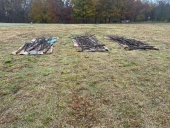
I think I have mentioned before that I need to move my garden beds as the current ones are located in a place where it is hard to get a fence to wrap around. My new area is in my tall, grassy area and I designated three of six future beds in fall by laying down cardboard and laying some branches on top so as to smother the grass underneath.
Strong winds blew the branches and cardboard right off the ground and into the air!
And unfortunately, while I would like to have started the beds this spring, it looks like I am going to have a neck surgery soon--I am getting a disk replaced between C6 and C7 due to having broken my C6 when I was 15. And this likely means that I will not be doing any heavy-exertion type of activities until late summer.
In the meantime I ordered some Crimson Clover (inoculated) and some daikon radish to prep the ground in advance.
I hope to get some pictures soon.
Eric
Edited to add:
I added pictures of the first three patches that will become garden beds. There is a pile of brush in the background that will become mushroom food.
Blake Lenoir wrote: Good evening folks! How are you? I'm looking for ways to combat higher fertilizer prices in an organic fashion without the chemical types and help others cope with the uncertainty in the world right now.
How can we create fertilizer for commercial use without chemicals and help grow crops quickly into autumn? I wanna help my community and others as much as possible. Please reach me on this forum if you need me. Good night!
Ashish Mukherjee wrote:Hi,
I was wondering what kind of small-scale technology exists for recycling multi-layer plastic packaging often used in food.
Regards,
Ashish
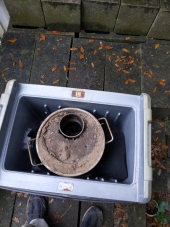
Mart Hale wrote:Today I decided to test out making a sand battery. I had this old pot with a hole in the bottom, I then took two cans cut out the bottom on those and put inside the pot over the hole then filled the pot with sand fir the first layer. Second layer I cut down the can a bit so it would fit in the pot and I laid in another layer of sand. For this first go around I had temps at the bottom at 325 degrees and at the top at 165 degrees.... After this I brought is inside put a welding blanket inside the cooler and put the pot inside.... I noticed a large amount of moisture building up inside the cooler, which figures as the sand I used was from outside. I am formulating how I could improve the heating of the sand was a fun experiment.
Bob Nall wrote:I'm curious if anyone has solar panels in a field approx 200+ feet away from their home. What is the preferred method for transferring power to the home inverter and batteries? Has anyone experimented with voltage drop at those distances? I was recently watching a youtube video on a water generator and he said something interesting, "if transferring power at the same voltage, DC is actually more efficient than AC." This goes against what many of us believe but it seems there is some truth to it. So it seems the higher the DC voltage I can transmit it at the more efficient it will be and I will also not have the restriction of eddy currents as I would in AC. Has anyone ran high voltage solar DC wiring at length? I am able to input 2 165V DV inputs into my unit, but I also understand at this point the DC voltage is getting to a "not safe" point. Obviously roof mount is an option but requires a lot more code and inspection processes.