Chance Lunceford

+ Follow
since Jun 13, 2013
Merit badge: bb list bbv list
For More
Apples and Likes
Apples
Total received
In last 30 days
14
Forums and Threads

Recent posts by Chance Lunceford

Joao Winckler wrote:Primocane fruiting on an erect type is interesting. Most of the primocane options I've looked at are trailing or semi-erect, so having something upright that doesn't need a trellis would be a nice change. Any idea if it's available to buy yet or still trial-only?


You can purchase at Pense (link above) for next year, and Raintree might restock next year. The other vendor I linked above I have no experience with.

It's pretty new, but is gaining steam. I expect a few more vendors to pick it up next year, but I can't say who will or won't.
14 hours ago

Joao Winckler wrote:That sounds incredible, I'd have grabbed every seed I could find. Plum seeds tend to germinate pretty reliably with a winter outside in moist sand, the hard part is the wait to see what the seedling actually produces. Could be years before you know if it kept any of that citrus flavour.


It's only hard if you make it hard, eh Joao? Otherwise, you just get 'em in the ground and wait.

I have some seedlings growing in my yarden now that came from seed harvested from my favorite local wild plums. I should know whether they're keepers in another year or two.
17 hours ago
I came across an incredible wild plum growing in Springdale, the little town just outside of Zion National Park, along the side of the road as I was walking back to my vehicle with my wife after a dinner in town on a recent trip to Zion.

Slightly smaller than a golfball, orange skin with vivid yellow flesh. Tart at the skin, and near the pit, but sweet and incredibly citrusy in a way I've never tasted in a plum through most of the flesh.

Seeds are small, around the diameter of a dime and a quarter inch thick.

I wish I would have harvested more, but I grabbed around a half dozen just as I was walking by, and by the time I got to my vehicle, I knew I was saving the seed.

They're cold-stratified in my fridge right now, and I'll keep them there until September and then pull one and see if it'll germinate. If it does, I'll pull the rest, if not, I'll save them and try again later.

Thing is, I've only got 4 seeds, and they're seeds of the greatest wild plum I've ever eaten, and I've eaten thousands. I'm bigly hoping to have success with these seeds, preferably all of them, because I'll plant one in the ground at home, and bucket plant the rest to be planted next year in my clandestine, guerrilla community food forest project where there are already hundreds of wild plums which are the hybridized seedlings of the American and European plums which were planted in the pioneer orchards in the area more than a century ago.

So, it would be wonderful to add these incredible genetics to that system z especially since it volunteered in a place as harsh as the outskirts of Zion Canyon.
1 day ago
There's a new variety, developed by the USDA plant breeding extension in Oregon.

It's called Thunderhead.

Here are the described features:

- primocane fruiting
- erect upright growth habit
- semi-thornless, with thorns up to 3' or less, with fruit bearing on the thornless portion of the canes
- Firm flesh suitable for shipping on a medium-large berry
- balanced, excellent flavor
- small seeds compared to other erect primocane blackberries
- extremely productive
- consistency of high quality fruit is very high

Here's more info:
https://journals.ashs.org/view/journals/hortsci/60/8/article-p1366.xml

Thing is, I tried buying some this year and every vendor was sold out. Among berry enthusiasts, this variety has been hyped like no other berry I've ever seen, and they were snatched up quickly.

However, I discovered that Pense Berry Farm is taking pre-orders right now, and they have great prices, and I had a good experience with them this year. They didn't have Thunderhead available when I purchased 15 blackberry plants and some other stuff from them this spring, nor did they have them available until about a week ago.

I just placed an order for a bunch more stuff from them, and I added 6 Thunderhead plants to the order. I'm pretty stoked to have found a source.

Here's the link:

https://penseberryfarm.com/products/thunderhead-primocane-fruiting-blackberry?_pos=1&_psq=thunderhead+&_psid=adb493634&_ss=e&_v=1.0

Here are a couple other vendors who offer the variety, even if they're sold out right now

https://raintreenursery.com/products/thunderhead-blackberry?srsltid=AfmBOoqHpUtviBFVHJ737GtIYsDjvHcljyqS2c-YT-O8p68TWgvV10wC

https://mayagardensinc.com/products/thunderhead-blackberry-plant?srsltid=AfmBOooKYSx1v0moHFfh5q1A8ogNfTfVsWKxyy5_bMj4yD4kY1Grc86B

Raintree is expensive, but I've gotten great plants from them a couple of times.

Haven't shopped with Maya Garden, so I can't say how that will go.

Anybody else have them in the ground already, or also wanting to try them?
1 day ago

Jay Angler wrote:

Chance Lunceford wrote: 3) Heavily alkaline soils - they don't like alkalinity, and had chlorosis and were way more susceptible to herbivorous insects.


We tend to run on the acid soil, but the only way I can water is with our deep, calcium rich well water. I think that's what did in my blueberries when I tried growing them. I'm thinking I will try putting some Fir needles on top as mulch, but maybe even more, put some Fir needles in a bucket, fill with well water, and let it sit a couple of days and then be watering from that bucket?

The plant looks to be a good colour and I haven't noticed an insect problem, so I'm thinking it's a sun problem mostly. I had already started some beans around it, and I'm trying to make sure they shade it, but our UV index has been in the "high" range regularly, and there's only so much I can do quickly.

The "well draining" is always an issue - we go from too wet to too dry with very little time in between. I am thinking that before the winter storms come I will need to have it covered somehow. I recall that the fellow who sent the plant to me sounds like he had it partly protected by the overhang of his house, so that also may be a factor I have to consider.

Thanks, Chance, for describing your experience with the plant so well. It gives me some directions I could experiment with.


For what it's worth, I have found the addition of char and clinoptilolite have greatly improved the water retention in my soil without allowing it to waterlogged.
1 day ago

Donna Lynn wrote:

Chance Lunceford wrote:As an alternative look at strawberry propagation, consider that seed grown strawberries aren't too hard either.

Lots of different methods, but if you cut a thin slice of strawberry, close to the surface so you have seeds all across one side of the slice, and bury it in good potting soil with the seeds facing upwards (and you should barely cover the top of the seeds with soil), then keep it moist for the next week (you can use the plastic over the pot trick, but don't let it get too hot or the seeds will rot), you'll see a bunch of little strawberry seedlings growing. You can keep them growing for awhile and then loosen the soil and pull them apart, or break the clump into a couple-few small pieces, plant in pots and thin down to a single plant (my preference). You can get ≈ 4-8 slices out of any strawberry that isn't a virginiana (in which case just use the whole berry), so you can get quite a few seedlings going from a single strawberry.

In this way, you can clone using stolons (runners) but freshen genetics+develop locally adapted cultivars with the seedlings.


Wonderful idea!  My container strawberries are currently being assaulted by chipmunks, who rarely eat a whole berry but also rarely leave a whole berry for me. 😠  I can take what's left of a chipmunk snack and slice a side off that still has seeds, and plant that into a container to start some new plants.  I'll do that today with a partial berry I saw this morning that was still attached to its stem, and see how it goes.  Thanks for the idea!


Keep us posted
If you have more aggressive runners that send multiple nodes, you can actually root from each node. So you could get, say, six starts off of one stolon.

As an alternative look at strawberry propagation, consider that seed grown strawberries aren't too hard either.

Lots of different methods, but if you cut a thin slice of strawberry, close to the surface so you have seeds all across one side of the slice, and bury it in good potting soil with the seeds facing upwards (and you should barely cover the top of the seeds with soil), then keep it moist for the next week (you can use the plastic over the pot trick, but don't let it get too hot or the seeds will rot), you'll see a bunch of little strawberry seedlings growing. You can keep them growing for awhile and then loosen the soil and pull them apart, or break the clump into a couple-few small pieces, plant in pots and thin down to a single plant (my preference). You can get ≈ 4-8 slices out of any strawberry that isn't a virginiana (in which case just use the whole berry), so you can get quite a few seedlings going from a single strawberry.

In this way, you can clone using stolons (runners) but freshen genetics+develop locally adapted cultivars with the seedlings.
I tried and failed with hardy kiwis a couple of times before winning this year (so far).

My mistakes:

1) Too much sun for young plants - scorched 'em. They're kinda like pawpaws, where you want them in the shade for the first year, and shade on their roots pretty much always, but they like lots of sun afterwards.

2) Sandy soil - Yes, they hate getting waterlogged, but I planted some in an area of my yarden that started as almost entirely sand. It dried too quickly, and the roots didn't like being dry in July, savvy?

3) Heavily alkaline soils - they don't like alkalinity, and had chlorosis and were way more susceptible to herbivorous insects.

My solutions:

1) I have a trellis (chainlink fence+add-ons) running along the back of my property that has the root zone + up to 4' of shade through most of the day in the 1/3 of the trellis area that I planted my specimens in. This gives them some good sun, enough to grow, but protects them from scalding and wilting while they're getting established.

2) I planted them in some of my best soil. It's rich, full of organic matter, and is tilthy and worm-rich. It keeps consistent moisture but doesn't get waterlogged.

3) The improved soil they're planted in helps, because it's neutral pH, but I also planted with elemental sulphur, and I add a little elemental sulphur to my system each year where I've got fruit that prefers something slightly acidic. I've avoided acid lovers (like blueberries, for now, though I'll container those buddies) because you can't shift pH very much in my soils due to a massive bicarbonate reserve, but the sulphur feeds the microbes which create acidic conditions locally, and roots only care about the pH of the soil they're touching. Additionally, the byproduct of sulphur consumption by the microbes is gypsum, water and oxygen. The gypsum helps with soil structure.

Anyway, tangents aside, you might need to figure out what works locally with a couple sacrifices. Hopefully not, but it's worth considering that hardy kiwis are persnickety while they're getting established, and you probably need to over plant to compensate for losses and then thin in the second or third year (or later, if you want to see which ones fruit better).
1 day ago

Thekla McDaniels wrote:Ah!  Diatomaceous earth.  That might help, and I already have a bag.

How is it most effectively applied?


I've had best results with the following three methods;

1) Mixed into water and sprayed through a backpack sprayer
    - Pros: Even distribution, precise application, efficient
    - Cons: You gotta keep annoyingly agitating the sprayer or it clogs, is a thin layer so isn't as fast as a thick layer of powder

2) With a puff/pump duster (in the screenshots)
    - Pros: Easy, fast, can lay down lot or a little with skillful use
    - Cons: Inconsistent, messy, inefficient

3) Flour Sifter
    - Pros: Efficient, targeted, total control
    - Cons: Slow, messy


Bonus: Make sure you cover your mouth with a bandana or gator or something, it can agitate your lungs.
2 days ago
Here's what they love at my house:

Honeysuckle
Some kale, but not others (they'll eat some of my perennial kale to the stem but not touch the plant literally touching the one they love)
Hollyhock
Some salvia but not others
Pretty much any damaged or weakened plant
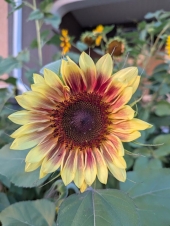
Some sunflowers but not others

They never touch:

Lilacs
Serviceberry
Most tree leaves (some fruit tree leaves get mildly munched)
Lots of other stuff

We have "bad years" here most years, but I did the research and it's a lot of fertility they're leaving behind throughout the season via their waste and their bodies are, as has been mentioned, excellent fertilizer and it is a "slow release formula."

If they get obnoxious, I make run a pass of diatomaceous and it'll bring things back into balance for awhile.
2 days ago