

Kim Goodwin

gardener
+ Follow
since Jan 27, 2014
Merit badge: bb list bbv list
Biography
Native of Oregon, love the forests, now staying warm and dry in the desert.
For More
4200 ft elevation, zone 8a desert, high of 118F, lows in teens
Apples and Likes
Apples
Total received
In last 30 days
3
Forums and Threads

Recent posts by Kim Goodwin

Do you mean too sour?  If so that's brewing too long, typically.  If you have to brew too long to get it to work, sometimes that's not using enough active starter, in my experience.

I use about 1/4-1/2 c of kombucha (best the cloudy stuff off the bottom) plus the rubbery mother.

The sugared tea mix I use is 1/4 cup of cane sugar to 4 cups of water, with 4 tea bags or one heaping tablespoon of loose leaf tea.  For the amount of mother I'm mentioning above, I will use 4 - 8 cups of the sugar water.

If I make more, I use more mother mix to keep the ratios near the same.  I also let the mother get FAT.  I noticed a friend of mine was using a really thin layer of mother and sometimes it would mold.  I like a beefy mother.  haha

I don't usually make less than 4 cups at once.  There is a sort of golden ratio of material, kitchen temp, and time to figure out.

So when the kombucha has used most of the tea up, it will taste sour but not anywhere near unbearable, and the sweet tea flavor is diminished significantly.  If the yeast ratios are happy, there will be bubbling.

Then I bottle the booch for a second ferment at room temperature.  I use one big growler or storebought booch bottle that has a reusable lid (Synergy is the best brand for reusing bottles here in the US).  One big bottle works better than many smaller ones.  (I also do the smaller ones, but the results are much more consistent in one big one).  

I add either a little bit of fruit juice (about a 1:10 ratio), 1/8 tsp ginger juice, 1/8-1 tsp dry turmeric powder, or sweetened herbal tea at that point.  Then bottle and cap, and let sit 1-3 more days to get fizzy.  And watch for lid swelling!

You can learn to start the secondary ferment at a point that will make a product that tastes almost exactly like storebought.  Not lemon-pucker sour, but tart and vivaciously fizzy.  It's a matter of learning the flavors and timing.  Good luck!
15 hours ago
The wonderful Wendell Berry, who passed a few days ago.  Amazing he wrote this in 1973, right?  He was kind of like the Jules Verne of farming.

Manifesto: The Mad Farmer Liberation Front
by Wendell Berry


Love the quick profit, the annual raise,
vacation with pay. Want more
of everything ready-made. Be afraid
to know your neighbors and to die.
And you will have a window in your head.
Not even your future will be a mystery
any more. Your mind will be punched in a card
and shut away in a little drawer.
When they want you to buy something
they will call you. When they want you
to die for profit they will let you know.
So, friends, every day do something
that won’t compute. Love the Lord.
Love the world. Work for nothing.
Take all that you have and be poor.
Love someone who does not deserve it.
Denounce the government and embrace
the flag. Hope to live in that free
republic for which it stands.
Give your approval to all you cannot
understand. Praise ignorance, for what man
has not encountered he has not destroyed.
Ask the questions that have no answers.
Invest in the millennium. Plant sequoias.
Say that your main crop is the forest
that you did not plant,
that you will not live to harvest.
Say that the leaves are harvested
when they have rotted into the mold.
Call that profit. Prophesy such returns.
Put your faith in the two inches of humus
that will build under the trees
every thousand years.
Listen to carrion — put your ear
close, and hear the faint chattering
of the songs that are to come.

Expect the end of the world. Laugh.
Laughter is immeasurable. Be joyful
though you have considered all the facts.
So long as women do not go cheap
for power, please women more than men.
Ask yourself: Will this satisfy
a woman satisfied to bear a child?
Will this disturb the sleep
of a woman near to giving birth?
Go with your love to the fields.
Lie easy in the shade. Rest your head
in her lap. Swear allegiance
to what is nighest your thoughts.
As soon as the generals and the politicos
can predict the motions of your mind,
lose it. Leave it as a sign
to mark the false trail, the way
you didn’t go. Be like the fox
who makes more tracks than necessary,
some in the wrong direction.
Practice resurrection.

"Manifesto: The Mad Farmer Liberation Front” from The Country of Marriage, Harcourt Brace Jovanovich, Inc. 1973. Also published by Counterpoint Press in The Selected Poems of Wendell Berry,
1999; The Mad Farmer Poems, 2008; New Collected Poems, 2012.
15 hours ago
My experience is:

- I can can rotate without deep tilling.  

- Mycorrhizae seem resilient enough to recover from mild disturbances.  

- I suspect rotation is mostly to change/support different soil biomes that enable different minerals to become bioavailable to the plants.

I think diseases are usually secondary.  Meaning they tend to be a side effect of conditions-stressors (too much or too little sun, wind, water; too much nitrogen; or lack of compatible plant/fungi communities) and/or lack of needed nutrient availability (typically, lack of compatible plant/fungi/biome interactions).  I've come to this conclusion after years of growing and having people note "How is it your X doesn't have X (bug, disease, problem, etc)??"  I grow a garden in a radically different way than most people.  It's the whole system in action.

- Much of my rotation happens naturally on it's own.  A large part of my annuals and biennials are self seeding and move all over.  They only require a tiny amount of soil disturbance, like literally scratching the surface.  I don't usually even do it myself.  I think birds do.  Carrots, celery, parsley, Sweet Williams, hollyhocks, lemon bee balm, cornflower, Hopi tea - these all move around the garden at will.

- Nitrogen is not a fix-all.  I've found it's use causes nearly as much problems as it seems to fix. Example, Strawberries can last a long time in one spot if they are being grown in a diverse enough low nitrogen system.  I suspect overfertilization causes them to crowd themselves badly, and then fizzle out.  So the need to rotate increases, or the soil is perceived to get "tired".  

That's my sense of these things at least.  I have lived and grown plants in the PNW and the desert SW.  But I have no experience in the east, mind you! So I can only speak to the western growing conditions.  :-D
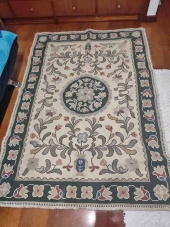
Hook and Loom sells a wide assortment of natural rugs, including some really cool old style braided recycled cotton ones. Theirs are made in India, but they have a lot of skilled rug makers there so it makes sense.

You can order swatches, too.

https://hookandloom.com/
7 months ago
My dogs eat raw, so it would be super simple for me and the scraps are relished.  My Aussie won't eat feathers, though.  Feathers can go in the compost and make a slow nitro release. Right now I buy frozen chicken backs and sternums from Azure Standard, and local beef and lamb organ meats.   I am looking forward to having birds again and yummy scraps!  Poultry offal would be a great supplement as well.

One thing that people often think of as a scrap - but is SO GOOD and worth trying if you haven't already... chicken foot broth.  The feet make the best broth by far.  I don't even bother with making any other type now because the chicken foot broth doesn't smell as strong as chicken broth made from other bones.  Foot broth is the only one my husband can stand now.   The broth is makes is so rich in gelatin!

I do it in a pressure cooker in two batches, for 20-25 minutes each.  So 1/2 gallon of water to 6-8 chicken feet, pressure cook 20 minutes.  Then pour off the broth and refill with another 1/2 gallon and repeat.  

The reason for the two batches off the same feet is that I've noticed it pulls a better broth off that way.  I've tried using a gallon of water and going longer, but there is a point at which the gelatin seems to break down and no longer thicken.  If overcooked, the broth stays watery even when cooled.  It's might be breaking down into collagen, but I can't tell and so I prefer to keep it at the set-able gelatin stage.

After the second pressure cooking, the bones will be soft and crumble under firm finger pressure.  There is still some collagen-rich joint tissue and skin left.  Then the whole mess, softened bone and all is a great dog meal, too.  This is the only time I feed my dogs cooked bones.  Otherwise only raw.
7 months ago

James Bradford wrote:Ideas...35 in. per year zone 8b
4.  Question ...what plants absorb water the fastest and store water for the longest?  My 4000 gallon tank makes my small "from rainwater only" nursery possible, but tanks are expensive ...i wanna "grow" water tanks


In your area (I'm in 8a, the Chihuahuan Desert, we had 6 inches of rain last year - in a drought - and normally get 12") I believe a large prickly pear cactus will soak up and holds the most water, plus then is able to be trimmed, chopped and put back on plants or fed to animals if you need to.   The thornless (which actually means no large spines, but they still have glochlids) prickly pears are the easiest cacti to use that I've come across.  Other cacti are pretty hard and undesirable to chop and drop.  Prickly pear also grow fast (for a cactus) and many varieties grow tall (some to 10 feet).  That speed of growth and vertical gain is where you will get your real water catchment.

This year I've even had to water our chollas.  Everything is looking kind of rough.  There are sand dunes all over from the blow sand, and our planting basins have been filled to the brim with sand.  Dreaming of a verdant monsoon....
1 year ago
Vines all the way. Like Thekla said above, the usefulness and climate modification is also prime for me.

One of my favorite posts (and gardens) on Permies is Leigh Martin's Sky Gardens and Chicken Orchards:

https://permies.com/t/154864/Sky-Gardens-Chicken-Orchards

That is such an inspiration to me!

I live in the mid-elevation desert SW and we get 70mph winds here at times. I've seen that once, and 50 mph winds lots of times now. "Normal" spring winds are *only* in the 35 mph gust range!

Vertical gardening makes it all work, though we have to use strong trellises.

We have vines up all over for windbreaks and shade creation - microclimate creation. Everything from perennials including blackberries, grapes, evergreen passionflower and deciduous passion fruit, and trumpet vine to annuals like cowpea, lablab, and of course melons and other circurbits decorate our trellised gardens and the general fencelines.

Online I also love the gardening style of  AsianGarden2Table and their videos on YouTube.  I learned a lot from their videos about how to build affordable, hurricane-sturdy trellising.  They came up with a system of a metal conduit frame to which they attach sturdy twine. Then they grow more than half of of the plants they sell up the twine trellising! It's impressive. They even grow sweet potatoes vertically.

At the end of the season, they cut the vines and twine down with a hedge trimmer, and compost everything twine and all.

Other gardeners' vertical techniques inspired me to go vertical, which has about doubled my production area, as well. Probably tripled now that I think about it. Because I also layer vines. Learned that from a Geoff Lawton video of Zaytuna Farm.  If the trellis is sturdy enough, you can put many types of plants on it. I have one trellis now with overlapping grapes, runner beans, passionflower and then various, changing annual vines.

Meanwhile, here's a happy trellis year in my garden, from a couple years ago...
2 years ago
This is such a great question and I spent the good part of the last twenty years figuring out my answer.  Turns out it came down to privacy, autonomy, dogs and nudity for me.

Back in rural Oregon, originally, I was very curious about and interested in community living even though I also loved having my own land.  Then an intentional community moved in right next to me.  The people who run it are still dear friends.  We adore them, have met so many wonderful people in the process of knowing them, and I value their community mission - I even fully aligned with it.  But in the process of living next door to an intentional community, I learned that I have an extremely high need for privacy, like having my own animals and being the sole one who chooses their method of care, I want to be in charge of all gardening decisions, I don't like to have to wear clothes all the time, and I absolutely hate to be surprised.  

Those needs of mine finally made me recognize that what I want out of community living is the perceived unity of purpose, but I wouldn't be able to handle all the interaction, give up control, work together with anyone other than my husband (and that's hard enough sometimes), and I NEED privacy.

Now my husband and I live in this unusual rural area in the SE Arizona.  It's about 2.5-3 hours in any direction from the nearest cities.  This distance and isolation has had an interesting effect.  Over the years, this town has spontaneously organized it's own support system and entertainment.

The town (under 500 people spread over about a 30 mile diameter) has two email groups for informing people of community events, another email group for sharing and bartering goods and services, a volunteer fire department, a post office and internet available.  People start all sorts of groups here from clubs (hiking, tennis, writing, gardening, crafting clubs) to talent shows and dances, to the volunteer fire department. Decent small bands come out and play regularly.  Someone started an Azure Standard drop out here years ago (which was so great - saved me from doing it myself).  And people get together in all sorts of friend groups.  If we wanted to hang out with friends every week, we could easily do that (but nooooooo)... many people here have bigger social lives than I would ever have imagined.  This is all an effect of the isolation that was once much more so here (both pre-internet, plus cell service only came here about 7 years ago.  Internet was first.).

So I ended up finding a community in a non-intentional community.  It's not a permaculture community, but I have some permaculture friends out here and we are each working on our own projects while cheering each other on and sometimes helping one another.  We also have five sets of friends here who are building (or finished building) their homes.  We've helped on some of their builds, they've helped on ours.  We've helped with off-grid builds, a modified earthship, putting up a yurt, and others have helped with our alternative build-in-progress, too.

I know this is special.  I know this doesn't exist everywhere - it certainly didn't back in my home community in rural Oregon.  I do wonder if there is a renaissance going on country wide, though, as least among the work-from-home set.  I still subscribe to Communities Magazine and look forward to reading the articles out loud to my husband each time it arrives.  And I hope more people who are right for community will continue to build and design intentional communities with shared purposes, love and support, awesomely clear governance setups, building wonderful things together.  It turned out it's not for me in the intentional community sense, but it works in the un-intentional one.
2 years ago
I grew up at a property with solid clay at the edge of a bog. That was where I first learned to garden. It took years and years to make topsoil, but it happened finally.  I learned a great deal in the process, including things I wouldn't want to repeat.  

My main thing I never want to repeat is using ruminant manure on virgin ground.  The reason is that virgin ground usually has few "weed" seeds (weeds meaning particularly challenging plants like quack grass), and ruminant manure tends to introduce those plants in spades.

Then my husband and I moved to the desert SW. The first property had almost pure sand. I learned a lot there, starting with the cool discovery that hugels still work in sand.

Then we moved to a different location in the arid SW.  It's been so surprising to see how different soil can be from one property to the next. We have friends on solid clay, others on almost solid rock, others on solid caliche, and we have two properties with totally different soils!

One has an alluvial round rock silty soil that has about 10" of rocky topsoil and then is 90% rock beneath that. The rocks are from boulder size, done to large gravel, but most are fist-sized. The topsoil at this property feels like flour.

The house we live at currently and are developing the property using permaculture- this is also where all my garden posts from 2020 to now come from- that soil is very sandy, a little bit of silt, and a tiny bit of clay.

That mix above makes an almost perfect adobe brick, which is what this soil feels like dry.  You can't stick a survey flag in the ground far enough to hold!

Fortunately when it's wet, it becomes malleable and dig-able.

We decided to use the zai pit method, modified like a desert hugel.  We dug deep beds, filled them with all the plant matter that we could find on the property plus kitchen scraps, then topped off with the plain dirt. We made these beds sunken so they collect water.

It's a lot of work initially, but has had a great payoff.  These beds were used for annual crops to help build soil and make fast food in the first year, and since have been transitioned to a full poly culture of perennials, reseeding annuals, and then interplanted high value annuals (like tomatoes, peppers, squash, beans and cukes).

Most people who came out here and saw what we were doing shook their heads, and were internally commenting on how their new neighbors were nuts.

We heard a lot of clucking sounds, "you might want to add some compost" and "good luck with that!" Haha.

It took off faster than I expected, the plants and the soil creation. That was nice.

So we did have to create soil from dirt, and to do so we used plants and fed and developed the soil biome.

The ground here does not have worms naturally, so instead ants, termites, cockroaches, and crickets were the first transformers of plant material. Fungus grew into beautiful webs underground as well. And now we have soil that is becoming better each year.

This winter we finally had grown enough plant material to start mulching all the pathways. I can't wait to see the shift that makes. It will keep the ground cooler.
2 years ago