gift
Rocket Mass Heater Manual
will be released to subscribers in: soon!

John Gould

+ Follow
since Apr 04, 2009
Merit badge: bb list bbv list
For More
Apples and Likes
Apples
Total received
In last 30 days
0
Forums and Threads

Recent posts by John Gould

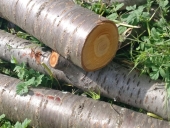
You need to slow down the drying process to minimize cracking/splitting. Varnish the ends maybe with some polyurethane varnish and leave in a damp place. You might even have to store a while in a bag with damp sawdust or wood chips. Cherry is great for things like handles, doorknobs, other tools (handles for chisels), facing for wood vice, ornamental boxes etc.
6 days ago
You need masses and masses of organic matter. Composting is great but you have to get more than kitchen scraps. Look everywhere for <free> biomass:

Tree trimming services
Ranch waste
Friends with horses?
landscapers
sawmills
Autumn leaves

This is going to take time and effort. Remember that large amounts of biomass can get quite hot piled up into windrows, which is good for composting, but on a large scale is a lot of work without a tractor front bucket. If its not kept wet enough you can risk combustion (specially if your climate is a bit hot and dry). I would go for no more than 12 in deep layer rather than windrows and keep a clear area immediately around the house.
Fortunately I had a friend with horses and brought in around 4-5ton manure each Autumn. The soil was pretty good after ~ 6 years! This was just 1/4 acre in suburbia.

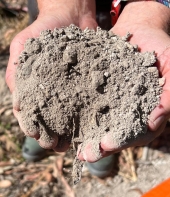
You will notice that the ground will be very "hungry" with all that sand. In a  blink all that biomass will just melt away, but your soil fertility will be much better and you will have much better luck establishing your foundational planting. By around year 3 tree/shrub and other garden waste will be generating substantial amounts of mulch.

Now is a good time to think very carefully about the local flow of water. Since you are on a sandy loam your difficulty will be with having too much drainage and the land will be droughty. A lot of recommendations in books and online often give advice for clay-loams and will not be suitable as the techniques are all aimed at moving water away from plants and improving moisture. Rather than planting on hills go for planting in dips, buried rotting timber (e.g. Hugel), swales to try slowing down run-off (within reason, don't end up directing water into your basement) plus lots and lots of organic matter.
Sandy soils means looking for more drought resistant plants. One trick: if its grey or silver its probably going to work well. Many drought resistant plants have fine hairs or waxes on the leaf surfaces giving them that glaucus look. You will probably get sick of seeing grey everywhere.....but later on you can establish more interesting plants. Work with your environmental conditions, not against them.


1 week ago
Hello Megan,

I've just been through a move and had similar thoughts on moving plants. I decided to not try digging anything out, although I took some cuttings. If you take a lot of the plants, the garden will be a bit of a mess. In the end I resigned myself that perhaps the garden would be like leaving a bit of an echo. I know a young family moved in, and perhaps in a few years we will sprout a new permi here?

Secondly, this is a real opportunity to start over and avoid some mistakes that were just too much work to overcome in your old place. Make a truly spectacular garden. You might have to learn how to fit in with the new environment. Did you move far enough to change Ag Zone? Change soil type? If so you will have lots of fun making a whole new set of mistakes!

Over the years of wandering, I've left fruit trees, asparagus (why do they take 3 years to start yielding and my jobs would only average around 3 years?), raised beds and trellis in my wake.

Good luck!

1 month ago
There is a technique used in the UK where leeks are sown in a seed bed late spring. By September they are around 8" to 10" high and are then planted in 2" diameter holes x 12" deep on 12" centers, diamond pattern. Left to over winter and then they are harvested Spring of the next year. Note that UK winters are very mild compared to most of the continental US. I've always wanted to try this out in Iowa, but never got around to it. Alliums are pretty hardy, but the problem would be a tendency to bolt the next year. Perhaps fixable with some selective breeding?
1 month ago
How does one deal with quack grass in Hugel beds?
I prepared a Hugel style raised bed (only about 1 ft high but also excavated to 1 foot) for blueberries and was always pulling quack grass over a 7 year period. As I was going to move anyway, I excavated a portion of it to see what was going on and found the logs nice and sponge like with a mass of quack grass roots running through them. The bed was always getting additional pinestraw, horse manure, and cut up branches to maintain its height. I've found that if you are careful not to compact the soil quack grass is pretty easy to get rid of as the roots are pretty tough and come out as a single string....but....if its grown through a log its impossible to get all of the root out.
Any advice?
1 month ago


Radon is a noble gas, element 86. It cannot chemically react, so will not accumulate in your plants, soil, microbes etc. It has high density, 9.73 g/L at 0 C. Compare that to Air at 1.3 g/L which explains is why there is a concern with it building up in  basements.
1 month ago
Maybe we are trying to be too complex. Do it the permie way:

How to pull a car out of a lake

technically this is a capstan. I've used very similar setups in a small scale for creating tension.
2 months ago
I've had some luck in zone 5 with Georgia Collards. I was down to my last pinch of seeds (the pack lasted me over 10 years!) so I really wanted them to get through to the next year and flower. Instead of pulling them up at the end of year, the tops were chopped off and the stems left in and covered by the Autumn compost, manure and leaves. Next spring they sprouted like crazy and flowered well.
2 months ago
Do you think Osage Orange would work well for a layered hedge, or is it too vigorous/sucker too much? There are quite a few of these on my property I've been thinking about turning into deer proof "fortifications" (can you guess some of the depredation problems I've been facing?).
2 months ago
Paul,

what are the units for the reading on that radon detector?

Thomas
16 years ago