Nina Surya

rocket scientist
+ Follow
since Apr 25, 2015
Merit badge: bb list bbv list
Biography
Permie gardens, healing herbs, critters, creativity ...and Spirit/Source connection.
A Finnish woman travelled via the UK and Netherlands to rural France.
For More
in the Middle Earth of France (18), zone 8a-8b
Apples and Likes
Apples
Total received
In last 30 days
13
Forums and Threads

Recent posts by Nina Surya

Then clags would be the growing amount of soil (usually clay) firmly attached to the soles of one's boots
3 days ago
Hi Brian,
That's a fantastic concept!
I think it's a very good blueprint for homesteading hamlets, regardless of where on this beautiful Earth they're located at.
I wasn't familiar with the term Homestead Collaboratives, will check it out!
3 days ago
Finally a long due update on this heater.
The cast refractory slabs on top of the bell cracked - maybe there were tiny bells or air within, maybe it was the size, maybe...
We made two slabs, the first 2cm thick, the second one 2.5cm thick. But alas, failure.

At last we ordered a cast iron plate, made to measure; 60x60cm and 12mm thick. It's working like a dream.

The burn is hot and rockety, warming the mass nicely. There's a good draft going on, as always. All in all, very pleased with this one!

Here's the latest photo


4 days ago
Hi Nicole,

I only now read your initial post in the thread as well - sorry, too hasty action from me to jump in half way in a thread and start yapping.

The Coptic binding looks really nice when it's done with wooden covers (but you need strong enough thread, and there's some drilling and lots of sanding involved).
It's also lovely when done with (board covers covered with) handmade paper.

You don't want to use anything bulky to be able to fold around the corners - even with handmade paper I'd stay between the thin and medium weight range.

I'm not sure how the sheet cloth will work.
Make a mock-up if you can; just a scrap piece of board in the thickness you think you'll be using (I'd go for 3mm, = 0.12 inches according to converter), and do a corner with the cloth, pretending you're covering the board with the cloth and turning the edges over. Use the actual materials you think you'd be using for the project, including glue.
There's an extra dimension coming into play with gluing textile to board; glue bleeding through the cloth. Remedied by lining the cloth first with japanese paper/strong tissue paper, using paste as glue. By; laying a piece of japanese paper/tissue paper on a slab of marble (or similar smooth, rigid stuff), brushing it evenly in all directions with paste, smoothing out the paste to a thin layer as you go, deliberately also pasting the marble as you brush away from the center of the paper. Then carefully laying the piece of cloth (which is bigger than the paper) on the pasted paper, starting from one corner or edge, and smoothing it over the pasted paper with the side of your hand as you go, pressing out any bubbles or wrinkles. The cloth will adhere not only to the paper, but around its edges to the slab of marble (or glass etc) as well. You leave it in place to dry = dries out smooth and flat. & hey presto, you've got your lined cloth ready to be used for covering book covers!

Marbling textile with shaving cream (and food colouring, good find!) sounds good fun as well! But maybe that could be another project, for tote bags or t-shirts for instance?

These are just my gentle suggestions. I hope I'm not ruining any fun, just whispering from the sidelines. As always; follow curiosity, do what you love


6 days ago
As a handbookbinder by trade, I've made both, paste marbled and 'proper' marbled paper. The 'proper' version only in the study setting, because it's a bit more complicated as tools and materials are concerned, but paste paper is relatively easy and a lot of fun to do.
I cut 'combs' out of cardboard.

For paste marbling, use a tough, smooth paper. I used to cook my own paste out of wheat flour, and use leather dyes as colouring agent.
Try to make the paste quite thin (but not runny). We want a thin layer of pattern-paste on the resulting paper.

I haven't watched the YT video, but I'm sure it explains the process.

One of my favourite patterns with paste marbling was achieved by
- pasting the paper with just one colour paste (usually it's more about the patterns than colours, or the paper colour acts as 2nd col.)
- gently folding the paper on itself
- tapping the folded paper with fingertips a couple of times
- slowly drawing the paper open

The resulting pattern is that of "mountaintops", I really liked it.

After drying the papers well, I'd iron them with the paste side up, some kind of protective sheet between the paper and the iron - I used baking paper.
This makes the paste pattern more flat, otherwise it has a slight bevel to it.

I closed my atelier 15 years ago, so I'm afraid I don't have any samples anymore to share.
1 week ago
YouTube and Instagram, both seem to be driving traffic - Yay!
Hi Liceo,
You're spot on with your planning!
Good luck and have fun

3 weeks ago
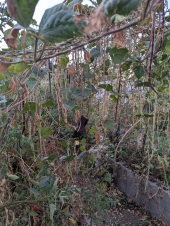
In June, you'll be cutting off 'excess growth' - long vines without grapes (the grapes tend to sit close to the stem).

Next winter, this is what I'm doing:

The red lines give you an idea of what to keep and what to loose. Just establish a pattern in your head and trim away the extra branches.

The green bits show a dilemma situation. On the right side, you could go with the upper or the lower branch, but since the upper branch seems to grow in all kinds of weird directions, I'd prune that one and keep the lower branch.

On the right side I've circled the area of a similar kind of dilemma area. You are the gardener, you decide where the grape vine goes and grows.

When cutting of 'extra growth' in the winter, KEEP TWO TO THREE BUDS per branch. So where I've drawn the red line, between the stem and the cut should be two to three buds/eyes (where new growth starts in the next season) per stump.

In the beginning I always kept three, now two. Leave maybe 3/4 of inch branch after the second or third bud and the cut. Because frostbite might kill of the tip of the branch, and this way you're saving the bud.

I hope this is somewhat clear? If not, just ask. And whenever in doubt, STOP and take a break. With a mug of your hot beverage of choice in hand, stand at some distance of your work and look at it. What does the vine want ? What do you want? What are the cuts you'll be making?
Good luck!
3 weeks ago
Hi Liceo,
Welcome to Permies!

I'll try to untangle your question.

First of all a disclaimer: I'm not a professional with grape vines, but I've pruned them for 12 years now.

What you'll have to establish at the beginning, is an idea of how do you want your grape vine to grow.
Yours looks as wild as the ones I 'inherited', and I'm going with the idea of a stem and then long branches where the grapes grow on.

Normally one would prune the grape vine in the heart of winter, when it's dormant. I do it between Christmas and New Year, or just after New Year, but not if it's freezing.

I'm guessing it's a bit late in the season for pruning your grape vine now, it can 'bleed to death' if the saps are flowing. To be on the safe side, do a trimming at the end of June, and the bigger shaping pruning next winter.
3 weeks ago
Awesome design, lovely colours.
Can't wait to see the results!
3 weeks ago