Inge Leonora-den Ouden

pollinator
+ Follow
since May 28, 2015
Merit badge: bb list bbv list
Biography
Accompanying the gardens (front and back yard) of my rented ground-floor appartment in the transformation to a miniature-food-forest, following permaculture principles (nature's laws) in different aspects of life
For More
Meppel (Drenthe, the Netherlands)
Apples and Likes
Apples
Total received
In last 30 days
14
Forums and Threads

Recent posts by Inge Leonora-den Ouden

Nancy Reading wrote:

Samantha Lewis wrote:Now I am spinning the yarn from my own sheep too.  I think this a great way to create long lasting garments.  

I make cotton and linen stuff too.  It does not have to be all wool.   Everything seems to last longer if it is homemade


Do you think the fibres are better when handspun (longer or otherwise superior) or that the machine made yarn is damaged in some way? Handspun and handmade is obviously more precious, but I'd have thought that inconsistencies would be detremental to longevity not ending up superior.


I think the handspun is better because of some reasons:
Handspinners use the best quality fibers, they don't want to waste their time on low quality fibers.
Handspinners prepare the fibers in the best way. Machines do it fast, but often that isn't the best way.
Handspinners are aware of the end-product they want to make. They have different ways of spinning, depending on what they're spinning the yarn for: a warm sweater, hard-wearing socks or maybe a woven shawl ...

Of course this is not always the case. But I think of experienced spinnners.
6 days ago
This is great news! A whole family will be added to the Wheaton Labs Community!
I hope you'll keep us updated here.
There's another thread about houseplants (more on the subject of plants that are easy to keep alive). So I do have some photos I can share here too ...

a 'plant corner'

some (easy) plants on the window sil and my avocado tree grown from seed.
2 weeks ago
Difficult to tell what was my best find. I don't 'dive' in dumpsters, but I always have a look at the larger things they put next to the garbage. I take (garden) chairs, baskets and (house)plants (still alive!) with me.

Most people I know (friends and family) don't just throw away stuff, if it's still in good shape. They first ask if others want to have it (mostly through app-groups). So I have curtains from friends who moved (to a house with different size/shape windows). And more.
2 weeks ago
This is not an earthquake zone at all. Flooding can be the problem here.
I have shoes and boots, and a coat, next to the doors (both front and back door). And I have my camping gear ready to take with me if I need to evacuate (including food, like cans of beans, for a few days).

2 weeks ago

tuffy monteverdi wrote:...
I don’t know what clogmakers did before rubber was invented? Maybe used thick leather on the bottom of the wood sole?
....


I don't know what they did in other countries, but here in the Netherlands traditionally the wooden shoes are all one piece of wood, nothing else. When the underside has become thin, a new pair is needed. I saw an interview from the 'wooden shoe museum' and they told that a farmer needed a new pair of wooden shoes each month!
2 weeks ago

Thekla McDaniels wrote:Theres a company called Dharma Trading company.  It is located in San Rafael CA, but they mostly sell and ship. ...


Because I'm in Europe I don't order from the USA. But there are European companies too selling natural fabrics (or clothes made of them).
My favourite one is Ecotex. Most fabrics and clothes they sell are even organic and GOTS certified.
2 weeks ago
My interest in archaeology came as a consequence of my interest in textile crafts. Because I wanted to use natural materials, I wanted to know what materials were used (in the region I live in) in the past. The 'past' starting with the first inhabitants.

That question brought me in a museum showing how people lived here in paleolithic, mesolithic, neolithic and later until iron age. Everything known about that subject comes from archaeological finds (artefacts, but also discoloration in ground layers). The archaeologists working for the museum are in contact with other archaeologists (f.e. at Groningen University).
The interest of most archaeologists is: were and how houses/huts were built back then? And then comes: what was their food and how did they get it (hunting and gathering, or some kind of agriculture, or both)? What clothes and other textiles they had comes last. Not because of lack of interest, but because there are so very little finds of textiles. And tools used to make textiles are often hard to recognise as such.

Permaculture is not only about food. Every thing used in daily life is part of it too. And it isn't only about 'growing' (agriculture). Foraging (hunting and gathering) is part of it too. So (i.m.o.) archaeology is important for permaculture.
To know how people did what they did with what they had in their surroundings (land, water, plants, animals, etc.). In modern society a lot of that knowledge is lost ...
3 weeks ago
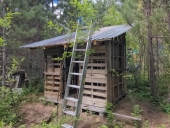
My son built me a garden shed using pallet wood a few years ago. I am very proud of him. He had to take all of those pallets apart first.
All I had to do was stain it (brown) when it was finished.
Here is it seen from different sides.


4 weeks ago
As far as I read this thread I think you want a quick and easy solution.
But I'll give my answer anyway. I use my sewing machine to change a flat sheet into a fitted sheet with seams and elastic corners. That involves measuring, cutting and pinning too. It isn't the easy way. And it can't be undone.
4 weeks ago