Kit Collins

+ Follow
since Sep 09, 2015
Merit badge: bb list bbv list
For More
Apples and Likes
Apples
Total received
In last 30 days
0
Forums and Threads

Recent posts by Kit Collins

So many interesting posts here.
I want to add that it is very beneficial to marry someone who is similar in frugality. It makes for a much happier marriage! I know this from experience.

Frugality is also stimulating for the mind, like a puzzle: how to make use of the as-yet-unused, how to solve a problem without going to the marketplace.

My wife is probably the best user of solar energy in the neighborhood. She dries the laundry in the sun on dry days. Sun-drying gives a great feeling to the clothes. Net cost of the solar installation: a $20 portable rack, which now I could build myself from scrap, since I have the basic idea of it. For years we had a drier but never used it, so we just got rid of it. On rainy or coldest days, she puts the rack in the living room instead, and that even helps keep the heating system from becoming not too dry in the winter. Once every couple years or so we'll take bulky quilts or such for drying in a laundromat.

I was reading the 1930s diary of my grandmother about ten years ago. Grandpa and Grandma made work clothes out of burlap sacks, and enjoyed hunting raccoon. I'm sure they used every bit of it they could! Grandmother was especially a great inspiration for me and other siblings/cousins, for activities like canning, gardening, harvesting fruits, etc.

Small, efficient houses were the norm for that generation, and even till the 1970s small houses were typical. Now the houses marketed as "eco-friendly" and "eco-conscious" houses are generally huge with tall ceilings. It's just eco-virtue-signaling, as the heating  and A/C bill will be enormous, not to mention the cost of the twice-weekly maid.

Nowadays I commute past the long waiting line of cars for the food bank twice a week. Long line of cars, almost all of them nice, even new-looking. At any rate, most of them nicer than my car. Going to the foodbank is not frugality. Often it is the opposite: those people are suffering from a lack of frugality. They get deep under with loans and "financing" then can't feed themselves or their families. They buy $50,000+ cars then look for handouts. Modern society is suffering from really warped priorities, specifically from a lack of frugality. My wife and I probably earn less than most of those people in the food bank line, and we drive kinda frumpy cars, but we feel like a king and queen, having everything we need and want, eating great fresh interesting food, with no feelings of being limited by money.
3 weeks ago
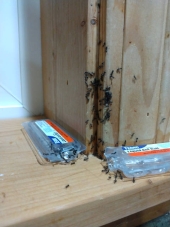
I'll ditto what M. Rives said above. The Terro liquid bait traps (sugar and borax basically) are easy and work very well for the very common odorous ant house infestations (at least in NW USA). Borax is rated less toxic than table salt, and is a common and fairly traditional laundry additive, so I have no worries about it. Just let the ants feast and don't disturb them. They disappear in a couple days.
Regarding other uses of borax: It's a safe substitute for chlorine bleach. I and wife used to soak cloth baby diapers in it to remove stains and freshen them before washing. Works very well for this. The last I read, it's also still listed in at least one European pharmacopeia, as it has traditionally been taken internally in small quantities as medicine.
1 month ago
...was just thinking about this topic a bit more. Perhaps these modern Brits have the wrong idea of how the floor/wall hypocaust was typically used back then?  Perhaps the ancients chiefly used interior fire heat, like a hearth/chimney, and the hypocaust system was just used sparingly to take the "edge" off of the coldness of floor and walls, rather than to heat the house. It's hard to imagine the ancients using so much wood for so little heat return.
1 month ago
Quite interesting to watch these two videos. However, what a waste of wood to do this! They used 540 kilos of wood to heat essentially a tiny home for 8 days plus an extra day of "inertial" heat (and not even in very cold weather). In terms of efficiency, this is an abject failure. Could heat same home with, say, a good fireplace insert or a RMH, for a  fraction of that amount of wood, like less than 20%. Having a toasty floor is nice, but there's got to be a better way.
1 month ago
Once I saw a subfloor that was done entirely with 2x4s, not situated flat on the 4" sides, but all situated resting on the 2" sides, and pressed together. Extremely strong and eliminates need for close joists underneath: you could span them prob at least 3 feet, I imagine, but don't quote me on that. Probably adds a fair amount of insulation too, though it would be heavy and expensive to build.
1 month ago

But as for the quote above, I am baffled by your logic.  


Matthew, basically for me it's a matter of keeping things simple. I guess I've made things too complicated in the past and I'm reformed now! Natural and simple is generally better; complicated and artificial is generally not as good. That's become a matter of faith for me, but I'm still willing and quite able to read actual science. It's just that I haven't actually seen a study on the "science of nutrition in fruit dehydration" yet.  From my experience doing it, it occurs to me that it is nearly impossible to do dehydration in a low-tech manner without sun/UV exposure. It would only be possible in the hottest, most arid locations. So logically, it is very likely that the "ancients" would have typically dried fruit (and other food) with direct sun. Seems like they did OK with it too. So I'm not worried at all about it.
4 months ago
I've been doing the car-window dehydration (no fancy acronyms for me!) for years, with fruit. I just crack the windows a bit to let condensation out. Works on hot days. See pictures, including cracked door window. We don't use our cars as much as most families, so it's not too inconvenient. I've even done it in the back window while driving around town. I'll roll up the windows in the evening so bugs don't get in, or else bring the trays inside. Takes a couple days, maybe three, for prune plums. I use folded or rolled towels to angle the trays toward the sun better.

I also have done simple rooftop dehydration with an old glass shower door (with safety glass). See other picture and this youtube: https://www.youtube.com/watch?v=BJf-6XfN4uY . I later made a lightweight wood rectangular frame to fit under the glass shower door to keep the fruit a bit toastier and elevated off roof surface for more ventilation. But I'm not sure making that frame was really much improvement unless to keep the fruit safe from night critters.

For years I've done simply canning of dried fruit in mason jars with no sort of pasteurization. Just pack 'em nice-and-dry and don't fill the jar too high, and they keep without refrigeration for years. I've only noticed spoilage (a bit of mold) in maybe 2 of the probably 100 such fruit jars I've canned in past dozen years, likely because the fruit wasn't quite dry enough in those 2.

I'm skeptical about sunlight UV being bad for fruit. Can't get much more natural than sunlight. Would like to see actual science on those claims. Plus, it would just be MUCH more difficult to dehydrate passively without direct sun, so if there was a small tradeoff in some vitamins, it would still be worth it. KISS!
4 months ago
Just a note to readers about a common alternative to soap nuts. I think horse chestnuts, very common in many areas (including in the Netherlands, FYI to Inge), are rich in saponins, and a mild soap or shampoo can be made from them. I did this a few decades ago. Some people even make laundry soap from them. Just do an internet search.

That being said, I want also to reply to Inge's most recent post. I have short hair and it does NOT seem to have gotten oily (you said "fatty", but I think it's the same) after I went "poo-less". So I'm wondering if your shorter hairstyle might solve the problem of hair getting oily.  I do take warm showers, not very hot, but I think probably warm running water can remove at least some oil.

This topic reminds me of older practices, before people had a habit of bathing/showering so much. People--esp. men--often oiled their hair on purpose. It was considered fashionable and neat. People--men and women--also used to habitually wear hats or headcoverings whenever they were outdoors, partly to keep dirt/dust from their hair. The hats were removed when coming indoors, as a matter of politeness.
5 months ago
First, thanks to Permies people for furnishing the inspiration for me to become soap-less.

This thread inspired me a couple years ago to go shampoo-less and soap-less. Well, let's say 98% less of that stuff now, because I still wash my hands as needed with soap, and very rarely use soap on other body parts, only in the event of major dirtiness.

I'll describe the process of my change here, some advantages and disadvantages, and some things I discovered on the way, including the use of pumice stones.

When I started going soap-less, the first couple weeks I felt a bit itchy, but my body adapted and I haven't looked back.  Hair is fine, and body is fine. I felt completely "normal" again within a few weeks. Less expense, fewer chemicals: win-win.

An unexpected benefit of soap-less living is that there has been FAR less mess and cleanup necessary in the bathtub/shower. I hardly have to clean at all there now, if I'm the only one using it. Unfortunately, it's hard convincing family to also go soap-less!

One disadvantage of soap-less living is that I don't exfoliate as much. I guess soap might soften the skin so that the outer layer rubs off more easily. Just rinsing and light rubbing with water doesn't seem to accomplish this unless I do a long warm soak. So when my skin starts seeming too "thick", or looks a bit grayish, then--the next time I take a warm bath or a hot shower--I will rub my arms, legs, and face with, say, a towel that is a bit rough. That'll get the excess skin off, so I feel "baby-fresh". Might help to have a little strainer in the tub drain in order to catch and discard the skin bits.

As part of my soap-less journey, I discovered the effectiveness of using pumice stones instead of soap. I read that ancient Romans used pumice stones and skin-scrapers instead of soap. I tried pumice stones, and found that they work great at getting tough stains (like dried paint or oil or ink stains) off of fingers. Dried paint on fingers seems to just dissolve when rubbed with a chunk of pumice. Just avoid rubbing the more delicate areas of skin too hard, like the inside of the wrist, because you might break the skin there. Pumice "sticks" are available in a lot of hardware stores in the cleaning section, and natural pumice stones are available very cheaply at Mexican stores where I live. Pumice is sold for the use of cleaning scaling off of toilets or other hard surfaces, but now I mostly use it for hand-washing.

I definitely encourage others now to go soapless. No soap, no problem!

9 months ago