

Lif Strand

pollinator
+ Follow
since Sep 02, 2019
Merit badge: bb list bbv list
Biography
I'm a retired Arabian horse breeder and endurance competitor, a writer, photographer, and fabric artist, currently living the good life off-grid in the high country of the US Southwest.
Apples and Likes
Apples
Total received
In last 30 days
4
Forums and Threads

Recent posts by Lif Strand

I've been on solar for around 30 years now. I went the same route as has already been described - few knew anything back in the beginning - and being land rich and financially poor, I upgraded along the way as I could afford it. Because all the government incentives seem to only be offered for new installations, I've never had any help exept from a relatively local (75 miles away) solar company that would not do the actual installation or troubleshoot my system (unsurprisingly) because it was too far away.

My system now is more than adequate for my current (very conservative) electrical needs, but experience has taught me to keep my generators full of fuel, just in case [note generators is plural! I want backup for everything!].

I'm planning on installing a separate, parallel power system to use as a backup - very basic, just enough to run a few lights, my Starlink, and charge the phone, flashlights, etc. As I upgrade everything in the future,  I will take the functional replaced components and install that in my barn (right now it's flashlights at night and generators for power tools).

Security for me is not about having money in the bank or depending on the grid, but having functioning backup systems for as much as I can on my property.
6 days ago
HALF-MOON BASINS


Photo: Half moon basins in Niger during dry season.

in Africa, half-moon basins (also called bunds) are used on gentle slopes. They're dug out with pickaxe and shovels and the removed soil shaping a half-moon berm about 3 m (a little over 3 yards) in diameter and about 25-50 cm (10-20 inches) deep. Soil/manure are added to the inside of the half-moon, which collects rainwater that would otherwise just have run off.  

I have noticed here in my part of New Mexico that anything that even mildly blocks water runoff tends to be at least marginally greener than elsewhere. This includes hoofprints of elk and cattle, the uphill sides of rocks or downed branches, or my own efforts at slowing down the flow of water that gushes down off of mesa sides whenever it rains here.

The photo below shows the moist soil from a recent rain of less than a tenth of an inch. Surrounding soil surface has already dried. Obviously the weeds (kochia) love that spot!

I'm very fond of this kind of water retention/restoration. Check out Regreening Sub-Saharan Africa website if you're interested.

NEXT: Waffle gardens
Note: I am developing this post gradually as I do the research and learn how to properly embed images. Please be patient!

The Sahara desert is turning into Africa's green wall

We are getting some rain now in my part of western New Mexico USA, but nowhere near enough to reverse the drought conditions that we've been living with for years. Rainfall is too often measured in hundredths of inches! And yet there is a project along the bottom edge of Africa's Saraha Desert called The Great Green Wall. The 8,000-kilometer (nearly 5000 miles) mega-project of theAfrican Union and backed by the United Nations is intended to stop the Sahara Desert from growing. Today, nearly 20 years later, the project has restored about 20% to 30% of its goal.

Seems to me if they can grow plants that provide food for humans and forage for livestock and wildlife, plus control the creep of the Sahara Desert, I should be able to grow 50 foot long garden in New Mexico.


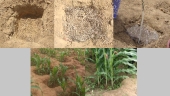
Zaï (or tassa) is a farming technique of digging pits in less permeable soil to catch water and concentrate compost.

The pits are between 15 and 50 centimetres (0.5 and 2 ft) across and around 5 to 15 centimetres (2 to 6 in) deep, spaced approximately 80 centimetres (3 ft) apart. The technique is traditionally used in western Sahel (Burkina Faso, Niger, Mali) to restore degraded drylands and increase soil fertility. The technique has also been adopted by smallholder farmers in semi-arid regions of East Africa, particularly in Kenya, where farmers in counties such as Kitui use it in combination with modern agricultural practices to improve water retention and crop yields in dryland conditions.[

Zaï holes were reintroduced since the 1980s by Yacouba Sawadogo, a farmer from Burkina Faso, who introduced the innovation of filling them with manure and compost to provide plant nutrients. The manure attracts termites, whose tunnels help further break up the soil. He also slightly increased the size of the holes over the traditional models. Zaï holes help by improving the yields of trees, sorghum, and millet by up to 500 percent.

As an alternative to the zaï technique, some agricultural engineers suggest using a diking technique, especially in the case of very light soils.

Image is of Zaï holes from Wikipedia

NEXT: Half-moon basins
Note: I am developing this post gradually as I do the research and learn how to properly embed images. Please be patient!

Lif Strand wrote:

Ray South wrote:In autumn, we put peach/nectarine seeds in a small bucket with damp sawdust, put a lid on it and leave the bucket out the back in the shade for the winter. "


How cold does it get in your winter season? I'm in New Mexico at 7000' altitude and often find that Australian gardening advice works for me, or at least points me in the right direction. Thanks!


Also I want to point out that peaches do grow in areas that freeze during the winter. It has to get pretty darned cold ( below -20°F) before they get damaged. How much damage depends on the strain.

Peaches were introduced by Spanish missionaries and explorers in in New Mexico in the 16th century and cultivated extensively by the folks of Pueblo and Navajo nations. Unfortunately the US government had the miltary destroy those peach groves back in the 1800s - it would be cool to get pits from any of today's generations of peaches from surviving trees but are there any?
2 weeks ago

Ray South wrote:In autumn, we put peach/nectarine seeds in a small bucket with damp sawdust, put a lid on it and leave the bucket out the back in the shade for the winter. "


How cold does it get in your winter season? I'm in New Mexico at 7000' altitude and often find that Australian gardening advice works for me, or at least points me in the right direction. Thanks!
2 weeks ago
It's been a minute, as they say. Way more than a minute. It's been two years since I posted any photos. Partly that's because I've been busy (two novels published in that time, plus one new edition of a third novel). Partly it's because I've been swept away by politics. Partly because of drought. I have no garden, just a few struggling plants that I have to water every day. I am keeping them alive, but theya ren't really thriving. In the wild, there is nothing but a few super-hardy weeds growing near my house, and the pinon pines on the mesa sides are turning brown.

I no longer see cows every day. I miss them. My neighbor rancher gave up and moved to another state. Fortunately the land was purchased by another rancher, who has the financial resources to hold off doing any ranching on that land until there is enough rain for long enough for the grass to recover.

Unfortunately  he has turned off the well for the cattle tank near my property. The well is shallow, I'm sure his aim is to preserve what can be preserved. Unfortunately that means the wildlife that have depended on that water since 1934 when the well was dug, now have no water.

So I am tearing down my horse fencing that protects my own water trough so that whatever is willing to come close to the barn can drink.
My old stallion had to be put down a couple months ago and I am now out of the horse business, horseless for the first time in 50 years. I sent his companion goat back to her breeder, who has also gone out of business and sold her herd. The goat was happy to be back where she gew up (the goat is 10) and the goat's owner is happy to have a pet goat.

My best buddy pup, Bubz, died of cancer last year. He wasn't young, but that doesn't really ease the hurt. A new rescue dog is in my life. She is 10 this year, going blind, and has other medical issues. I knew when I adopted her she'd be a short-timer, but I'm her sixth owner and she is a good girl, deserving to live out her life in a home, not a rescue... or be euthanized before her time.

So many changes. It all seems to be happening so fast, but it's not all hard. It's just life. I'm letting myself look at the past and let it go. Here's a photo of a week-old Arabian foal born on our California ranch in the early 1980s. A foal grown old since then and no longer with us.

Also shown: the cover of my latest novel, COLD TRAIL
3 weeks ago
Too good a deal to pass up, especially when the $ will be used to keep permies.com going.
I'm downloading some of the goodies right now. Thanks.
1 month ago

Maxeem Konrardy wrote:This may be nuts but does anyone do open air insulation?


I've thought about it, but I can't come up with anything that wouldn't be an ugly industrial thing able to withstand New Mexico's increasingly frequent high-wind events (not just straight wind but powerful dust devils that can reach 85MPH).
1 month ago

Fred Tyler wrote: 1" of insulation is not enough in New Mexico,  so I went with about 18".  


Is the insulation between the decking and the metal, or where is it in the layering? Is it foam panels? Asking because all I've ever seen is 4" of the stuff.

Also, doesn't increasing from 1" (presumably what was there) to 18" make joining the new section to the old difficult? How did you deal with it around the skylights? Or am I misunderstanding how you did what you did?  Thanks.

1 month ago