Shayok Mukhopadhyay

+ Follow
since May 02, 2020
Merit badge: bb list bbv list
For More
Broome County, NY, Zone 5b
Apples and Likes
Apples
Total received
In last 30 days
0
Forums and Threads

Recent posts by Shayok Mukhopadhyay

Anne Miller wrote:A corn board usually refers to a board with nails that catch the corn kernels when the ear is rubbed against them.


Would one expect to have enough of them to dry a whole harvest?

By the way, I use one of those rings with ridges inside them to shell corn.

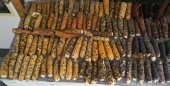
Joseph Lofthouse wrote:They dry quickest on a corn board.


What is a corn board?
I baited a hav-a-hart with canned sardine to catch a feral cat that I suspected of getting my ducks. Weeks go by, no cat, the sardine starts smelling strong, then I catch a woodchuck. I have previously (intentionally) caught woodchucks with apple.
2 weeks ago

Anne Miller wrote:
It would be really great it the OP, Shayok form 2022 would come back and let us know how she solved the problem.


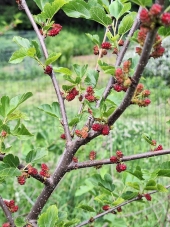
The problem solved itself, and I'm not totally sure through which mechanism. I planted four Red Mulberries in a 10' diameter enclosure in spring of 2023 and managed to kill all but the central one. This spring (2026) I noticed little green berry-like things on it with a white fuzz. Looking on the internet, I'm guessing that's what mulberry flowers/catkins look like. The website of the nursery I bought them from says male catkins are 2-3" and female 3/8". I'd say the "flowers" I saw were more like 3/8". They turned into bright red berries around 1/2" long and are now turning a very dark red. They are sweet, but I wouldn't call them extraordinary. Birds seem to like them. I've had better from a tree I found roadside (in a different zone).

I'm guessing the dark red is its final stage; funny thing is the seller's site says they take 8-9 years to make fruit, which ripen in August. (It's early July now.)

So it's less a likely a moneicious tree (having both male & female flowers) and more likely a female tree being fertilized by a nearby tree that I haven't seen.

I also tried to solve the problem by planting nearby a Dwarf Everbearing Mulberry tree from Stark Brothers in Fall 2024. It did not leaf in Spring 2025. However, in Fall of 2025 I noticed it sending up shoots from below. It did not do that in Spring 2026. So that didn't work.

2 months ago
Thank you very much Burton for those references. I will go through them when I have some time. It seems, though, that neither criterion listed in the table is obtainable in the cold temperate zone. I'm assuming that the time length specified has to be continuous, not merely cumulative.

In the meantime, I also found some literature survey on human waste processing and elimination of pathogens. Here's a paper focused on doing so in tropical conditions.
10 months ago
I see the statement that after 2 years in a closed bin, the poop is going to be pathogen-free. Have people tested this in a lab? If it's so safe, why restrict it to willows or trees, why not use in the vegetable garden as well?
11 months ago

Andrés Bernal wrote:Willow feeders are a best solution than compost for gardeners:


I understand that the product is superior in nutrients to compost, but if the product is only usable for willows, it is a product of limited use. I was hoping that the Wiki would say that it has wider use. I was also hoping to hear a claim that willow itself has wider use.
1 year ago
Maybe it will be useful to have more information on what the willow feeder feeds? Well willows obviously, but not everyone may have use for a lot of willow. (It seems like a mediocre grade firewood.) Can other plants take the willow feeder output in smaller quantities and thrive? (I'm guessing so, as "night soil" used to be a common fertilizer before synthetic fertilizers.) That kind of information would be valuable.

Regarding this key claim: "An interesting thing about pathogens ...  99% of them die in about two months.  That number goes up to 99.999% in six months.  And 99.9999999999% in two years.  Faster in a dry environment. " A number of us who want to implement a willow feeder will need to convince not only themselves but skeptics around them regarding this claim. People will bring up worms, eggs of worms, etc. So some pointers to some authoritative research backing this claim will aid adoption.
1 year ago
Hello, I'm looking for a cold climate- (Zone 5) friendly softneck garlic. I grow hardneck quite well but they don't keep past March/April. Fruition used to sell a cold-weather adapted Lorz (https://www.fruitionseeds.com/shop/vegetables/garlic/organic-lorz-italian-softneck-garlic/) but since they're stopping selling stuff, I don't feel so sure about trying Lorz from a different supplier.

Any suggestions?
2 years ago
Here's an update after using soil blocks for 4 seasons and Winstrips for 2 seasons.

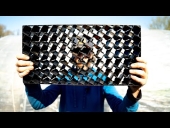
I think I'm getting better at soil blocks and honestly it doesn't feel like that much more labor than Winstrips. I've tried the Mini Wini Large (this is equivalent to the 50-cell tray) and the Mini Wini Small (equivalent to 128-cell tray). The former works well for me. The latter I'd say is actually more work than soil blocks as the extra seeding mix doesn't readily fall through the gaps between the cells - I have to use a pencil to poke them through. Moreover, I had a significantly lower germination rate of onions with the Mini Wini Small than with soil blocks. I have no idea why that would happen and I should probably repeat the experiment to be certain. I wish the Small worked well for onions as they don't really need that much space/soil as seedlings.