B Beeson

pollinator
+ Follow
since Jun 04, 2015
Merit badge: bb list bbv list
For More
SW Virginia zone 7a (just moved from DFW, TX)
Apples and Likes
Apples
Total received
In last 30 days
4
Forums and Threads

Recent posts by B Beeson

Wood chips, as Anne suggests.

Also, is it a deep layer of gravel with perennial weeds established in and below the gravel?  I have a gravel path I made with my huge surplus of rocks and gravel from my stream floodplain alluvial soil. I find this is pretty easy to dig into with the right tool, but only when it is still moist from a rain or melting snow. I use a sturdy 4-tooth garden fork, working it in with a rocking motion to get through the gravel. Then I'm able to leverage out the tap roots of the deep rooted weeds, and sift out the roots of grasses and shallow weeds as I pry it up. By summer, everything is dry and compacted, the weed roots are well established, and they wont come out easily.

Frost heave is your friend. Do the hard work in late winter, early spring when frost heave makes the ground easy to work, and before the weeds get going. Over winter, they are putting their energy into the root system. They benefit from the frost heave, too, spreading their root networks out. Short circuit their progress by extracting their root systems with your fork. Even if some of the roots survive deep down, they will be greatly set back by your efforts.

If its just a thin layer of gravel, well.... that's not doing much good anyway. Scrape that useless stuff out with a mattock, dig down and root out the offending weeds, put down some cardboard and paper, extra thick, and cover with 12 inches of woodchips. Repeat every year or two. Harvest the perfect topsoil at the bottom the worms will make for you. Worms love cardboard. I think its the glue, made from waste animal parts, its their second favorite food (after coffee grounds).
2 weeks ago
I have one rule for gardening and homestead owning. Its a simple rule and it is valid under one specific circumstance. It definitely applies here.

Here's the rule:

Whatever the problem is, applying wood chips is the solution.

Obviously the special circumstance is that one has access to unlimited free woodchips from ChipDrop or a local arborist.

So before the big storm hit, I renewed the mulch around the house foundation, really piling it up high, thick and wide, right up to and a bit over the bottom of the siding. As it settles over the next few months, the recommended gap between the masonry foundation and wood structure will re-emerge. The gap is to prevent termites from finding an easy entry.
2 weeks ago
I had grand(iose?) plans to grow lots of sweet potatoes this year. I started early in a pot on a sunny windowsill...

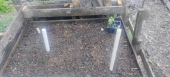
planted slips out to the garden area protected by a fence...

The deer LOVED this idea, the early leaves are very nutritious and tasty - perfect to help out the local deer population explosion. The fence was no barrier at all to motivated deer.

In the end, the plant in the pot survived, produced about 470 grams of tubers in a pot of about 5 liters.
3 months ago

Nancy Reading wrote:I believe it is a tender perennial - so won't take a frost. I don't know how cool it will tolerate.... My house is pretty cold in winter; especially on the windowsills as we don't yet have full double glazing.


At your latitude, with your cool wet winter climate, basil will struggle, and suffer from fungal disease. It greatly prefers warm+dry+sunny. Best case, you keep it alive through the winter, and get a head start on a vigorous plant in late spring when it will finally gets the longer daylight it needs.

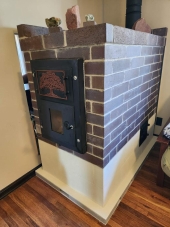
Grow lights will help, warm and dry helps with the fungus, maybe near the woodstove? And pick off any suspect leaves to keep the fungus at bay.
4 months ago
Looks like chert, common in sedimentary rocks. Chert is primarily  composed of a type of quartz.

Does it scratch glass?

If yes, could be quartz (and therefore chert)

If no, something softer, like dolomite or limestone is possible.

Either way, the purple color could be a result of iron or some other metal oxide, as mentioned by Burra. Doesn't look like fluorite, spodumene or the other exotic minerals. These are not found in Missouri.

But.....

Google says the state gemstone of Missouri is mozarkite! A colorful variety of chert/flint/jasper. Can be polished real pretty, makes good arrowheads, found west of Lake of the Ozarks.

I think that is the answer.
5 months ago
I'm endorsing Phil's suggestion of paper/cardboard plus deep mulch.

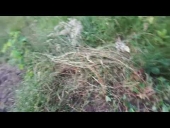
But that is just the opening salvo in a long war. Your enemy wins a battle when you allow photosynthesis to replenish the energy reserves in the rhizomes. That energy is spent growing new rhizomes to spread out, and new leafy parts to harvest more light. You win a battle when you dig up rhizomes, and when you cut off the leafy parts as soon as they appear.

Deep mulch helps immensely because it forces the deep rhizomes to grow farther up before reaching the light, and it will colonize the deeper parts of the mulch instead of the hard ground. Rhizomes are very easy to pull out of the mulch, so you don't have to work so hard as you do in the video. You don't have to get the deepest roots out, but it shortens the war. With deep mulch the hard soil will be softer and easier to dig to get the last, deepest parts out.

A complementary tactic is to establish a barrier around cleared areas to block rhizomes from penetrating into the cleared area. Cardboard installed vertically in a slit trench can work, but will need replacing frequently. Sheet metal is a good choice for longer term, and very useful once you've cleared to the edge of your planned bed. Tilt the vertical barrier slightly inwards. The rhizomes will try to grow over the vertical barrier making it easy to pull them out before they make it over. Whereas the horizontal barrier alone allows the roots to encroach underneath.

Obviously, constant vigilance is the key factor. I have 2 year old beds that are completely clear, only requiring policing of the perimeter, and one year old beds that I'm still working on. With a garden fork, the roots are easy to pry out mostly whole, instead of chopping them into smaller pieces with a hoe or shovel. Smaller pieces just grow twice as fast as the original!

I have a 3 year old bed that I neglected, and the rhizomes are everywhere, but now clearing is pretty easy. The broken down deep mulch of leaves and wood chips has turned into fabulous soil that is full of earthworms and worm castings, and the rhizomes are easy to pull. I just pull back the top layer of chips, save the best soil underneath for the growing beds, fork out the rhizomes, lay down new cardboard, put the old wood chips back  to cover the cardboard and replenish with more chips and leaves to make it deep enough. With the summer heat, deeper is better, especially in the walkways. I can mound up the beds a bit, cover with 10-20 cm of good compost - its ready for transplanting. The walkways get 20-30 cm. This makes them safer to walk on as wet cardboard or paper with a thin layer of mulch on top can get very slippery, and hard rainfalls have a deep reservoir to soak into.

6 months ago
Have you looked into ChipDrop?

I've gotten several loads.

Free, delivered right where you need it if accessible to a dump truck, lots of fresh leaves mixed with wood chips, small branches - an ideal ramial mix for composting. I've laid it on thick over cardboard for pathways, and after a year I've redone the pathways to root out the persistent grass stolons and roots. I found the year old chips to be loaded with earthworms, fungi and black soil underneath. So the pathways ended up with better soil than the beds!

You can also choose the option of random wood logs and pieces as well. Good for hugel building, biochar production, or burning for heat.
7 months ago
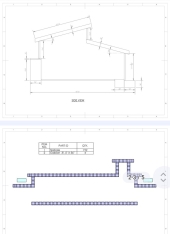
Kind of a barndominium inspired mashup... I like the idea.


I have some thoughts that don't mean criticisms, but could be slightly aimed that way.

1. Greenhouses make a lot of humidity, houses suffer from excess humidity, especially in summer. In winter the humidity would be a benefit, especially if your heating systems are drying out the living space. But summer is going to get moldy if you don't have an air conditioner fighting against the humidity in the living space.

2. With the orientation greenhouse towards the south, that puts the deck and covered patio facing west, making them uncomfortable outdoor spaces in both summer and winter, and your garages are blocking the morning sun from your living spaces. If you mirror/flip it around, an east facing patio and deck become nice sunny morning coffee spots and cooler, shady evening grilling areas. And the garages are blocking the late afternoon summer sun when you don't want its extra heat, and blocking the northwest cold prevailing winds in winter.

3. The clerestory windows would be better reversed so the light can penetrate in to the living space bypassing the greenhouse glazing, allowing better control over the living space light and ventilation independent of the greenhouse.

4. As I mentioned in point 1 above, HVAC is going to be a challenge, and I bet there is little experience in the conventional building and HVAC  industries to give you good guidance for such a unique structure. Be prepared for experimentation and repeated revisions of the system.  Prepare for this by setting up the infrastructure to allow easy modifications to the HVAC, like in-slab heating/cooling pipes with the option to transfer heat from living to greenhouse space, electrical connections for ventilation fans in several locations, etc.  

5. Consider a couple of direct-drive solar powered mini-split like this:

https://signaturesolar.com/eg4-hybrid-solar-mini-split-air-conditioner-heat-pump-ac-dc-12000-btu-seer2-22-plug-n-cool-do-it-yourself-installation/

6. There are several greenhouse builds that have been featured here on Permies over the years, some have the insulating curtains that deploy on the inside. See if you can find some in the archives.

7. Its a big project. Expensive. Can you make a small scale proof of concept? Tiny house sized? I'm sure you'd learn a lot and avoid some expensive mistakes in the full-sized version.


I look forward to more as you develop you plans.


8 months ago