• Post Reply Bookmark Topic Watch Topic
  • New Topic
permaculture forums growies critters building homesteading energy monies kitchen purity ungarbage community wilderness fiber arts art permaculture artisans regional education skip experiences global resources cider press projects digital market permies.com pie forums private forums all forums
this forum made possible by our volunteer staff, including ...
master stewards:
  • Nancy Reading
  • Carla Burke
  • John F Dean
  • Timothy Norton
  • r ransom
  • Jay Angler
  • Pearl Sutton
stewards:
  • Devaka Cooray
  • Leigh Tate
  • paul wheaton
master gardeners:
  • Christopher Weeks
gardeners:
  • M Ljin
  • thomas rubino
  • Megan Palmer

Expedient insulation

 
steward & bricolagier
Posts: 15864
Location: SW Missouri
11943
2
goat cat fungi books chicken earthworks food preservation cooking building homestead ungarbage
  • Likes 32
  • Mark post as helpful
  • send pies
    Number of slices to send:
    Optional 'thank-you' note:
  • Quote
  • Report post to moderator
As I write this (January 2026) there's a bad winter storm coming that will affect farther south than normal, the whole Southeast US is bracing for way worse than they are used to.
What do you do if you are in that area, and have no time and no supplies?

Start with water: Everyone bathe now. Won't do it again until it warms up, getting wet will make you colder. Filling only the tub is rarely the best plan, as you rapidly have nothing but funky water in it, nothing to drink etc. Fill the tub, give it a pan or bucket and use it to flush the toilet with (you just pour it fairly quickly into the toilet and it will flush if there's not frozen drain lines.) What do you have that will hold water? Fill it and put it in the bathroom or kitchen. Everything like buckets, cat litter containers, empty jars, and bottles, pans, and thermoses.

Look around your house, what do  you have to work with?
Look at everything fabric in the house: blankets, clothes, towels, rugs, shower curtains. Look at anything that might block wind: cardboard, plastic, tarps, chairs, tall empty shelves, a table you can turn up on end? Check any camping supplies you have, any of that usable?  Tents as space reducers for heating  
Look for things that hold things in place: Tacks, nails, screws (washers if you are using nails or screws to keep things from ripping, bits of cardboard make good washers.) Clothespins, safety pins, binder clips, hair clips, twist ties, pipe cleaners, bits of wire, string or rope of any sort.
Look for structure that might help: Curtain rods, booms, long garden tools.

Start by minimizing the amount of space you are using. Close doors, close off vents, move kids into one room and close off the rest. Anything you don't have to worry about is a win. Adding Heating Zones to the House

Pick ONE door into the house, if possible to be the ONLY one that opens. Any others do anything you can to cover them. I'll give a good weird example here, I have a door that needs to be closed off, it's on the north side and it's going to be a problem. I have an armchair, I can slide it up against the door. I have a broom and a rake and a big flat cardboard box, a big blanket, clothes and a plastic shower curtain that's not being used. I can put the broom and rake behind the chair so they stand up, and they'll hold the cardboard high up behind the two of them. Before I put it up, I'll check if there is space under the chair, if so, I'll prepare to pack it with clothes I'll get the big blanket and the shower curtain, clip them together to make them hold still, then lift it high  with the plastic toward the door to stop wind. I'll hold the cardboard up as high as I can, put the broom and rake in place then slide the chair in tight to hold it all. Pack under it with clothes. It REALLY helps to have two people to do this! Any bits of door I didn't manage to cover I'll thumbtack towels over, getting into the Sheetrock on the sides to seal it as best I can.  If something like this has to be done, don't fret if you don't get all of it, ANY of it will help, the more the better, but anything will.

Windows that leak are bad, if you can cover the windows with anything, do so, at LEAST do the bottom part if at all possible   Waterfalls: Odd window insulation that's working!  Push something up under the window and pile it with clothes if possible.

Cover any of the floor area you can with anything you can, I currently have on my floor rugs, blankets, towels and yoga mats! Anything that will sit still. If possible cover the layers with fabric like sheets to stop trip hazards. Weight the edges down with stuff like canned food or books. It works better than you'd expect!

The door you are going to open needs to be covered but accessible. Mine has a curtain rod over it (that extends past the door on each side)  that has a blanket that slides on it, right now I have a second blanket pinned to it and a shower curtain binder clipped to the back of it, and I have a blanket rolled up with clothes in it tied with rope into a neatly done burrito that moves easily to fit across the whole bottom of the door and extend to both sides. Be sure to tie up a mess like that, or it will be difficult to deal with.

Get creative with what you have, fort building for big kids! Get your kids excited about it too! The more air flow you can cover, the warmer you will be. The tents thread has stuff about covering tables to make tents, kids will like having a nest under a table!

Body heat will keep rooms warmer than you think, wearing layers of clothes helps too. Everyone in the household sleeping in the biggest bed helps too. One person by themselves is warm, two is warmer, adding kids cats and dogs is even warmer! Stay in bed as much as you can, read books out loud to each other, or play games that do not involve disrupting the blankets.

Add other ideas below, share what you have learned or can think up.

:D


master steward
Posts: 14689
Location: Pacific Wet Coast
9007
duck books chicken cooking food preservation ungarbage
  • Likes 22
  • Mark post as helpful
  • send pies
    Number of slices to send:
    Optional 'thank-you' note:
  • Quote
  • Report post to moderator
In climates that are warm, people often think that insulation isn't needed. The reality is, good insulation helps keep summer heat out, and then it's there when you need it if Mother Nature throws a curve ball.

The year we moved to British Columbia, over the New Years period we got 3 ft of snow - considered the storm of the millennium. People used to heating with electricity were in trouble if theirs went out. But even if it stayed on, their inefficient houses left them with heating bills of hundreds of dollars.

We had come from Ottawa, Ontario, so our kids still had warm clothing and we had lots of warm blankets. The house came with a very inefficient wood stove, but at least it could burn wood. Rather than being "open concept" the house was of an age where the kitchen had walls and doors that closed. When we had power, the baseboard heater, or the stove if I was cooking, could keep this one room warm.

This was also not an extremely cold storm. Not like Ottawa cold! However, anything below freezing can result in hypothermia, particularly if you get wet shoveling snow. My understanding is that areas not used to cold, are at risk of significant cold arriving soon. It wasn't that long ago that people died in Texas when they got atypical weather.

Read Pearl's advice above. Consider which direction the wind is coming from. Air gaps with stagnant air are your friend, and this thread, ones she's linked to, and others on permies will tell you ways to slow the air down and keep you warm.

Beware of candles or any open flame! They will devour your oxygen and risk deadly fire. If you can create a sheltered area outside using tarps, tables, boxes etc, then a camp stove or similar will give you a place to heat water to bring inside. Stack up the snow to windward and that alone may give you a spot to cook.

Good luck to everyone in the path of this storm - stay safe!
 
gardener
Posts: 926
Location: Ontario - Zone 6a or 4b, depending on the day
630
dog foraging trees tiny house books bike bee
  • Likes 19
  • Mark post as helpful
  • send pies
    Number of slices to send:
    Optional 'thank-you' note:
  • Quote
  • Report post to moderator
If it's colder than normal for your area, and your house isn't well insulated, remember to leave your taps dripping overnight, and sink cabinet doors open to avoid a freeze and an expensive pipe burst! I have been known to use an incandescent lamp (if you have power) to add a little heat to a cold bathroom, utility room, or pump room, though be careful not to knock it over or get it wet!

You can buy electric heaters that turn on if the temp gets below 10C (whatever that is in F), and I have one set up constantly in my utility room in the off chance my boiler fails (again) while I am not home.

Figure out where your water shut-off is, and if it's possible to drain your water at all, well in advance of any power outage.

There is always the 'watch the smoke from a smoldering piece of cotton twine" trick to find drafts.

I hang a curtain up in the winter in my entry with a cheap tension rod , to block cold air as we go in and out. Makes a big difference, and also blocks some of the remaining draft from my well sealed door. In a pinch, duct tape willhang a curtain!  The best curtains go from floor to ceiling without gaps.

For layers - remember it is not the weight of clothes that insulates you, it's the trapped air.

So one pair of fluffy socks that are a bit too big is going to be far warmer than 6 pairs of socks you need to stretch to get on. Same goes for pants, sweaters, jackets, and even boots.

 For bedding - put your heavy layers like an old wool blanket on the bottom, light layers (like a duvet or comforter) at the top of the pile. It does help to cover a fluffy layer like a fuzzy blanket, if it's at the top, with a sheet to trap more air. I grew up with a bedroom that was often below freezing in winter. I learned to wrap a fluffy blanket around my head and neck for insulation.

Do not allow yourself to sweat, if you do not have heat - it's very difficult to rewarm if you are damp, and get chilled. Take off whatever layers you need to, and work at whatever pace you have to in order not to sweat. Similarly, if you are cold - make yourself get up and move, you will rewarm quicker when you are moving.

Do you have a natural gas hot water heater? If you do, it may keep running in an outage. My mom is able to repeatedly fill her tub and kitchen sinks with hot water (town water, so she has pressure) and add a little heat back to the house during an outage that way.
 
master steward
Posts: 8230
Location: southern Illinois, USA
3157
goat cat dog chicken composting toilet food preservation pig solar wood heat homestead composting
  • Likes 11
  • Mark post as helpful
  • send pies
    Number of slices to send:
    Optional 'thank-you' note:
  • Quote
  • Report post to moderator
A desperation move that I used once in my life in a city house…If heat sources are gone, you probably still have hot water in your tank type water heater.  Fill the bath tub , sinks, bowls, etc with the hot water.   My house did not stay comfortable, but it did stay well about freezing.  As the house cools, be sure to monitor the hot water heater so it doesn’t freeze .  Simply place a small bowl of water on the floor near the water heater. The water in the bowl will freeze before the water in the heater.

This approach can be especially useful if you have a relatively small bathroom and you have a small child that needs to stay warm.
 
pollinator
Posts: 289
Location: North FL, in the high sandhills
114
  • Likes 12
  • Mark post as helpful
  • send pies
    Number of slices to send:
    Optional 'thank-you' note:
  • Quote
  • Report post to moderator
North Florida here, where it has been getting into the low 20s a couple nights this week.

Things to deal with that..and worse?

A 10 x 35 greenhouse with 15 55 gallon plastic barrels along the walls to soak up heat during the day and give it back at night.
The water in the drums is chlorinated to keep it useable for drinking long term.
If the sun is out during the day the greenhouse heats up nicely even if it's cold outside.
If we lose power the greenhouse will hold above freezing if temps are in the 30s, maybe high 20s, but I'll lose the plants if we go very far into the 20s.
Two tiny electric space heaters will hold the greenhouse above freezing, as thy did this week when night temps were in the low 20s, but no power would mean goodbye tomatoes.
If I really wanted to save the tomatoes I have a long piece of steel flex pipe to fit my garden tractor exhaust and I believe leaving it running inside the greenhouse with the exhaust vented out might hold it above freezing. Haven't tried that yet.

The old mobile home I live in isn't very well insulated so I might be inclined to go "camping" here on my property in a severe cold snap.

My shop is an old army surplus  20 x 32 truck maintenance tent tucked in under some big oaks.
Anything plant-wise I wanted to try to save from freezing seems to make it in there.
The big trees seem to hold a good bit of heat under them.
I have a large camping tent I could set up inside the big truck tent, and yet another smaller tent that would fit inside the big camping tent if needed.

All my camping gear I've had since the 1970s, like Coleman stoves and lanterns, multiple sleeping bags and grills and other gear to cook over a wood fire.
Lots of oak here for fuel wood. I could have a lovely campfire for quite a few days.

I used to work outside in very cold weather 50 years ago and still have all the clothing and insulated boots from that.

I have 2 small generators and an old pickup truck with the 24 gallon  fuel tank behind the seat, so an easy to siphon fuel storage for generators.

The last really bad freeze here was 1984, with 3 - 4 days steadily below freezing. I remember having to use the exhaust from my car via flex pipe aimed at the water line up into my house to unfreeze the line daily.  
That was the end of any serious commercial citrus growing in this part of Florida. the trees froze right to the roots.
I was in the junkyard business at the time, and this being a very poor area, a lot of folks didn't run antifreeze in their cars. I ended up junking a LOT of cars with their engines split wide open from the water in them freezing, up and breaking the engine block.

If I never have to deal with extreme cold, snow or ice again that would suit me just fine.

 
John F Dean
master steward
Posts: 8230
Location: southern Illinois, USA
3157
goat cat dog chicken composting toilet food preservation pig solar wood heat homestead composting
  • Likes 9
  • Mark post as helpful
  • send pies
    Number of slices to send:
    Optional 'thank-you' note:
  • Quote
  • Report post to moderator
Hi Dave,

I had a friend in MN who had a single wide mobile home.  When the weather got rough, he would move into his hogan. That hole in the ground stayed at a comfortable temp ( with the oil drum stove going) on even the coldest days.  The mobile home was next to useless at 10 below.
 
Pearl Sutton
steward & bricolagier
Posts: 15864
Location: SW Missouri
11943
2
goat cat fungi books chicken earthworks food preservation cooking building homestead ungarbage
  • Likes 13
  • Mark post as helpful
  • send pies
    Number of slices to send:
    Optional 'thank-you' note:
  • Quote
  • Report post to moderator
Random thought: Before the storm hits, empty all trash cans in the house, and compost bins. One less reason to go outside, and it keeps the house from smelling bad when you are getting no fresh air in.

I also, at this point, am brewing up a lot of the tea I drink, so I have it even if power goes out. Stale tea isn't my favorite, but lack of caffeine gives me headaches.

And all the extra layering on doors etc that I got done yesterday (still a but more to go today) was DEFINITELY noticeable at 22 degrees this morning. I'm pretty pleased with all of this.

The storm track has shifted, spreading more northerly, CHECK THE CURRENT PREDICTIONS FOR YOUR AREA!
 
pollinator
Posts: 756
Location: SE Indiana
435
dog fish trees writing
  • Likes 13
  • Mark post as helpful
  • send pies
    Number of slices to send:
    Optional 'thank-you' note:
  • Quote
  • Report post to moderator
20 F as a morning low isn't much of a concern for me but this storm has potential for a few days of 20 F or lower as the daytime high and that does get my attention because it may come with sub-zero lows.  I may be blocking off the upstairs from the heat entirely; I don't mind sleeping in the cold and better to keep the living area comfortable. Already brought in more than the normal amount of firewood and completely restocked the supply under cover on the porch so I don't have to go out to the big stack in the snow.  

I actually like winter, but I have limits. Our forecast is calling for some days with highs in the low teens. That could mean lows in the minus teens and that is outside my limits of what's enjoyable. The bad ice and power outages are projected to stay south of us, I hope so, but you never know.
 
John F Dean
master steward
Posts: 8230
Location: southern Illinois, USA
3157
goat cat dog chicken composting toilet food preservation pig solar wood heat homestead composting
  • Likes 9
  • Mark post as helpful
  • send pies
    Number of slices to send:
    Optional 'thank-you' note:
  • Quote
  • Report post to moderator
Since living in Minnesota, I have made certain that I have multiple discrete sources of heat. Now that I am in southern Illinois, it seems like overkill.  The wood burning fireplace in my living room is my go to.  Sorry to all anti fireplace people, but nothing perks me up like a roaring fire in the fireplace. I have a newer lp furnace that is set on 50 degrees, a have two free standing lp space heaters, a kerosene heater, a wood burning fireplace insert in the basement, and multiple electric heaters. Most of the above are seldom used.

And yes, the premise of this thread is spot on, if you are not losing the heat in the first place, you have to worry much less about making heat.   I moved into my house with 3” of attic insulation.  It now has 18”.
 
Pearl Sutton
steward & bricolagier
Posts: 15864
Location: SW Missouri
11943
2
goat cat fungi books chicken earthworks food preservation cooking building homestead ungarbage
  • Likes 11
  • Mark post as helpful
  • send pies
    Number of slices to send:
    Optional 'thank-you' note:
  • Quote
  • Report post to moderator
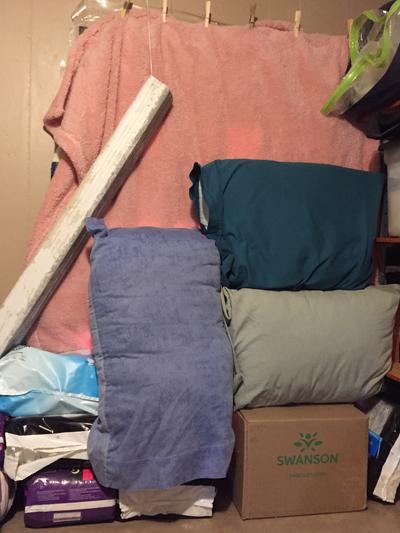
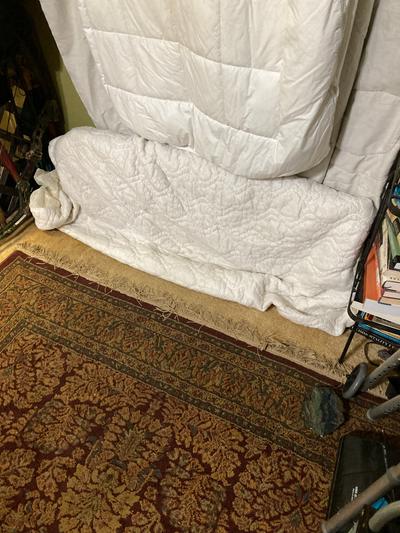
An example!! This window already had blinds, plastic and a thin blanket on it mostly for shade. It got an extra blanket tucked up as tight as I can get it, and a nice neat stack of asst crap that will block the lower half of the window. Don't think I could get it higher without adding more structure. If the cold hangs on as long as some predictions are saying (1.5 weeks!) I'll have more time to add structure and bury it deeper.

quick cheap insulation for cold weather

I'm getting creative :D

Next project is to see If i can get a layer of bubble wrap envelopes under a heavy houseplant, I got all the others up off the floor, but that one is big, heavy, and amok.
 
Jay Angler
master steward
Posts: 14689
Location: Pacific Wet Coast
9007
duck books chicken cooking food preservation ungarbage
  • Likes 6
  • Mark post as helpful
  • send pies
    Number of slices to send:
    Optional 'thank-you' note:
  • Quote
  • Report post to moderator
I just watched a report which suggests that some southern USA areas will be getting significant freezing rain.

Park your car, spread ash or kitty litter on your walkways, use a cane for extra wide base of support if you do have to go out. Broken bones take weeks/months to heal - please don't be a statistic!

It doesn't matter if you believe you're such a good driver, you won't run into trouble. The next driver over can take you out with one bad move.
 
Pearl Sutton
steward & bricolagier
Posts: 15864
Location: SW Missouri
11943
2
goat cat fungi books chicken earthworks food preservation cooking building homestead ungarbage
  • Likes 15
  • Mark post as helpful
  • send pies
    Number of slices to send:
    Optional 'thank-you' note:
  • Quote
  • Report post to moderator
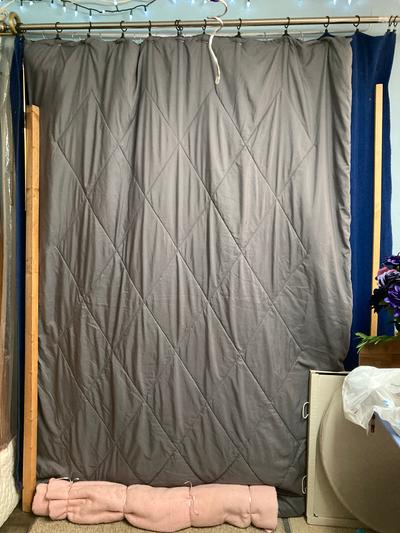
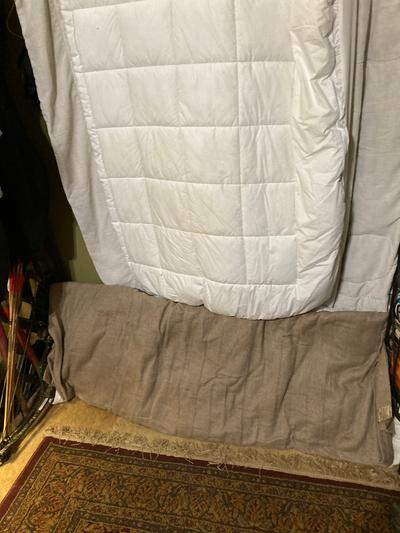
Another picture... I always have curtain rods across this door with a blue blanket on one, a clear shower curtain on the other. Lets me adjust how much heat/cool/air/light come in it. I added the gray blanket yesterday, and the pieces of wood on the sides to hold it all tight against the wall. I hadn't thought of that until I realized the cold was coming out the edges at me, as the curtain rods are not tight against the wall, they need sliding room.

This morning I woke up to 16 degrees with a wind chill near zero. Nasty bitey wind. Usually, no matter how much the heat runs, this house feels cold.  This morning it did not, and the heat hasn't been running often to keep it feeling this nice. It's not tropical, but that constant feeling of "Augh it's cold!" is gone. Thermostat hasn't been changed. Only factor that changed, besides the temps dropped when the front hit, is I have insulated everything I can reach, all of the doors, windows, floors.

I'm WINNING!!!

how to quickly insulate a window against the cold
 
Pearl Sutton
steward & bricolagier
Posts: 15864
Location: SW Missouri
11943
2
goat cat fungi books chicken earthworks food preservation cooking building homestead ungarbage
  • Likes 12
  • Mark post as helpful
  • send pies
    Number of slices to send:
    Optional 'thank-you' note:
  • Quote
  • Report post to moderator
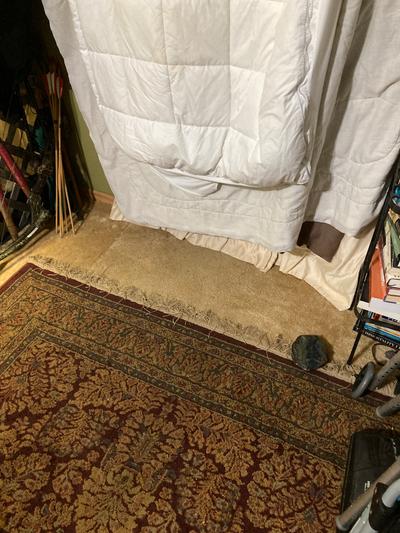
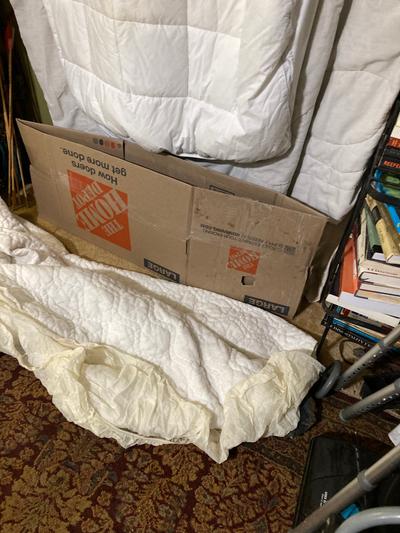
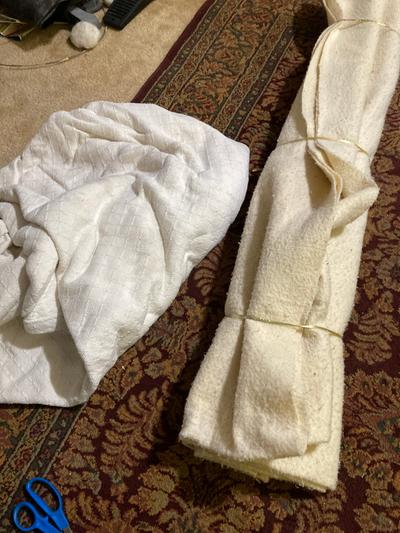
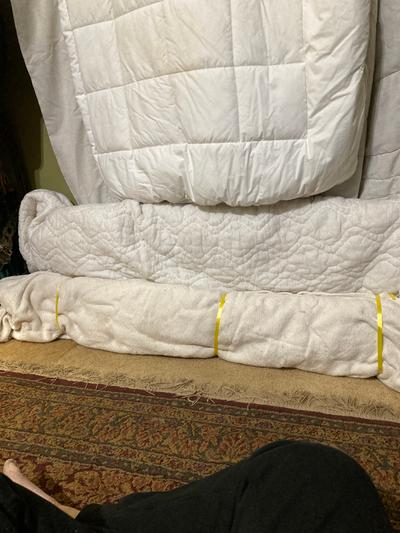
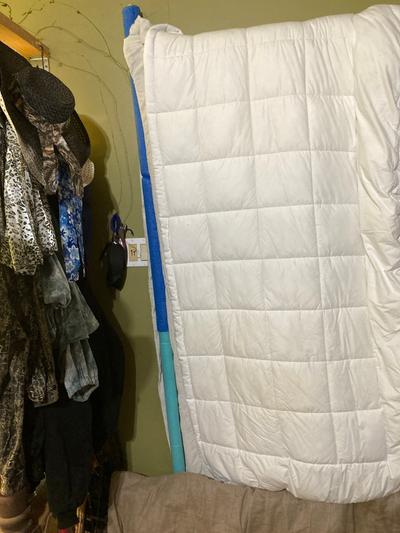
I was working by my north door, and it was still drafty so it got reworked, this time I had a camera with me. I added one blanket to the top part of the door before I started the low part. That's where the main problem was. Main door covering goes outside too, blanket, Styrofoam chunk that is too small, the door, another small foam sheet, the drapes that magnet to the wall, 2 thin blankets, that mattress pad on top. (And the fact that all that isn't enough to stop the wind tells how how pathetic that door is! )

All the bottom stuff removed


Cardboard box as a windbreak


Tucked up with a blanket


Victims about to be used, my usual draft blocker and a blanket


Rolled up into a burrito and kicked up tight


Dead electric blanket folded so the wires support it, kind of stood up and forced to behave


Checked it, bottom is warm now, still a draft off the left side. Looked around, ended up with a chunk of trim wood probably from a trash pile, needed bulk, threaded a pool noodle from another project (that's sitting on the floor) onto it. (brooms etc were too short)


Spiffy! Put another one on


Stood it up, hey it reaches under the curtain rod! Even more spiffy!!


Needed something to  just kind of enforce it staying put... The vacuum that lives right in that area (still plugged in!)
preparing for the cold weather draftproofing a door

THERE WE GO!! Draft free door!  Take THAT, you crappy door!!   :D

Incidentally, when I was preparing for cold this year (having looked at the long range forecasts) I saw that rug you see there rolled up at a thrift store, tried to move it to see if it had a tag, holy CRAP was that heavy!! Tag was 25.00. At that price, and weighing that much, I don't care if it's hideous or not, I have a VERY cold floor right there, if it's damaged badly, I'll cover it up.  It's in perfect condition. I had to wash it, one good spill on it, too much to be pee, maybe a pan of soup? Dried it on the the hood of my truck, took 4 days to dry. Not my colors, I don't care. It's heavy!!  5 foot 2  by 7 foot 11.  Wonderful score!!!  Every time I walk over it my feet say Aahaaahhhhh!!

 
pollinator
Posts: 863
Location: Illinois
190
  • Likes 5
  • Mark post as helpful
  • send pies
    Number of slices to send:
    Optional 'thank-you' note:
  • Quote
  • Report post to moderator
Pearl, we have a very similar rug, also bought on sale. I like it.

Temps here, west of Chicago, -15F (-25C).
 
Posts: 79
8
  • Likes 9
  • Mark post as helpful
  • send pies
    Number of slices to send:
    Optional 'thank-you' note:
  • Quote
  • Report post to moderator
I've been testing woodstove heat tendencies, window drafts etc for years with incense sticks.
 
Posts: 2
2
  • Likes 12
  • Mark post as helpful
  • send pies
    Number of slices to send:
    Optional 'thank-you' note:
  • Quote
  • Report post to moderator
Pearl, thank you so much for the great information! I took your advice on several of your suggestions. Moving along into our 2nd 24-hour timeframe of ice/freezing rain/sleet/snow mix. Throughout the day, the snow plows have passed, some vehicles can be seen unable to reach the summit of a hill, many 4-wheelers and side-by-sides driving the 5-lane hwy. I took precautions yesterday and have been able to enjoy a few good books, hearty soup, calm music, and a warm fire today. Thanks again!
-AM
 
Pearl Sutton
steward & bricolagier
Posts: 15864
Location: SW Missouri
11943
2
goat cat fungi books chicken earthworks food preservation cooking building homestead ungarbage
  • Likes 8
  • Mark post as helpful
  • send pies
    Number of slices to send:
    Optional 'thank-you' note:
  • Quote
  • Report post to moderator

Bever Branson wrote:I've been testing woodstove heat tendencies, window drafts etc for years with incense sticks.


This is how I do it, I'm atypical, and think sideways :D
Low budget air flow visualization
 
Pearl Sutton
steward & bricolagier
Posts: 15864
Location: SW Missouri
11943
2
goat cat fungi books chicken earthworks food preservation cooking building homestead ungarbage
  • Likes 10
  • Mark post as helpful
  • send pies
    Number of slices to send:
    Optional 'thank-you' note:
  • Quote
  • Report post to moderator

Chival Lambent wrote:Pearl, thank you so much for the great information! I took your advice on several of your suggestions. Moving along into our 2nd 24-hour timeframe of ice/freezing rain/sleet/snow mix. Throughout the day, the snow plows have passed, some vehicles can be seen unable to reach the summit of a hill, many 4-wheelers and side-by-sides driving the 5-lane hwy. I took precautions yesterday and have been able to enjoy a few good books, hearty soup, calm music, and a warm fire today. Thanks again!
-AM


Chival: Welcome to Permies!
I'm VERY GLAD to hear you used some of this!!
I have soup too, fresh bread, and I'm sewing, nice peaceful day.
I got my bare feet wet yesterday evening, and walked around to see if I felt any more drafts, I win! I did not!! I'm dancing smug :D
More snow tonight, looking like by tomorrow noon or so I'll top out at 8 inches, give or take.
I'm glad I'm warm, hoping I don't lose power, but ready for it if I do.
 
Posts: 214
Location: KY
75
wheelbarrows and trailers hugelkultur forest garden gear trees earthworks
  • Likes 12
  • Mark post as helpful
  • send pies
    Number of slices to send:
    Optional 'thank-you' note:
  • Quote
  • Report post to moderator
Been splitting wood the past 2 days as much as my back would handle, and otherwise buttoning up the place. The wood stove is blazing. Great advice everyone so far, I've definitely stuffed some towels and clothes in the cracks!

I have two 20 pound propane tanks and a burner just in case, and for early morning hours when the fire is low and cold wakes me up.

Theres no electricity here, but I re-upped a good supply of beeswax candles!

I totally should have taken a shower yesterday, because now the "frost" proof hydrant is completely frozen and temps aren't above freezing for over the next week, with nites around 0°F. Good thing it's just me here ;)

I only have 2 gallons of water in containers, so I'll be melting snow if need be. I already bucket compost toilet, so no worries there!

This isn't my first winter, but this will be a tuff week in northeastern KY!

Hopefully I'll be able to get out of my drive in a few days if all this predicted snow falls, I'll go visit a friend for a shower and re-up water if I feel the need...but I got a few new books and a big battery charged to keep the phone going, so hopefully this snow-in will be "fun"!

Good luck all, we are in this together!
 
Rusticator
Posts: 9503
Location: Missouri Ozarks
5162
7
personal care gear foraging hunting rabbit chicken cooking food preservation fiber arts medical herbs homestead
  • Likes 6
  • Mark post as helpful
  • send pies
    Number of slices to send:
    Optional 'thank-you' note:
  • Quote
  • Report post to moderator

Pearl Sutton wrote:

Bever Branson wrote:I've been testing woodstove heat tendencies, window drafts etc for years with incense sticks.


This is how I do it, I'm atypical, and think sideways
Low budget air flow visualization


Me, too. I think I learned it from Mother Earth News, waaaayyy back when. It's always worked like a charm.
 
pollinator
Posts: 49
Location: SW Virginia zone 7a (just moved from DFW, TX)
33
  • Likes 8
  • Mark post as helpful
  • send pies
    Number of slices to send:
    Optional 'thank-you' note:
  • Quote
  • Report post to moderator
I have one rule for gardening and homestead owning. Its a simple rule and it is valid under one specific circumstance. It definitely applies here.

Here's the rule:

Whatever the problem is, applying wood chips is the solution.

Obviously the special circumstance is that one has access to unlimited free woodchips from ChipDrop or a local arborist.

So before the big storm hit, I renewed the mulch around the house foundation, really piling it up high, thick and wide, right up to and a bit over the bottom of the siding. As it settles over the next few months, the recommended gap between the masonry foundation and wood structure will re-emerge. The gap is to prevent termites from finding an easy entry.
 
Thom Bri
pollinator
Posts: 863
Location: Illinois
190
  • Likes 8
  • Mark post as helpful
  • send pies
    Number of slices to send:
    Optional 'thank-you' note:
  • Quote
  • Report post to moderator

Pearl Sutton wrote:
More snow tonight, looking like by tomorrow noon or so I'll top out at 8 inches, give or take.
I'm glad I'm warm, hoping I don't lose power, but ready for it if I do.


It's a lot colder here, but not much snow. One nice thing about the cold is the roads are dry. Wet, freezing snow is the worst.

We have a newish, high-efficiency gas furnace. It's actually slightly oversized for our square-footage. Last night it couldn't keep up and the house was colder than the temp setting. In really cold temps we turn up the temp higher then we normally keep it, in order to prevent pipes freeing.

Stay snug!
 
Jay Angler
master steward
Posts: 14689
Location: Pacific Wet Coast
9007
duck books chicken cooking food preservation ungarbage
  • Likes 8
  • Mark post as helpful
  • send pies
    Number of slices to send:
    Optional 'thank-you' note:
  • Quote
  • Report post to moderator
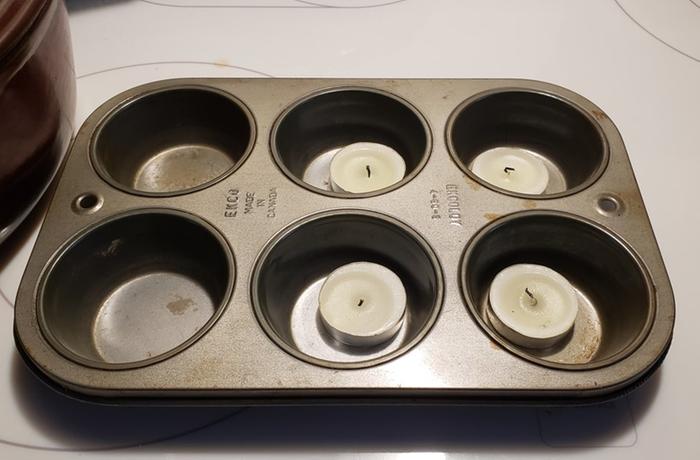
I know I said to avoid candles a little higher up, but I did just see this neat trick and it would be interesting to try it:

The lady took a metal muffin tray and put a tea light candle in each of 4 adjacent cubbies, and lit them. She then put a metal teapot over top and implied that the water boiled. I think the key idea was that the tea lights were close enough to do the heating, but the pot was held up enough that the flames stayed lit - but does it work in real life???

Anyone up to giving this the permies test?
1. Please don't leave it untended even though it seems safe.
2. Do the candles reliably stay lit? I can't remember if she had used a pot that was not quite covering the 4 cups, or if she had used something metal a spacer to keep the kettle just high enough for adequate air to reach the candles.
3. Be wary what you put the muffin tray on - the video was unclear. I would set it on my stove or our hearth which is rock. I would not risk it on my very old countertops.
4. How long does it take for an identified amount of water? Something like enough to fill a mug of tea/coffee? Or enough to make Ramen soup?

I might have time to play with this concept later, but I'd be happy if people did some early troubleshooting for me!
 
Jay Angler
master steward
Posts: 14689
Location: Pacific Wet Coast
9007
duck books chicken cooking food preservation ungarbage
  • Likes 12
  • Mark post as helpful
  • send pies
    Number of slices to send:
    Optional 'thank-you' note:
  • Quote
  • Report post to moderator
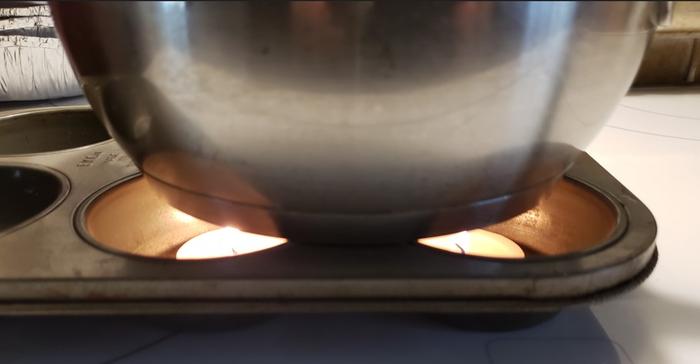
OK, I decided to give this a go on my lunch break. The kitchen was running about 60F. I forgot to check what temperature the water came out of the tap at.

I had the equipment:


I got it lit just fine:


...and then I waited, and waited, and waited.

Finally after 55 min and the water only reaching 136F according to my meat thermometer, I was out of time, so I dumped the water into my pot of chopped potatoes and used my burner to get the water boiling and the spuds cooked, in barely 15 more minutes.


So, if you have no other option, this will give you a warm drink using a bullion cube, or some homemade broth, or some home dried herbs.
It would also give you warm enough water to fill a hot water bottle to take the chill off the bed.
It will *not* be a practical way to avoid a boil water advisory - just too slow.
It will *not* be a practical way to actually cook anything.

You would be so much better off to make sure you had some dry firewood stashed and build yourself some sort of mini-rocket stove out of bricks. Yes, this would have to be outside, and those little stoves have to be constantly fed, but at least you'll get some serious heat out of it.

So this does *not* pass the permie test overall, but if it's your only choice for a warm drink, it would be better than nothing.
 
Catie George
gardener
Posts: 926
Location: Ontario - Zone 6a or 4b, depending on the day
630
dog foraging trees tiny house books bike bee
  • Likes 11
  • Mark post as helpful
  • send pies
    Number of slices to send:
    Optional 'thank-you' note:
  • Quote
  • Report post to moderator
My mother is a huge fan of fondue pots for emergency prep. They can be used indoors, which is a huge bonus. You can often find them inexpensively in thrift stores.  Fuel is methyl hydrate.

I call her during power outages, and she's fried up some toast or an egg for breakfast, perc'd a cup of coffee, and heated up soup for lunch or hot water for a hot water bottle, all without going outdoors and getting chilled.

I have a stick stove, and I like it for camping,  but expect to ruin any pot you use on it with soot.
 
Posts: 749
170
  • Likes 11
  • Mark post as helpful
  • send pies
    Number of slices to send:
    Optional 'thank-you' note:
  • Quote
  • Report post to moderator
I did not see anyone post this: if you have a gas range you can use that to heat your home. Just turn the oven on to 400 degrees and then open up the door when it gets up to temperature. You can keep the door opened a crack, or you can repeatedly close and open it, but eventually you will heat the air inside your home.

A great product I recently discovered is bubble wrap with foil on both sides. It only has an R factor of one technically, but is considered to have an r-factor of 6 in real-world situations, but here is what I found, R-factor is a terrible way to determine heat migration. The stuff actually reflects 95% of the heat back into the heated environment, but because of how the R-factor is scientifically determined, and yet does not take into account radiant heat migration, it has a low R-factor when in reality it works wonders. It is also fire retardant and is cheap. I bought a roll 100 feet long, 4 feet wide for $79. I live on a pier foundation and needed something thin to insulate under my flooring. This stuff is only 5/16 thick but makes a HUGE impact on heat loss and keeping our feet warm.

For other people, putting the thin foil behind pipes on outside walls might be enough to reflect heat back onto the pipes to keep them from freezing. It is foil backed so you cannot see through it, but cut into windows, it will also reflect the heat back at night, retaining much of your heat. You can easily cut the stuff with a utility knife.

I use the stuff now as insoles in my boots. Not only is it soft to step on, easily cut into an insole shape to fit my boots, but reflects the heat of my feet back into my feet. For really days, I have a foot layering system the US troops used in World War Two to keep their feet warm. I slather Vaseline on my feet to stop moisture from being transferred to my boots. Then I put on a pair of nylon footies... yes, do not laugh, nylon or polypropylene wicks moisture and stops further moisture from getting into my leather boots. It also keeps moisture off my skin. Then I step into bread bags to further stop the transfer of moisture to my boots. Then I put on heavy socks. Finally, my boots.

Hope this helps
 
Steve Zoma
Posts: 749
170
  • Likes 10
  • Mark post as helpful
  • send pies
    Number of slices to send:
    Optional 'thank-you' note:
  • Quote
  • Report post to moderator
As stated above, I live on a pier foundation in a house on an island that was formerly a summer home only. Most of the pipes are routed through the inside of the house on inside walls, but the water line coming up from the well ran up under the house. I knew I needed to insulate it so I made a box out of sytrofoam insulation. You can buy small squares of it at lumberyards so its cheaper, sized better, and easy to put in your car. I made an inner and outer box and encapsulated my water line. Just for insurance, I put a Frost King heat tape on my waterline in case the insulation was not enough. I routed an extension cord and had everything ready, but not plugged in.

This is what I found.

It can get down to about 6 below zero (f) with just the insulation box being enough to keep the water line from freezing. But when we got -14 below zero (f) with a gale (winds 34 to 49 mph) my pipe froze. Luckily I had the heat tape in place, along with an extension cord and so in the middle of the night plugged it in and it thawed my pipe in an hour. It was WELL WORTH INSTALLING. I only had it plugged in for an hour, but it worked.

Electric heat, even in the form of heat tape gets a bad reputation but it really should not. It is the only source of heat that is 100% efficient. You buy 1500 watts worth of electricity and you get 1500 watts of heat; no other heat source does that. IF... you use the heat tape sparingly and advantageously, you can save yourself a lot of grief. The key is to have it in place beforehand and only use it when you must.
 
Steve Zoma
Posts: 749
170
  • Likes 10
  • Mark post as helpful
  • send pies
    Number of slices to send:
    Optional 'thank-you' note:
  • Quote
  • Report post to moderator
One of the easiest ways people can prevent pipes from freezing is to simply leave them running at a trickle.

Yes it wastes water, but how often are you really going to do this? It is most likely not all winter but for just short cold snaps. While flowing water does not freeze, leaving the valves open also helps prevent pipe breakage because it is not so much the ice itself that breaks pipes, but the pressure that builds up from behind the pipe that causes breakage. Opening a valve helps alleviate this pressure. And by all means if you do have a frozen pipe, open a valve as quickly as possible to allow any pressure to be vented.

As for thawing frozen pipes, I like to use two methods to thaw them.

1. A hair dryer. It takes longer than a heat gun, but will not cause a fire as the air temperature is not quite as hot. They also have a built in GFCI that prevents shock considering you are using it around water pipes that has the potential to leak.

2. Boiling water. This too prevents fires from a heat gun or blowtorch, but works much faster than a hair dryer.

A common place I use boiling water is in my shower. Living in a house on piers means frozen water lines gets a lot of attention but frozen drains are just as much a pain. Water in means nothing if it has no place to go out.

The shower is a common point because the trap lies under the floor where no heat can get to and so it freezes. An easy way to fix this in super cold weather is to boil a pot of water before your shower, dump down the drain that will melt the frozen water in the trap, that way while taking your shower the hot water will keep going down the drain.

Many times frozen drains are just because the trap is frozen. This does not happen on toilets because the trap is in the toilet itself above the floor line and with bigger waste pipes, heat from the sewer system travels back up the main pipe and keeps the line from freezing. None of that is true for showers, clothes washers and sinks.

While not expedient by any means, rerouting drain lines might be a better long-term solution. At my house I realized with a little bit of work I could combine my clothes washer drain, a second bathroom sink, and my kitchen sink, and all be above the floor where there is heat so it will not freeze.  It also leaves me with less drain lines to run heat cable along. Not every house will be able to do that, but whenever possible, drain line or supply lines: whenever you can run a pipe along an inside wall instead of an outside one, you will be better served.
 
Carla Burke
Rusticator
Posts: 9503
Location: Missouri Ozarks
5162
7
personal care gear foraging hunting rabbit chicken cooking food preservation fiber arts medical herbs homestead
  • Likes 7
  • Mark post as helpful
  • send pies
    Number of slices to send:
    Optional 'thank-you' note:
  • Quote
  • Report post to moderator
In this last freeze, we had a small pipe freeze, but no outlet was available near it, so I heated up a rice bag, and wrapped it on the pipe. It took 3x, but that's only added up to about an hour - and I didn't have to sit there and hold anything, there was no danger of fire, etc. But, I did have power, so heating the rice bag was easy, in the microwave - my otherwise last favorite item in the kitchen - but it's great for the rice bag.
 
Jay Angler
master steward
Posts: 14689
Location: Pacific Wet Coast
9007
duck books chicken cooking food preservation ungarbage
  • Likes 8
  • Mark post as helpful
  • send pies
    Number of slices to send:
    Optional 'thank-you' note:
  • Quote
  • Report post to moderator

Carla Burke wrote:...so heating the rice bag was easy, in the microwave - my otherwise last favorite item in the kitchen - but it's great for the rice bag.


I so agree. I use our microwave for heating my rice bag more than any other use! Other uses only under sufferance...
 
Steve Zoma
Posts: 749
170
  • Likes 4
  • Mark post as helpful
  • send pies
    Number of slices to send:
    Optional 'thank-you' note:
  • Quote
  • Report post to moderator

Jay Angler wrote:OK, I decided to give this a go on my lunch break. The kitchen was running about 60F. I forgot to check what temperature the water came out of the tap at.

I had the equipment:


I got it lit just fine:


...and then I waited, and waited, and waited.

Finally after 55 min and the water only reaching 136F according to my meat thermometer, I was out of time, so I dumped the water into my pot of chopped potatoes and used my burner to get the water boiling and the spuds cooked, in barely 15 more minutes.


So, if you have no other option, this will give you a warm drink using a bullion cube, or some homemade broth, or some home dried herbs.
It would also give you warm enough water to fill a hot water bottle to take the chill off the bed.
It will *not* be a practical way to avoid a boil water advisory - just too slow.
It will *not* be a practical way to actually cook anything.

You would be so much better off to make sure you had some dry firewood stashed and build yourself some sort of mini-rocket stove out of bricks. Yes, this would have to be outside, and those little stoves have to be constantly fed, but at least you'll get some serious heat out of it.

So this does *not* pass the permie test overall, but if it's your only choice for a warm drink, it would be better than nothing.


The interesting thing about survival situations is that it is not what people KNOW that will enable them to get through a tough time, but rather their ability to ADAPT to a new situation. Unfortunately as people that is not what we want though. We want to know “this amazing hack” that if we only knew what to do, we could do it, and all be fine.

The reality is, as hard as adapting can be, that is the real hack to surviving situations.

Forget the candles, put water in a thermos, set it on your exhaust manifold and let the car idle for 15 minutes: it will be plenty warm. But that is not a hack, that is adaptive thinking. What do I have right now that can use as a means of heat?

The candle experiment you set up did not fail so much as a permie situation as much as it was simply the law of thermal dynamics. A BTU is the amount of energy it takes to heat one pound of water, one degree, in one minute at room temperature. Since we know it takes 120,000 btus to bring 70 degree water to a boil at sea level, and a candle burns at 80 btu’s, we can easily calculate that it will work, but will take nearly 24 hours to bring that water to a boil. If we use 24 candles, we can get the same result in a hours time. 48 candles will bring it to a boil in half an hour.
But incidentally, a gallon of gasoline has 125,000 btus in it. Since an engine produces 75% heat output and 25% mechanical energy, we can quickly conclude a thermos on the manifold will net is very hot water very quickly in an emergency situation. Why not two minutes? Because of that pesky thermostat in the engine block.

But my point is not to say, “use a running car to heat a thermos of water”, but rather to have the mindset of, “what do I have access to right now to accomplish what I need in the time frame I wish to accomplish it?” The more we get better at adapting, the better we can survive whether it be AI taking our jobs, a winter storm battering the Atlantic, or a tree branch taking out the major transmission line in the area.

Candles WILL heat water to a boil, but it either takes a long amount of time, or a lot of candles. It was not a failure in practice, it was a failure in that it did not accomplish your goal in your time frame. And that is okay. But what other means do we have to better achieve that?

If someone is looking for a list, they are already sunk.

If they start looking around to see what they can adapt: they will always win.

 
Steve Zoma
Posts: 749
170
  • Likes 10
  • Mark post as helpful
  • send pies
    Number of slices to send:
    Optional 'thank-you' note:
  • Quote
  • Report post to moderator
I am redoing my bathroom and so this thought came up regarding expediated insulation... Thermal Imaging Cameras. They are a high tech solution, but no longer an expensive cost! I bought mine at Harbor Freight for $140 and it paid for itself the first time I took it out of the box!

In my situation I had stripped the wall down to the plaster lathe, but really did not want to go further. Unsure how well the wall was insulated, I scanned it with my camera. It had some cod spots where insulation was deficient, but I could spot-fill those without starting completely over. That I kept doing until I found my wall was well-insulated. Despite being a cheap Thermal Imaging Camera, I have found it to be very accurate. Not just in seeing what is really behind walls, but also in its degree stating. Placing it on known temperatures, if it says it is 63 degrees, it is 63 degrees. Before I started insulating I had spots in the wall that had temp readings of 45 degrees (no insulation). When I was done spot insulating the coldest spot was 61 degrees. A two degree variation in a room with 63 degree temp is pretty good and means consistent insulation.

But you can also use a thermal imaging to check for water leaks in pipes behind walls, and inspect electrical connections. A scan of pipes might tell which are about to freeze and which ones are okay. They can also tell you if you have problems like a cracked heat exchanger in a furnace, or if a heat pump is working or not. Or a favorite trick of mine: before buying a house I scan the walls to see what is behind the walls and just what I might be buying (lack of insulation/water leaks/bad wiring/etc). For permies they can scan compost piles and see when the ideal time to turn them is. A lot of uses...

But how did my camera pay for itself the first time I used it?

I was scanning a wall for heat loss when an outlet showed it was really hot. I cut the power and checked the outlet and sure enough it had a loose wire. I checked the rest of my house and found another outlet. There is no way to say it would have caused a fire, but it could have! But from finding those two loose wires in outlets, and finding out my house was well insulated and that I did not have to tear out paneling and drywall to redo, it has saved me THOUSANDS of dollars.


Jay Angler
master steward
Posts: 14689
Location: Pacific Wet Coast
9007
duck books chicken cooking food preservation ungarbage
  • Likes 6
  • Mark post as helpful
  • send pies
    Number of slices to send:
    Optional 'thank-you' note:
  • Quote
  • Report post to moderator

Steve Zoma wrote: Thermal Imaging Cameras. They are a high tech solution, but no longer an expensive cost!


Cost is relative, and $140 could still stretch some budgets. But never fear, my Regional Library is here and near! Yes, I can put a request in for a Thermal Imaging Camera. And when I'm done with it, I don't have to store it.

I believe it was a different gov't agency that did the "buying" but had pre-arranged with the libraries to handle the sharing of them. The fact that we have regional libraries that are very used to sending books etc from the far north of BC to various Islands, large and small, makes it particularly convenient to tack on things a bit different, like an Imaging Camera.

Using it to find bad electrical plugs is brilliant and I would suggest people try that.
 
Ever since I found this suit I've felt strange new needs. And a tiny ad:
Learn Permaculture through a little hard work
https://wheaton-labs.com/bootcamp
reply
    Bookmark Topic Watch Topic
  • New Topic