
Bonnie Kuhlman

pollinator
+ Follow
since Sep 08, 2015
Merit badge: bb list bbv list
For More
Zone 7a, AZ
Apples and Likes
Apples
Total received
In last 30 days
0
Forums and Threads

Recent posts by Bonnie Kuhlman

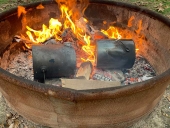
Mike Farmer wrote:At a small scale for animal feed, making biochar can be as easy as throwing a (clean/new) metal paint can with a few holes punched into it full of wood chunks into a backyard fire pit (or wood stove) while you have the fire. I've fed biochar to my chickens when I make it (I also add it to their bedding) and I think it's a great use for biochar (and the chicken's guts are great at inoculating biochar).


But don't you have to seal it off from oxygen after everything is burned?  Or would you just pour water on this?
1 day ago

Phil Stevens wrote:

This is a big part of why I have chosen to use the IBI terminology. I don't want to give the impression that you can take low-grade charcoal full of tars and gunk (or something at the other end of the scale that's practically graphite), soak it in compost tea or whatever, and suddenly have something that will do your soil a whole lot of good for the long haul...because it won't work. This is not to say that "accidental" biochar is worthless...most of it is good, because the temperatures reached in a wood fire are conveniently in the sweet spot for decent pyrolysis.



I have never made biochar, but am interested for the garden and livestock.  Is it possible to use hardwood charcoal to make biochar by further processing it?  How would you go about that?
2 days ago
I have an unlimited supply of spent blocks available.  Most are oyster varieties, some lions mane, chestnut, black pearl, and pioppini.

I'm wondering if I could use them in my pasture.  Would I just break them up and spread them?

Someone mentioned parasite control.  How could they be used for this?  Could they help control barber pole parasite in goats?

How should they be used for fruit and nut trees that are already established?

I planted a new bay laurel a few weeks ago, and broke up a block into the hole below the root ball.  It seems to be doing well so far - like it might live.  This is exciting because I've lost 3 other bay laurels that I planted.

I broke up a bunch of blocks and had my husband go over the new garden area with the rototiller (don't hate me, hopefully that will be the only time, but it was necessary).  So far, this garden looks better than any I've tried to grow the past 5 years.

Fabulous post, Beau!  Thank you.

1 week ago

Bonnie, can you share the approximate dimensions of the garden and fences?  What type of fence is it?

I currently have a large (175' x 200') garden that I inherited.  I had great success with a 3D electric fence (two wires on the inside and a 3rd wire 4ft away in the middle) for deer, but I'm struggling with grass on the edges and other animals like ground hogs.

I don't have chickens currently, but had great success with them keep areas cleared in the past.


The outside fence is 1/4 acre.  I'm not sure what the inside fence measures, I'd have to check.  We did the outside fence with 2X4 welded wire, 5' high, and T-posts.  The inside fence is electric poultry fencing.  The poultry fencing works well enough to keep the chickens in, what we call, the chicken mote.  We are discussing replacing the poultry fencing with the same 2X4 welded wire fencing to make it easier to weedwack along the edge.  The poultry fencing is designed to be portable, but it's a pain to move it every time we need to mow.  
1 month ago

Julia Schmoyer II wrote:This is cool to see. I think many jumping animals need a particular "runway" or visual clearance in order to make the jump, and this might just trick the deer's instinctual sense of physics into believing it's not possible to make the jump. Out here in Georgia, people talk about using a 2-fence system - installing 2 parallel fences about 4 ft apart. The deer can figure out how to clear one fence, but the small in-between space makes them think twice because they wouldn't be able to position themselves to clear the second one.


We use this two fence system and it works well.  We've never had a deer get in, or a hawk steal a chicken.  It was from an old article in Mother Earth News.  The deer don't have depth perception so they cannot judge the distance between the two fences.  Ours is about 10' apart.  The hawks don't like to fly in a corridor.  Our chicken coop is at one end and the chickens run between the fences catching  bugs before they get to the garden.  The inside fence keeps the chickens out of the garden.  Best thing we've ever done.  I think I posted a pic of it somewhere here several years ago.
1 month ago
I just purchased a linen shower curtain.  Linen is less susceptible to mildew, and easy to wash.  It does keep the water in, no splashes on the floor.
1 month ago
I wasn't sure where to post this, so here I am.

Terraponics is, supposedly, some type of cross between aquaponics and soil gardening.  I've just recently heard of it.  A couple sources on this are LA Crop Swap, and The Urban Hillbilly.  City Prepping did a youtube on LA Crop Swap that was good.  

I have plenty of land for gardening, but I wonder about the advantages of a system like this for city dwellers.  I do have some questions....like adding nutrients?  what is the make up of the soil biology?  I like to stick close to nature rather than thinking I know what nutrients to feed plants or soil.  But to a degree, most of us add nutrients in some form....compost, biochar, compost tea.

What advantages or disadvantages do you see?

Here's the youtube (I don't know how to embed them.) from Urban Hillbilly:  


And this one from City Prepping:  
11 months ago
[quote=Kevin Olson

Falci is an old school Italian manufacturer of hand tools - everything from scythe blades to leaf rakes.  Maybe like "True Temper" on the US - ubiquitous in hardware stores.

This model is somewhat like mine, though a lot beefier, and only having two big tines instead of three smaller ones:
https://www.falcitools.com/product-detail/zappino-006-classico-otondo-denti-arr/?lang=en


Apparently, United Rentals has the manual style of kick sod cutters for rent:
https://www.unitedrentals.com/marketplace/equipment/lawn-landscape/lawn-equipment/manual-sod-cutter-12

A couple of mom and pop hardware stores local to me have a fleet of rental tools, too, but I don't recall seeing a sod cutter in there - walk-behind trenchers, tillers, brush mowers, jack hammers, cement mixers, yes, but I can't remember seeing a sod cutter.

I think if you do a web search for "kick" OR "manual" AND "sod cutter" you'll get some useful links.

But, I had a square nose shovel already, so that's what I used.  It does work, and you won't need to use your gym punch card that week!

I think the kick style sod cutter would be a good option....if I can find one.  Thanks for the tips and links.
1 year ago

Kevin Olson wrote:

Know of anyone who's building a soddie?  They need a bunch!

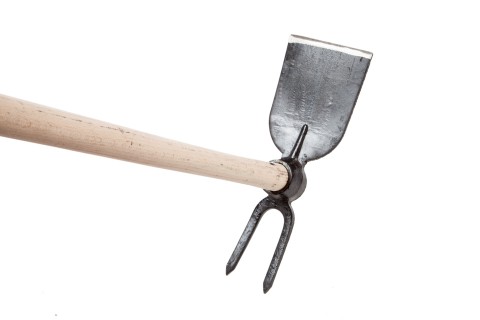
As a possible alternative to the sod cutter, for small plots, I've used a knock-off version of the Falci Magna Grecia hoe - a mattock on one end of the head, and fork tines on the other.  To be clear, the one I have is NOT a Falci, and is much lighter duty, but I found it used at the right price - a couple of dollars.  Because it's smaller, it takes smaller bites, but between the hoe blade and the three-tined fork, I can pull up sod fairly quickly.

When pulling up sod to relay (when I was fixing drainage issues around the stone foundation of my house), I used a square nosed shovel, and cut blocks that would fit on the blade of the shovel; so, first cut the edge(s) of the strip to the width of the square nose blade, either with a spade or the square nose, then sever the strip into short pieces, just the lengths of the shovel blade.  Then, slip the square nose blade under the roots, parallel to the ground surface, to remove a block of sod.  I slid the sods onto a tarp that I'd spread out adjacent to my excavation, trying to maintain some semblance of order for the relaying operation, but for your purposes, it could just be higgledy piggledy, I guess.

I'm sure the sod cutter would be better than either of my suggestions.  There are "kick" style manual sod cutters (I think Lehman's or somebody carries them), but I've never used one of those, either.  Too thrifty, I guess, so I used what I had.  But, for cutting a lot of sod, the proper sod cutter is probably just the ticket.


I think I'll try the shovel method.  If it doesn't work for me, I can then rent a sod cutter.  I'm not very accurate with throwing some of those tools...Falci---hoe, long handled ax, mallet, garden hoe; I can only imagine what it would look like, lol.  Thank you for your help.
1 year ago