• Post Reply Bookmark Topic Watch Topic
  • New Topic
permaculture forums growies critters building homesteading energy monies kitchen purity ungarbage community wilderness fiber arts art permaculture artisans regional education skip experiences global resources cider press projects digital market permies.com pie forums private forums all forums
this forum made possible by our volunteer staff, including ...
master stewards:
  • Carla Burke
  • Nancy Reading
  • John F Dean
  • r ransom
  • paul wheaton
  • Jay Angler
  • Timothy Norton
stewards:
  • Pearl Sutton
  • Tereza Okava
  • Nicole Alderman
master gardeners:
  • Christopher Weeks
gardeners:
  • M Ljin
  • Megan Palmer
  • Pete Podurgiel

Ha ha fence

 
Posts: 128
Location: kent, washington
4
  • Likes 11
  • Mark post as helpful
  • send pies
    Number of slices to send:
    Optional 'thank-you' note:
  • Quote
  • Report post to moderator
Thought this was interesting
https://www.permaculturereflections.com/the-ha-ha-fence-alternative/
 
gardener
Posts: 5770
Location: Cincinnati, Ohio,Price Hill 45205
1374
forest garden trees urban
  • Likes 8
  • Mark post as helpful
  • send pies
    Number of slices to send:
    Optional 'thank-you' note:
  • Quote
  • Report post to moderator
This is an old English garden technique.
It allows one to keep deer and sherp,etc off of the shrubbery without a fence spoiling the veiw.
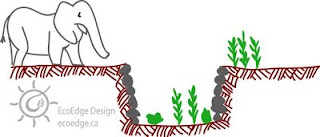
I believe one side is generally higher than the other.
 
trinda storey
Posts: 128
Location: kent, washington
4
  • Likes 3
  • Mark post as helpful
  • send pies
    Number of slices to send:
    Optional 'thank-you' note:
  • Quote
  • Report post to moderator
I was wondering if it would work for deer
 
Posts: 16
8
  • Likes 7
  • Mark post as helpful
  • send pies
    Number of slices to send:
    Optional 'thank-you' note:
  • Quote
  • Report post to moderator
A haha has the main intent of keeping the animals of a landscaped park (sheep, cattle, deer) from encroaching on the gardens around the house, yet keep the appearance of a continuous lawn stretching from the house into the far distance.  So there's a ditch rather than a raised feature like a fence, and the far slope of the ditch (away from the house) is gentle and grassed.  The near side is always a vertical wall, high enough that the animals won't try to jump it.  You'll get the dimensions by looking at the real ones around grand houses in England (which mostly have deer parks), that have been found to work.  Google 'haha ditch' and click 'images'.
Here, for example:
 
Posts: 11
Location: Olympia, Washington
  • Likes 2
  • Mark post as helpful
  • send pies
    Number of slices to send:
    Optional 'thank-you' note:
  • Quote
  • Report post to moderator
Might work for deer if you had a straight vertical wall 7 ft tall. Cheaper method might be an electric fence, depending on what you are trying to keep the deer from.
 
David Croucher
Posts: 16
8
  • Likes 2
  • Mark post as helpful
  • send pies
    Number of slices to send:
    Optional 'thank-you' note:
  • Quote
  • Report post to moderator
This photo shows a deer ha-ha as it's being used NOW for a deer park.  Maybe it's the slopes, but the deer won't cross.  In other places, yes - the fences are 8 feet tall, or the deer will cross - especially rutting stags!  They're fallow deer, by the way.
 
steward and tree herder
Posts: 14321
Location: Isle of Skye, Scotland. Nearly 70 inches rain a year
7978
6
transportation dog forest garden foraging trees books food preservation woodworking wood heat rocket stoves ungarbage
  • Likes 12
  • Mark post as helpful
  • send pies
    Number of slices to send:
    Optional 'thank-you' note:
  • Quote
  • Report post to moderator
I saw the lovely remains of a ha ha in a country house hotel we were celebrating a family anniversary in a year or so ago. The house and croquet lawn on the left, the (former) animal parkland on the right.
A big investment in labour to gain the perfect view, however this ha ha is about 150 years old and would still function over the remaining length.
IMG_20240817_182844.jpg
Ha ha fence in Scotland
 
gardener
Posts: 823
Location: Semi-nomadic, main place coastal mid-Norway, latitude 64 north
543
  • Likes 10
  • Mark post as helpful
  • send pies
    Number of slices to send:
    Optional 'thank-you' note:
  • Quote
  • Report post to moderator
Cool technique! I've seen references to this, but never understood what a ha-ha was... Don't think they've ever been used in my part of the world.

How wide is the ditch? Two meters or so? Just wondering if it would keep roe deer out. They can jump really far.
 
Nancy Reading
steward and tree herder
Posts: 14321
Location: Isle of Skye, Scotland. Nearly 70 inches rain a year
7978
6
transportation dog forest garden foraging trees books food preservation woodworking wood heat rocket stoves ungarbage
  • Likes 8
  • Mark post as helpful
  • send pies
    Number of slices to send:
    Optional 'thank-you' note:
  • Quote
  • Report post to moderator
From memory the wall here is about 6 foot tall, so maybe 2m+ wide. Maybe it would have been deeper originally. It probably depends on what livestock they were grazing in the parkland, but that could have included red deer. We certainly find that the sheep are less likely to jump a fence up hill than one that is below the road: I'm thinking a ditch could be used strategically with a fence to make it more of a barrier.
 
  • Likes 8
  • Mark post as helpful
  • send pies
    Number of slices to send:
    Optional 'thank-you' note:
  • Quote
  • Report post to moderator
This is cool to see. I think many jumping animals need a particular "runway" or visual clearance in order to make the jump, and this might just trick the deer's instinctual sense of physics into believing it's not possible to make the jump. Out here in Georgia, people talk about using a 2-fence system - installing 2 parallel fences about 4 ft apart. The deer can figure out how to clear one fence, but the small in-between space makes them think twice because they wouldn't be able to position themselves to clear the second one.
 
gardener
Posts: 3889
Location: Western Slope Colorado.
1013
5
goat dog food preservation medical herbs solar greening the desert
  • Likes 9
  • Mark post as helpful
  • send pies
    Number of slices to send:
    Optional 'thank-you' note:
  • Quote
  • Report post to moderator
I looked up “ha-ha” recently because one is mentioned in a Jane Austen book and I had no idea what it was.  What I find astounding is that these things were built in pre-industrial times.  No tractors or earthmovers or trucks, just teams of animals and equipment they can pull.
 
steward
Posts: 19487
Location: USDA Zone 8a
4904
dog hunting food preservation cooking bee greening the desert
  • Likes 6
  • Mark post as helpful
  • send pies
    Number of slices to send:
    Optional 'thank-you' note:
  • Quote
  • Report post to moderator
A gentle slope as seen in the photo that David posted will allow trapped animal to get out.
 
pollinator
Posts: 187
Location: Zone 7a, AZ
29
home care forest garden chicken food preservation medical herbs ungarbage
  • Likes 14
  • Mark post as helpful
  • send pies
    Number of slices to send:
    Optional 'thank-you' note:
  • Quote
  • Report post to moderator

Julia Schmoyer II wrote:This is cool to see. I think many jumping animals need a particular "runway" or visual clearance in order to make the jump, and this might just trick the deer's instinctual sense of physics into believing it's not possible to make the jump. Out here in Georgia, people talk about using a 2-fence system - installing 2 parallel fences about 4 ft apart. The deer can figure out how to clear one fence, but the small in-between space makes them think twice because they wouldn't be able to position themselves to clear the second one.


We use this two fence system and it works well.  We've never had a deer get in, or a hawk steal a chicken.  It was from an old article in Mother Earth News.  The deer don't have depth perception so they cannot judge the distance between the two fences.  Ours is about 10' apart.  The hawks don't like to fly in a corridor.  Our chicken coop is at one end and the chickens run between the fences catching  bugs before they get to the garden.  The inside fence keeps the chickens out of the garden.  Best thing we've ever done.  I think I posted a pic of it somewhere here several years ago.
 
pollinator
Posts: 993
Location: 10 miles NW of Helena Montana
572
hugelkultur chicken seed homestead
  • Likes 8
  • Mark post as helpful
  • send pies
    Number of slices to send:
    Optional 'thank-you' note:
  • Quote
  • Report post to moderator
My hat is off to the builders of that ha ha fence in Scotland.  The fence was probably built by hand and took a long time, the dirt that was moved, by hand......  Makes me appreciate modern equipment.
 
Posts: 1
4
  • Likes 8
  • Mark post as helpful
  • send pies
    Number of slices to send:
    Optional 'thank-you' note:
  • Quote
  • Report post to moderator

We use this two fence system and it works well.  We've never had a deer get in, or a hawk steal a chicken.  It was from an old article in Mother Earth News.  The deer don't have depth perception so they cannot judge the distance between the two fences.  Ours is about 10' apart.  The hawks don't like to fly in a corridor.  Our chicken coop is at one end and the chickens run between the fences catching  bugs before they get to the garden.  The inside fence keeps the chickens out of the garden.  Best thing we've ever done.  I think I posted a pic of it somewhere here several years ago.


Bonnie, can you share the approximate dimensions of the garden and fences?  What type of fence is it?

I currently have a large (175' x 200') garden that I inherited.  I had great success with a 3D electric fence (two wires on the inside and a 3rd wire 4ft away in the middle) for deer, but I'm struggling with grass on the edges and other animals like ground hogs.

I don't have chickens currently, but had great success with them keep areas cleared in the past.
 
Bonnie Kuhlman
pollinator
Posts: 187
Location: Zone 7a, AZ
29
home care forest garden chicken food preservation medical herbs ungarbage
  • Likes 2
  • Mark post as helpful
  • send pies
    Number of slices to send:
    Optional 'thank-you' note:
  • Quote
  • Report post to moderator

Bonnie, can you share the approximate dimensions of the garden and fences?  What type of fence is it?

I currently have a large (175' x 200') garden that I inherited.  I had great success with a 3D electric fence (two wires on the inside and a 3rd wire 4ft away in the middle) for deer, but I'm struggling with grass on the edges and other animals like ground hogs.

I don't have chickens currently, but had great success with them keep areas cleared in the past.


The outside fence is 1/4 acre.  I'm not sure what the inside fence measures, I'd have to check.  We did the outside fence with 2X4 welded wire, 5' high, and T-posts.  The inside fence is electric poultry fencing.  The poultry fencing works well enough to keep the chickens in, what we call, the chicken mote.  We are discussing replacing the poultry fencing with the same 2X4 welded wire fencing to make it easier to weedwack along the edge.  The poultry fencing is designed to be portable, but it's a pain to move it every time we need to mow.  
 
Posts: 50
Location: Heart of the Great Lakes in Southern Ontario
14
4
forest garden trees chicken homestead
  • Likes 4
  • Mark post as helpful
  • send pies
    Number of slices to send:
    Optional 'thank-you' note:
  • Quote
  • Report post to moderator

Eino Kenttä wrote:Cool technique! I've seen references to this, but never understood what a ha-ha was... Don't think they've ever been used in my part of the world.


Presumably, ha-has weren't used in Norway for the same reasons they weren't used in my part of Canada. I call reason #1: "Exposed bedrock." Reason #2 is perhaps because neither Norway or Canada were "blessed" with as many "great families" as England with their retinues of great numbers of land-slaves.
 If I was to attempt a modern ha-ha, I'd enslave a mechanical excavator or 'dozer and build a relatively shallow sloped ditch COMBINED with a just-high-enough fence ("aha-ha") to repel the hordes of marauding deer or attacking orcs. But because soil is endangered species where I live, I used wire and artfully piled stacks of stones.


pollinator
Posts: 451
136
2
dog trees books bee medical herbs
  • Likes 2
  • Mark post as helpful
  • send pies
    Number of slices to send:
    Optional 'thank-you' note:
  • Quote
  • Report post to moderator

David Wieringa wrote:

Bonnie, can you share the approximate dimensions of the garden and fences?  What type of fence is it?

I currently have a large (175' x 200') garden that I inherited.  I had great success with a 3D electric fence (two wires on the inside and a 3rd wire 4ft away in the middle) for deer, but I'm struggling with grass on the edges and other animals like ground hogs.

I don't have chickens currently, but had great success with them keep areas cleared in the past.


I'm not Bonnie, but below is a link to a great video by Tom Bartells of growfoodwell.com explaining and showing the "psychological deer fence" in detail. I learned about it from him many years ago, and let's just say that I was very excited to learn about such an effective and inexpensive method of deer fecning. In another video that he has on his actual site, he also mentions putting chicken wire fencing around the bottom of the outside fence to keep rabbits and other smaller mammals out. I'll just link both, they're about the same fence, but two is better than one sometimes.

On youtube:
https://www.youtube.com/watch?v=CL4vX4N_dyg

A different video about the same fence by the same person, done a few years before the above one with a couple of other bits of information about it (from the page on his websire https://growfoodwell.com/build-a-deer-fence/:
https://gfwvideos42014.s3.amazonaws.com/deerfence.mp4?_=1

 
pollinator
Posts: 1157
Location: Inter Michigan-Superior Woodland Forest
244
7
transportation gear foraging trees food preservation bike building solar writing woodworking wood heat
  • Likes 2
  • Mark post as helpful
  • send pies
    Number of slices to send:
    Optional 'thank-you' note:
  • Quote
  • Report post to moderator

Peter George wrote:
Presumably, ha-has weren't used in Norway for the same reasons they weren't used in my part of Canada. I call reason #1: "Exposed bedrock." Reason #2 is perhaps because neither Norway or Canada were "blessed" with as many "great families" as England with their retinues of great numbers of land-slaves.
 If I was to attempt a modern ha-ha, I'd enslave a mechanical excavator or 'dozer and build a relatively shallow sloped ditch COMBINED with a just-high-enough fence ("aha-ha") to repel the hordes of marauding deer or attacking orcs. But because soil is endangered species where I live, I used wire and artfully piled stacks of stones.


I wonder if local "exposed bedrock" would help at all with the construction of the stone walls shown in Nancy's and David's pictures? Is bedrock too difficult to extract dimensional material from?

Speaking of Freemasons, we should also recognize that without "great families" back then, we might have lacked the impetus to develop the wonderful array of socialist organizational strategies we have today:

Is this where the term "ha-ha" comes from?
 
Rocket Scientist
Posts: 4796
Location: Upstate NY, zone 5
754
5
  • Likes 4
  • Mark post as helpful
  • send pies
    Number of slices to send:
    Optional 'thank-you' note:
  • Quote
  • Report post to moderator
"Exposed bedrock" can mean many things depending on the type of rock. Some like shale might be fairly easy to quarry or pull up chunks, while others like granite would be totally impractical to modify without specialist tools and knowledge... and a whole lot of energy
 
master pollinator
Posts: 2200
Location: Ashhurst New Zealand (Cfb - oceanic temperate)
784
duck forest garden fungi trees chicken cooking solar sheep wood heat woodworking rocket stoves
  • Likes 4
  • Mark post as helpful
  • send pies
    Number of slices to send:
    Optional 'thank-you' note:
  • Quote
  • Report post to moderator

Glenn Herbert wrote:"Exposed bedrock" can mean many things depending on the type of rock. Some like shale might be fairly easy to quarry or pull up chunks, while others like granite would be totally impractical to modify without specialist tools and knowledge... and a whole lot of energy :)



Did someone say they needed a little homemade black powder?

When I as at uni and worked in a lab, one of my jobs was to look after the hydroponic greenhouse where we grew the plants for tissue. As it happened, the standard soluble nutrient mix called for a lot of potassium nitrate, and there were many bags full of powdered sulfur to use on fungal oubreaks. I really couldn't say how much of those ingredients went unaccounted for, nor could I speculate on how I crushed a bunch of charcoal behind the apartment I lived in.

I only realised many years later that I should have invited my uncle over. He was a munitions tech in the Marines and did a little freelance work after he returned to civilian life.
 
We can fix it! We just need some baling wire, some WD-40, a bit of duct tape and this tiny ad:
12 Better World books +12 SKIP books +12 Cob Style DVDs
https://permies.com/wiki/380865/World-books-SKIP-books-Cob
reply
    Bookmark Topic Watch Topic
  • New Topic