T Melville

gardener
+ Follow
since Nov 16, 2015
Merit badge: bb list bbv list
Biography
This will show me where my real bio will appear if I write one.
For More
SW Missouri • zone 6 • ~1400' elevation
Apples and Likes
Apples
Total received
In last 30 days
5
Forums and Threads

Recent posts by T Melville

I decided to combine your ideas read, then half remembered Carla Burke's post above. I sprayed it with peroxide, let it sit a while and rinsed with water. After it dried, I poured a little vinegar in the bottom, saturated paper towels in it, and draped the sides and rim. Later I'll rinse it out again and consider it ready.

Christopher Weeks wrote:Do you know what the volume is? (The images don't have anything to provide a reference.)


I also used the vinegar jug for scale. I'm guessing it's about a gallon to a gallon and a half.

Sanitizing with vinegar


Measuring - Vinegar Jug for Scale
1 day ago

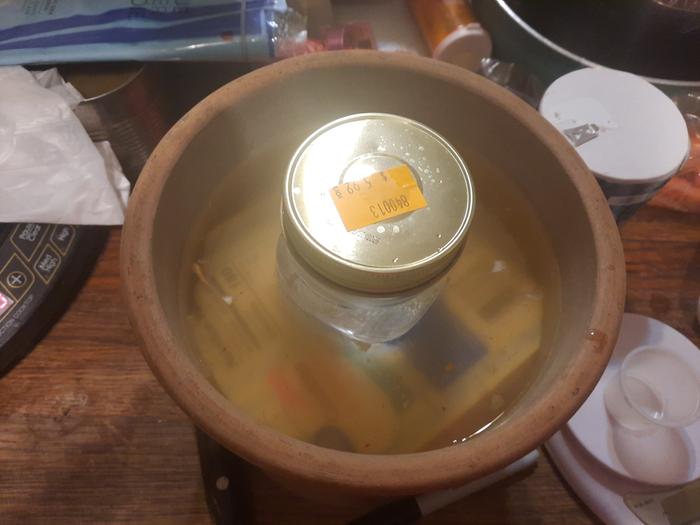
Christopher Weeks wrote:I wouldn't. An airlock is for situations where you're going to leave it alone for a long time and keeping the top of it blanketed in CO2 is a valuable mold preventative. The point of a perpetual crock is to take things out and add new things all the time. I'd try using a straight-sided crock and find a jar that almost fills it but allows you to weight the produce down to keep them under the brine.


I saw this in the garage about 25(ish) years ago and kept it in mind. As I recall, I didn't know what it was for until I saw one in an antique shop. This is the crock you mentioned, right?

What a crock!
What a crock!


Bottoms up!
Bottoms up!


Guess I should look into it.


I washed it, but the garage is open. This hasn't been rained on, but it's been exposed to heat and cold, dust, and anything blowing in the wind. I don't want to use anything harsh on it. Would it be prudent to put it in a big pot and boil it, or bake it in the oven to sanitize it? It feels glazed, but I don't know how porous it is. If I put it in the oven, should I use a heat below boiling for a while to get out any water so it doesn't explode? Or put it in the dehydrator for a day or two?

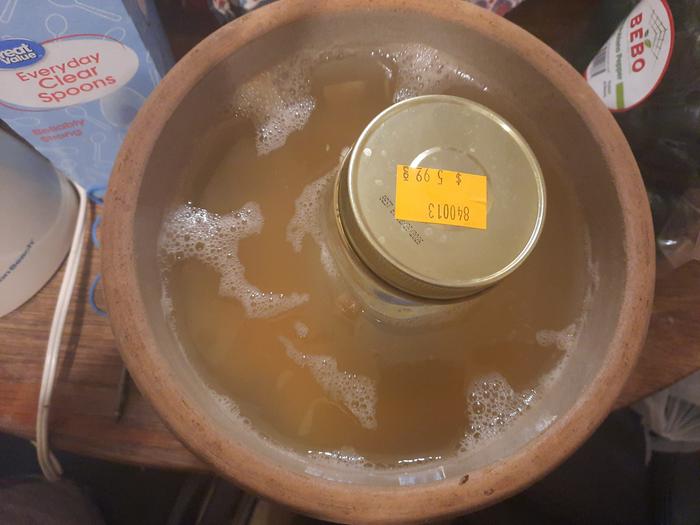
Once the crock is ready, I'm getting the impression I just need all the food to be below the surface of the brine. Is that right? Is the jar you mentioned just used as a weight? (On Good Eats, I saw Alton Brown do something similar when he fermented pickles, but with a gallon ziploc bag of brine. He said you could use water, but if the bag leaked, it would dilute the brine and salinity would go down. With brine in the bag, if it leaks, you just have more brine.)
2 days ago
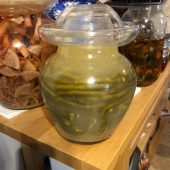
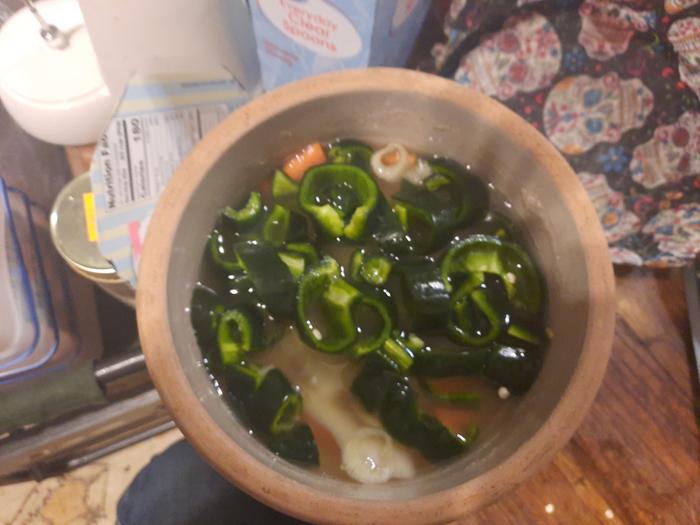
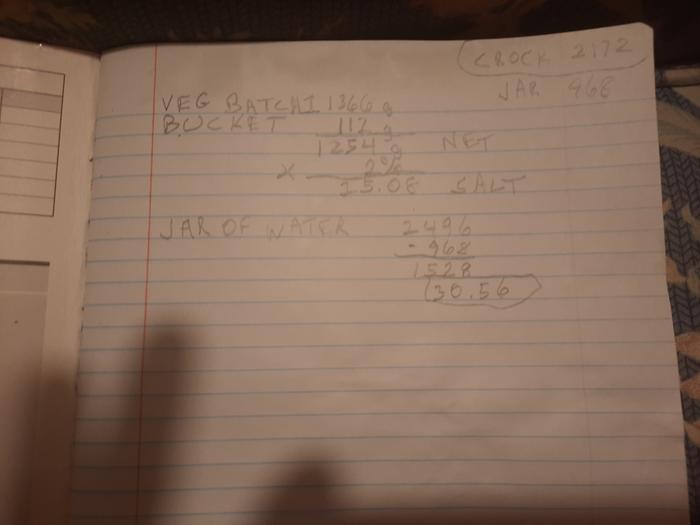
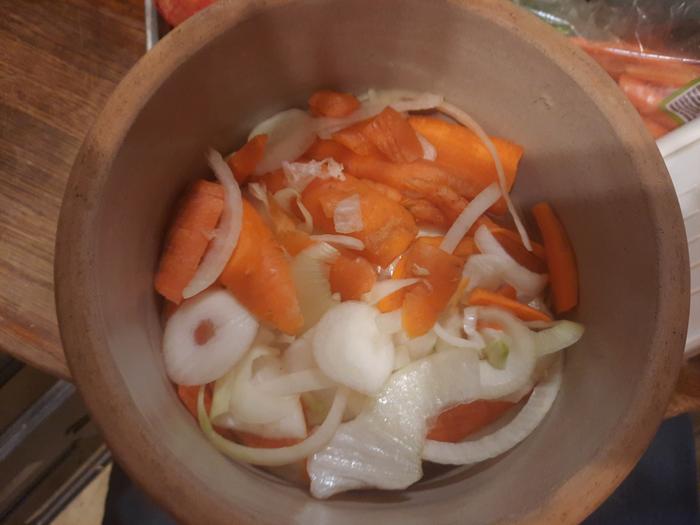
I've done very little lactofermentation, but I'm hoping to start a perpetual jar for the sake of my gut health. I was planning to cut up some onions and carrots, put them in the jar first, cover with water, weigh, subtract the weight of the jar, and add salt equal to 2% of the weight. I was going to put in two cans of sauerkraut and a jar of kimchi  to bring some heat and flavor and to boost fermentation.

Of course I have some questions:
1) How is the plan so far? I can adjust for flavor down the line, but is this going to be safe and effective?
2) I know temperature affects speed. I even read that it's wise to add a little extra salt if it's hot. Should my jar be on the counter or in the fridge? If it's on the counter, how do I know when to put it in the fridge?
3) If it's on the counter, I plan to find and use my airlock. I don't trust my self discipline to loosen the lid and let it off-gas as frequently as I should. Since refrigerator fermentation is going to be a lot slower, should I use the airlock if it's in there, or will just opening it every day or two be enough?
4) The carrots and onions are what I have on hand right now that I think would be good for this. What would be good future additions? I know I'll have asparagus and garlic later. Sunchokes are probably available right now, if I cared to look for them. Waiting for them to grow out will make them easier to find. There may be cucumbers and or green beans later. What else do you folks recommend?
5) Is there any rule of thumb for knowing when each veggie is ready to eat, or is it just constant tasting and experimentation?
6) Searching online, I can ask a question and get any number of conflicting answers. I'd love to hear what resources you trust. I'm more likely to use websites, downloadable PDFs from colleges, free e-books, etc. But a hard copy book (though it's a fall-back position to me) could be helpful to someone reading this later, so let's hear about those too.
3 days ago
When I'm invited to install an app to use for something I can do on a web site, it has to pass through the filter of: "How would using this app improve my experience compared to using the website?" before I even consider installing. Most fail. What I'm usually offered is a broken browser. A browser that can only visit one website is broken, right?
1 week ago
Paul said that somewhere. It may have been in the podcast.
3 months ago
art
I just thought of something that may help. If you'd like to use your kindle, but download the ebooks elsewhere, your kindle (or kindle app, on another device) has a unique email address. You can email ebooks of many formats to it. After a little processing time, it will show up in your kindle library. I used to do this a lot with books from project gutenberg. I found that I was happiest with the results if the ebook I was sending was in epub format.
If this sounds like something that might help, here's a link to instructions. If it's a little intimidating, let us know where you're hitting a snag and maybe we can walk you through it.
4 months ago
In what form or format are the ebooks available, and where are you allowed to download them from? There are lots of free ebook reading options available for windows, android and linux. (Mac too, I'd bet, but I haven't looked into it.) There is at least one free converter for windows and linux to convert ebooks from one format to another, though it may be difficult or impossible to use on proprietary ebooks like those controlled by kindle.

We might be able to help you find more resources if we knew a bit more about your situation and needs.
4 months ago
I'm thinking of making some beeswax candles and would like some input on enhancements. I want to keep everything as permie and non-toxic as possible. I know I can add ready made scents and colorings, but I don't know how they're produced or what's in them.

I'm really liking the idea of putting some cinnamon sticks in the wax. Is there anything in a cinnamon stick that hot wax could extract and hold onto? That would give me an option to use the scent even if I remove the sticks. The wax is so opaque that I don't think they'd be visible unless they were really close to the outside. Nobody has a worse sense of smell than me. I noticed that walmart has at least 2 different brands of cinnamon sticks. There's a significant price difference and I'd imagine a difference in potency. They were all sealed, I couldn't smell anything. I want to make candles with a pleasant scent as if cookies are baking, not an overpowering odor like being suffocated in a barrel full of cinnamon sticks. So... do I want to try the cheaper ones or the pricier ones?

I have a few pine trees out back, I have a hunch pine needles could be good for this project, though probably a different batch. I don't think I've ever heard anyone request cinnamon/ pine scent. I have pretty much the same concerns: can I extract the scent and remove the needles? What kind of potency can I expect?

I'm open to other scent ideas. Stuff from around the house, or leads on ready made scents that fall within the values I'm trying to adopt. Same with colors. Nothing natural comes to mind, unless polk berry purple is wax soluble. I doubt standard issue food coloring is within the value set. Plus I suspect it's water based and wouldn't dissolve properly. I could blend crayons into the wax, but I don't think that's a good fit. Surely Hobby Lobby has colorings, but I don't know what's in them, so again I'd love to hear from anybody who knows what's good to use and doesn't have stuff in it that you shouldn't breathe in.
4 months ago

T Melville wrote:...They must've been pretty standardized, at least at the time...


I looked it up at Ace Hardware. (A search showed they're popular in your neck of the woods.) It seems the solid rubber ones we used to sell have gone out of style. They do have one though. (See attached picture.) It looks like what's on my current washer. I've always suspected the old style would work too. This may be the evidence. Used to be, the hose needed to be flexible (and a little stretchy) and fit over the outlet of the machine. It would be clamped. I suspect the lower end of this new style is rubber and fits the same, but it would be good to check on that part.

Ace Hardware wrote:This washing machine discharge hose fits most washing machine discharge stubs


link
6 months ago

Thekla McDaniels wrote:...The washer has cracks in the drain hose.  I can’t find the model number...

Any suggestions?


My knowledge is old, things may have changed since. On the other hand, I don't know the age of your machine. At my first job (In a hardware store) we stocked one kind of washing machine drain hose, and didn't ask about make or model. They must've been pretty standardized, at least at the time. You could bring the cracked hose or  a tiny slice of it to confirm it's the same diameter and compatible material, but I doubt that's necessary.
6 months ago