L Cho

+ Follow
since Feb 03, 2016
Merit badge: bb list bbv list
For More
Apples and Likes
Apples
Total received
In last 30 days
8
Forums and Threads

Recent posts by L Cho

And I forgot to add, vacuuming some spices that come in plastic jars, keeps them from caking up.

Some companies sell spices and other things in plastic containers. This is bad faith by design, because plastic containers do not seal well, and any hygroscopic contents will create their own vacuum, by absorbing all the available water vapor, which in turn, pulls in more air containing water vapor, leading to a vicious cycle that fully cakes the contents. Their goal is to force you to buy a replacement, because you can't use it when it has solidified.

So your garlic or onion powder, instant coffee, anything that cakes up and is sold with a plastic lid, should be vacuum sealed, to keep it dry. Some companies use the tried and true glass jars with gasket lids, which most perishable foods come in. Those are the companies who you should give your business, because they are not selling you a purposefully leaky container.
1 day ago

Sandy Stacey wrote:I second the glass jars and vacuum seals.


I also store dry goods in vacuum jars. For anything that would oxidize, such as nuts, or get stale or soggy, such as crackers, a vacuum acts like a stasis field, preserving it almost indefinitely. No air means no oxygen, moisture, bugs, or mold.

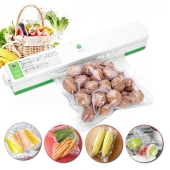
When I first got a vacuum sealer, I used it for packaging meats for the freezer. Used properly, it does a really great job at this, and I have not dealt with freezer burn ever since. Eventually I got some mason jars, and then realized what a game changer vacuum storage is. All of the dry goods that I used to date code and store in the freezer, only to eventually throw out the remainder after a year or so, could now be stored indefinitely in vacuum jars. And now I just write the year, only for reference, because I don't have to throw any of it out.

Any dry good that goes bad over time can benefit from this. Powdered milk stays pristine white, instead of yellowing through oxidation. Nuts never go bad. Coffee smells the same as when you first cut open the vacuum package. Spices last forever. Baking powder does not lose its efficacy. Any seldom used ingredients can be kept in like new condition.

Some soup recipes involve pouring all the dry ingredients into a pot, adding water and then simmering. You can premix the dry ingredients, and vacuum seal them in a jar, for when you are in a hurry for some soup.

Flour mixes for pancakes or biscuits can be premixed, and vacuumed.

Any dry good, with a true expiration date can benefit from vacuum storage.

There are tricks I have learned or come up with over the years.

Tapping on lids tells you the state of the vacuum. A dull thud means you seal was lost. A clear note means everything is good. I check my jars periodically for vacuum.

A good vacuum negates the need for lid rings. I just buy the lids now, as I have excess rings.

Lids can be reused many times, but gaskets will wear out eventually, although I have some I have been reusing since I first started. The newer ones don't seem to last as long.

Foodsaver makes mason jar sealer attachments. Their regular mouth sealer needs to be shimmed to work reliably. Put a lid on the jar and then stack another upside down, over it. Then seal the jar. The shim keeps the lid pressed down so that it seals properly when you release the vacuum.

The jar rim and lid gasket must be scrupulously clean. Even the tiniest bit of dust can cause a very slow leak. This can  be a big problem when sealing flours, as drawing the air out, creates dust clouds that get under the gasket. I solved this problem by poking a vent shaft, down the center of the flour with a chopstick. Air gets out through the vent shaft, and no clouds of flour rise up to foul the seal. My vacuum sealed flours no longer leak.

Breaking the seal on a mason jar can be difficult, because you don't want to damage the lid. The easiest method I found is using a chopstick, specifically the square handled cooking chopsticks. I put the chopstick tangential to the jar, with the square end underneath the rim of the lid, and spin the jar around until the chopstick is wedged between the rim and the jar thread, and lever the chopstick to lift the lid enough to break the vacuum. No lids are harmed doing this.

Non mason jars can be vacuum sealed through one of two methods. Chamber sealing, or punch and tape:

Chamber sealing involves using a larger container to vacuum a jar or jars inside. Wash and reuse any food jars that have gasketed lids, lightly close the lids, and vacuum them. Tap on the lid to be sure.

Pump -N- Seal sells a kit for vacuum sealing any food jar. It comes with punch, pre-cut squares of sealing tape, and a vacuum pump that goes over the tape covered hole. The pump is operated until the air is evacuated, and the tape seals the hole as the air tries to rush back in. Their kit is handy because it is hand powered, and works anywhere, but you can roll your own if you like. A metal push pin acts as your punch. Electrical tape is thick enough to create a hermetic seal. Any adapter for reusable zip lock vacuum bags can cover a taped hole, so one of those can vacuum your jar.

Vacuum storage, either in bags or jars, can be great for preserving almost anything that oxidizes or hydrates when exposed to air. Metal parts will not rust. Fabrics and leathers will not mold or mildew, and moths cannot get to them. Books will stay pristine, and silverfish can't survive without air. Matches will stay forever dry, and your first aid kit items can be individually waterproofed.

You still need to periodically check for leaks.

6 days ago

Thekla McDaniels wrote:To me, the discussion of medical benefits is germane…. if you are washing your rice to rid it of “contaminants” that also have medical applications, to me it speaks to the idea that tiny amounts are negligible, sometimes beneficial.  Wash if you prefer, but for those who stress over such things… it says “don’t worry” there’s probably no harm in it.


The problem is that the amount of arsenic in rice can be quite variable, based on where it is grown. Some areas have higher amounts naturally occurring in the soil, and some places have it from pollution. Some governments monitor arsenic levels in rice, but it varies worldwide. If your rice comes with high levels of arsenic, then washing is advised, because it can reduce the dosage by a measurable amount.

And it is a similar problem to fluoride in water. Your dosage depends on how much you consume, compared to your body weight. Small children can get comparatively much higher dosages because of their much lighter body weight.
1 week ago

Anne Miller wrote:
Did you know that there are medically approved benefits?  I have heard it is used for treating certain cancers,  leukemia  for one.


I don’t see how those medical uses apply here. We are talking about consuming rice, where any reduction in arsenic content, is a good thing.
1 week ago
Just an observation.

Rice is overall more calorie dense, and supports much bigger populations than other grains. More than half the world's population in fact.*  In Asia, there are cultures that choose rice for its flavor, and ones that choose rice for its calories. Thailand has jasmine and India has basmati. Korea and Japan are very selective of their short grain rice, with entire stores devoted to hyperlocal varieties. Population pressure has historically forced China to select rice for its calories.† This is changing. Increasing affluence has allowed the Chinese consumption of Jasmine, Basmati, Korean and Japanese varieties to increase.

Growing up in America many years ago, I found when eating out, that American rice was chosen for its calories, as it had no flavor of its own. This was in stark contrast to the short grain rice I ate at home, which tasted great, just by itself. I have been very glad in recent years to see the growing interest in more flavorful varieties, including some domestics, such as Carolina Gold, Blue Rose, pecan rice, and others.

So if you have been eating rice as a filler, just for the calories, it is time to branch out and try some flavorful varieties, that taste good, even without being smothered in gravy.  

*The Valeriepieris circle shows this.  

† In 1970, Yuan Longping, a Chinese agronomist, discovered a rice variety growing in a drainage ditch, and created hybridized rice, to increase yields 20-30%, and gave China the ability to feed its rapidly growing population. He received the Medal of the Republic, China's highest honor.
1 week ago

Anne Miller wrote:
How in the world can washing rice in the home remove enough arsenic to be beneficial>


Wouldn't any removal of arsenic, even a small percentage, be considered beneficial?
1 week ago
I am Korean and I was taught to always wash my rice. My mom showed me pictures of rice being dried in the streets, and explained that it is a common practice in most of Asia. She also taught me to wash produce, and wash the lids of cans before opening, because rats live in warehouses, and pee on everything, and roaches crawl everywhere.

Most grains never get washed between farm and table, primarily because they must be kept dry. I imagine that rice or other grains from industrial farms, here in the US, gets harvested and processed mechanically, so no street dirt, but there is still plenty of dust and pollutants that can make it past the blowers, and get bagged with your seeds.  
1 week ago
The feature that I look for in a wire whisk is a sealed handle. Specifically where the wires enter the handle. The good ones that I have used are sealed with epoxy, or something similar, preventing food from entering the handle. In my experience, it also seems to hold the wires more firmly.
2 weeks ago
My girlfriend uses two sheets. One underneath the mattress. Tie the sheets together at the corners with a simple square knot. The sheet underneath can be left in place when changing the upper sheet.
3 weeks ago
My experience is that sock makers have changed the way they make socks. Most of them have gone from a fully knitted sock, to one having a sole equivalent to a looped pile rug. One with a very thin weave supporting the loops. This makes the sole feel thick and cushiony, but also more prone to holes, when the thin weave fails.

Occasionally, I find fully knitted socks, and they last much longer.
4 months ago