Elizabeth Cramer

+ Follow
since Jan 28, 2024
Merit badge: bb list bbv list
Biography
Extremely rural primary care provider in a solo practice in the Cascade foothills of Blue River Oregon. Time spent foraging wild food (especially mushrooms), basket making with harvested materials, and engaging in various bushcraft related hobbies.
For More
Apples and Likes
Apples
Total received
In last 30 days
8
Forums and Threads

Recent posts by Elizabeth Cramer

Hey, I’m an avid forager. Equal opportunity and very general (mushrooms, lichen, moss, greens, ferns, rocks, clay, switches, bark, roots, cones, nuts, fruits, trash, plant starts, etc. I let the area tell me what’s ready at the time, but while out and about. I barely ever enter the area I am foraging with a certain plan. So my foraging kit is extremely generalized and tiny. It’s a fanny pack, a few carabiners (to clip bags to my fanny pack), a few plastic poo bags and random fast food wrappers  (for various tiny objects), a hawksbill knife (various uses), ratcheted pruners (switch cutting), a pair of needle nose fishing pliers (really short is good for fanny pack, used in basketry usually), a 3” round masonry chisel (or will sometimes use a pencil) (this is for poking holes into willow switches for basket bases, also for rockhounding). Then in my cross shoulder cloth bag I use for collecting, I’ll have a collapsing car trash can and one of the more robust plastic grocery bags. Sometimes mesh laundry bags. Then in the car, I’ll have a 2gal bucket or 2 as drop spots. Various mesh bags. Extra plastic bags, a few baskets. A big collapsible trash can (always hopeful, rarely needed). Gloves, shovels, rakes, extra rain gear, a mini chainsaw. This is my world and thank you for asking!

Photo is me with this exact fanny pack+cross shoulder bag setup i described above.
6 hours ago
Bump! Hey there from McKenzie river. You are in an awesome place when it comes to Homesteading. I hope you can find some land that’s affordable . Take care, and I hope you find a lady, the area has many IME, and if they are here on Permies, they’re already in the right place, just like you! Bump!
6 hours ago
A few tips/notes on my learned experience with wilderness wear while “doing work things in the woods”. Most of the advice centers around the fact that in winter, you need to have a protective layer of air and be able to stay dry.

Latex or rubber gloves underneath regular working gloves are perfect for waterproof work.

Split cowhide gloves that are a size too large and you are invincible against blackberries and (most) cactus.

Final glove advice is to use two different kinds of gloves. You get your big fat glove that’s waterproof for your non-dominant hand, and then your small fitted working glove for your dominant hand.

Rain boots that are one size too large and double layer socks are better than snow boots any day.

sock liners or just really thin and tight socks underneath big chunky waterproof socks will keep you warm and dry, even if your shoes are not waterproof. Tested down into the 38° water of the McKenzie River for Riverside cleanup all day.

OK, get a nice rain poncho. You can put that shit over everything. Combine it with a tiny plastic foldable bench, and you will be invincible in the woods and do whatever you wanna be able to do, seated!

A couple well placed carabiners on a book bag shoulder strap serve as an umbrella holder so you can have a hands-free umbrella experience.

Do not wash waterproof bibs. I know it’s gross, but just don’t. Just buy them a little bit cheaper and be willing to get rid of them. There is not a product that can adequately waterproof them. We’ve tried them all (scotch guard, technu wash, polyurethane spray, tent waterproofed, deck sealer, plexiglass melted into alcohol and then used as a soak, egg wash,  and they only get weirder from there). We’re always open to trying something new though.

Boot dryer. It’s a necessity if you wanna work outside and wet weather.

Layer your clothing with the understanding that you might have to take that clothing off to go to the bathroom.

Have doubles of everything and maybe even triples.

A handkerchief tucked up near your chin, like a bandanna around the neck for example, that can go a long way with wiping your face or eyes without you having to take your gloves off to do it.

A hat that has been wet with snow or rain can be made dry with about 15 minutes of the car dash defroster while driving to your next destination.

If you can’t get about four hours of use out of any one waterproof thing before it starts to have leaks or if you pull your hand out of a glove and it goes inside out, get rid of it or trade it to somebody who doesn’t go as hard!!

Children’s size snow pants or waterproof boots or even snow boots at the largest size that you can get are very often found in the children’s sections at donation stores and are rarely utilized because by then most children have gone to the adult sizes. They totally fit if a person is lucky enough to be a smaller framed individual. Also, you can purchase them from stores for around half the price as adult sizes. Just make sure that the size actually fits!! There are size conversion charts for those interested. I got a pair of kids waterproof fly fishing bibs for $60 when their adult counterpart was over 300!

And be ready to get nakey and hop in the tub immediately upon return home.

And finally, good moisturizer after can be really helpful at keeping weird finger cracks from happening.

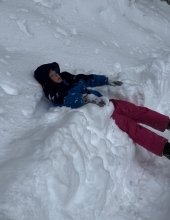
Context: I live in the cascade foothills in Oregon, where it’s very rainy in the winter. Most of my time is spent in the Willamette national Forest hunting mushrooms and making baskets or structures while out and about. Harvesting wild things take some really specific gear. And between my landscaper partner and I, we’ve had years to determine which is best. Thanks for reading! (Photo is of my son falling into a snow drift for fun because this gear was so good
1 week ago

Nancy Reading wrote:

Elizabeth Cramer wrote: And I’ve made coil baskets with them.


Hi Elizabeth - I don't think I found making baskets as a use for bracken...Do you use them green? I find the stems rather brittle once they are mature. What do you use the baskets for? How durable do you find them?


Hey Nancy, thank you for your question. I wanted to offer some validity to what the post was about, how it said that it could be used for thatching. Yes, it can be used for all types of textile things, including baskets. So, I am not somebody who prepares when I make my basket. I’m somebody who walks around and grabs things in real time. I tend to use the tops and not the stems because I like the way the fronds stick out. The better ones are ones where they have gone through an entire winter. I’m guessing the brittle part that you mentioned probably gets retted away in the decay of winter . The green does not work. The barely dead does not work.

Another material that is quite similar (but stronger) in how it functions as a basket material is sword fern if you happen to have any near you.

How I use the baskets is variable, and I have done each of what I am about to say. The basket ends up being very floppy and malleable. And so gorgeous. They make great inserts for metal hanging planters and you can plant right in them. The other use is as a seed starting ‘pot’. I’m guessing they taste bitter because creatures seem to be avoiding of them but plants don’t seem to mind them at all. I have one little hand size bracken basket that has made it inside for two years now as a planter for an orchid. But finally, I use them as decorative add-ons for their color and their fronds. They do not make the best exclusive material for baskets. But they are gorgeous bonus material.
2 weeks ago
Hey there, my family and I routinely eat Bracken fern shoots in the spring. Should we eat them from Forest fire areas vs from healthier ecologies only is the thing up for debate. And that’s just because it’s morel season. And we use them as a gauge if morels are coming yet (if the eagle’s claw has opened, it’s morel time). And I’ve made coil baskets with them. Good for restoring areas. Keeps weeds out.
2 weeks ago
Just wanted to show off my little chair I made from beaked hazel! The 2020 Holiday Farm fire in Oregon killed several younger wild hazel trees in the understory. The resulting wood is very straight and the bark is shiny silver.
First off, that is an adorable project to be starting with children . Well done on your innovative teaching method. I am a basketry nut x5y and I’ve been cobbing for 2y. Imagine how exciting it is to answer questions about a technique that combines two in one!

Second off I’d like to answer your question. As I was reading your post I instantly thought of natural hemp fibers. But then you mentioned nettle so you and I are thinking similarly about fine fibers for a tiny project. In order to scale it, nettle wouldn’t really be easy to source though. my idea for you is to cut up twine. Bonus if it’s hemp twine. You might get an aesthetic that is more pleasing with your paper clay if you were to use natural cotton and you can get a massive role of it if you buy cast padding. Another additive could be loose tinsel. I thought kids could like that. Or maybe even like friendship bracelet pieces, I don’t know I’m just trying to think outside the box for you . Anyways, good luck and I sure sure would love to see what you come up with.
1 year ago
cob
Hello, I live along the McKenzie River in Oregon (just west of the cascade crest). My area is affected by fires and has volcanic soil. I would guess it’s not dissimilar from Klamath. How I make cob without clay is either by adding manure (the boring way) or by collecting the talc like soil in the ditches of burn scar areas to add to my straw and soil (the fun way). The best runoff happens when I see open patches of white basalt rocks, My suspicion as to why this works so good is because it’s probably some natural cement/lyme. I build random cob things all year long and the manure version is better suited for building in the summers and the burn scar runoff version is better suited for the wet seasons.
1 year ago
cob