
Jeff Bigelow

+ Follow
since Feb 07, 2025
Merit badge: bb list bbv list
For More
Apples and Likes
Apples
Total received
In last 30 days
4
Forums and Threads

Recent posts by Jeff Bigelow

Joseph Fabbri wrote:The Framework laptops seem pretty sweet, the price is high though.  I'm on a Lenovo Thinkpad p15 gen1 running Linux Mint.  I've also run Zorin on it and I don't like it as much -- I ran into some software issues.  Ubuntu is easy but Mint is more secure.  Many laptops are pretty upgradeable.  My kids are running on cheap Dell Latitude 5490 laptops.  All of these are somewhat upgradable and they were cheap.  Long term it can be smart to just get something lower price and get another laptop down the road.  I recommend just going with used and refurbished stuff on Ebay, you can save a lot.  This laptop I'm on can upgrade to 64GB of Ram, right now it has 32GB.  I throttled the CPU frequency back and turned off turbo boost to increase battery life.  We have no power in our house so the laptop battery life was a big priority in our computer picks.  Earlier in my life I loved playing games and always built power hungry desktops.  My nerdy younger self would be ashamed of what I use as computers these days haha.


I also changed over from a Thinkpad P14 Gen 2. I was just running up against limitations on the CPU power and thermal throttling. If I didn’t need additional power, that would have been the last laptop I ever owned probably. I will set it up as a second device for at-home use with Linux Mint most likely.

But again, at some point, the CPU in that will be 20 years old and need replacing, which isn’t possible on that motherboard. Here’s to hoping Framework exists that long so I can change out the CPU in my new computer at some point.
1 week ago

Matthew Muhlig wrote:I hadn't seen Zorin before but since it is linux at its core it should work good.  As an open source OS it is only as good as the community and devs are though.

To the main topic, framework laptops are neat - I have followed them for years but the bang for the buck has never been there.  Technology works too fast to truly make it future proof (in a financial way).
Honestly I think along the lines of the people with older equipment that put a streamline OS on theirs are the right move for longevity purposes, I have old laptops that run fine on a linux kernel.  OS systems are far too bulky nowadays and that is the main reason computers show their age, probably intentional in design as well.

I worked as the IT director at a K12 school district and there was a single desktop that chugged along fine with XP.  It ran just as well as any of the new ones for what it was needed for.  The only thing that made me nervous was it was running a legacy meal program, and if it died that program was sunset over a decade ago, so I would have been dead in the water and all of the kids would have had free lunch or gone hungry XD

Going streamline is easier said than done.  I am in the IT world and I also am from a gaming generation so I have a beast of a computer, would never consider a laptop to be the workhorse of my life.

There is an opensource printer that I am ALL for though, I can't wait for it to be released!  


I agree that Framework offerings are more expensive than their competitors’ equivalents, at least when you just look at the hardware spec sheet. But I find the cost bump worth it when I factor in the fact that a broken display isn’t going to cost and arm and a leg to fix, or that I can upgrade the entire motherboard/CPU in 5 years when I need more compute power to meet my changing software demands.

But yes, no computer will ever be truly “future-proof”, but this is a great start in my opinion
. And I agree on streamlining your OS packages! What a great way to get older hardware to continue to run well.
1 week ago

John C Daley wrote:Jeff are you talking computers in general rather than laptops?
I use desktops everyday, but not laptops.


Framework is unique in offering a laptop that is at least notionally fully repairable and upgradeable. Others in this thread have correctly noted that this relies on Framework's continued financial solvency in the future (although RAM sticks and solid state drives can be sourced independently). Most laptops these days have soldered RAM sticks and none of the other main components can be swapped out. A notable exception to this are certain Lenovo Thinkpads, but even those are becoming more and more difficult to repair and upgrade as new models come out.

Desktop computers don't have a history of being nearly as difficult to repair or upgrade, so I'm not really talking about those as much. This is mostly aimed towards people that have a need for a laptop every day.
1 week ago

Cristobal Cristo wrote:I understand the concept, but the price is steep for something that will need even more cash invested in the future. The problem is software and lazy developers, so all the IT world is rather the complete opposite of "sustainable".

I use a work laptop. For my home use I have a $100 laptop with XP Pro, AutoCad 14 (before it got a new annoying "rubbery feel" interface) and awesome Corel Draw 8. All the software performs beautifully. I use it for designing buildings, masonry heaters, metal objects for machining, stonework, etc. All the designs became real structures and objects.

The 3 components of the laptop that fail the most are:
keyboard/pad, screen connection, battery. My company laptop has pretty bad keyboard, but still an excellent battery (rather not replaceable in an easy manner - disposable phone style). It works in dusty, hot/cold environment and still is going strong. I could already get two new replacements but I want to keep it as long as it lasts to minimize waste. I have an external backup keyboard, in case this one fails completely.
My home one needs a new battery every 2-3 years - as the aftermarket clones are low quality and original is pricier than the laptop. I already have it for 12 years. This company, albeit a good concept, may not even exist after such a long time.

All my equipment is powered by direct-to-solar-panel connection.


I think your approach to using lightweight software is excellent. I also do so where I can in my own computing tasks. You may be interested in Omarchy if you enjoy using Linux operating systems. It's very lightweight but very powerful for its size. It does make extensive use of LLMs in case that is a concern for you.
1 week ago

John C Daley wrote:I often wonder if the fixation with laptops is practical.
I only use desktops and have since about 1983 in my business.
I choose not to attend meetings where laptops exist, I believe a properly run meeting works better with no laptops and somebody taking notes.
I take my own notes on paper and transpose later.
I believe this takes less time, is more accurate and creates a better 'considered' document or outcome anyway.


John, I agree that taking notes on paper is a good idea and better than having a laptop open if that's the only use for it in the meeting. But most jobs, mine included, make such use of computing resources in pretty much all aspects of the work that laptops become indispensable for doing pretty much any business.
1 week ago

Daniel Andy wrote:As a software person, Framework is certainly the best outfit I know of in the repairable laptop space.

That said, everyone needs to think carefully about whether they need a laptop in the first place.

Office workers who attend lots of meetings certainly do. If youre working and traveling likewise.

But for your home, if you have a home office space and you dont move very much, a business PC that plugs into the wall and has a separate replaceable mouse/keyboard/monitor (especially if you avoid the companies like dell which make non-standard cases)...that will be far more durable and repairable simply because it doesnt have the need to pack everything into a very tiny efficient single package.

What framework is trying to do is make a laptop work like the desktop market has worked for 20 years. And thats great...but make sure you arent better off with the desktop because its better at doing what framework is trying to do. Its just not portable.



I second this for sure. I would add that learning how to put together a desktop PC from individual parts (I refrain from saying "building" a PC, because that makes it sounds a lot harder than it is) will likely net you a machine that is easier to upgrade and service down the road. Some PC manufacturers do not care about what the down-the-road upgrade path is, so you end up with proprietary connectors, outdated motherboard standards, and a whole load of other nonsense. Just query an LLM of your choice regarding a good budget-conscious set of PC parts to fit your desires and watch a few YouTube videos.
1 week ago
I know this subject is a little bit outside of the typical bounds of homesteading discussion, but I think this is an important topic that is relevant to many people involved in homesteading and permaculture. Most of us use a computer of some kind (we're on this forum, obviously, but some may use phones, tablets, etc). I use a high-end laptop for much of my work, and recently came across a company called Framework and upgraded to their "software developer" level laptop (13 Pro).

The fundamental value proposition of this company is to make computer hardware that the end user truly owns. This means that you can replace all of the main components/component groups using either their hardware sold on their website, or using hardware that you've sourced elsewhere. This is the biggest leap I've seen in recent memory for supporting the "right to repair" among computer manufacturers. The Input/Output slots on the computer (USB C, HDMI, Ethernet, etc) are also "hot swappable", meaning that you just slide out that port and put in a new one using their so-called "expansion cards". I am very excited to own a laptop that will allow me to upgrade the RAM/CPU/display down the road as new hardware becomes available or if my hardware becomes too outdated to continue performing the work that I need.

All of their devices some with Linux support out of the box as well, which is a big deal for those of us that are concerned with privacy and owning our data.

Here's the website: Framework. I think that many permies and permie families here would be well served by something like the Framework 12. I promise I am not sponsored by this company... I am just loving using my new repairable laptop and I think that other like-minded folks here would as well.

2 weeks ago

Judith Browning wrote:We store lumber on a base of a few concrete blocks.
....enough pairs of them to add cross pieces to support the lumber.
Each layer of boards is then separated by stickers...using plenty to support the boards.
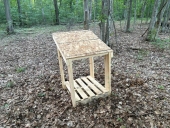


Just wanted to add an update to this old post. I ended up borrowing a lot from this approach, but had to stick with the pallets and tarp that I already had. I added quite a few extra stickers as shown in Judith's photo to reduce any deflection in the boards. The longest exposure time of the 2x lumber in my pile ended up being about 3 months in this setup during a particularly rainy early summer and a fairly dry late summer. There were a few weeks where I couldn't access the site and water puddled pretty deep in the low spots on the tarp.

I was happy with the condition of the bottom-most boards when I finally got to them and would be happy to use this method in the same climate again. I'd probably set up a basic roof with some scrap metal next time if I was going to have another long-ish several month project just to maximize airflow and reduce puddling on a tarp.
2 weeks ago

Ben Brownell wrote:I went for something similar, but more 'rustic' I suppose with small-D roundwood frame pieces, offcut slabs, and salvaged roof tin - and realized I could scale up in size a bit and have a nice elevated outdoor summer bed/lounge when not in use for wood storage!


I like your creativity with this design. My snow load requirements are pretty high where I am so I probably couldn’t do something exactly like this but I may experiment with the next version using green roundwood.
4 months ago

Eric Hanson wrote:Jeff, I like your design.  It has a simple, functional elegance.

I have to ask if you are planning on waterproofing or covering the OSB roof.  OSB just doesn’t stand up well to water—any water.  But some simple waterproofing (or maybe a covering layer) will fix that just fine.


Nice job!


Eric


I’ve since put some scraps of Tyvek housewrap over it and will screw down some corrugated steel on top to finish the roof.
4 months ago