Linda Johansson

+ Follow
since Aug 31, 2025
Merit badge: bb list bbv list
For More
Apples and Likes
Apples
Total received
In last 30 days
0
Forums and Threads

Recent posts by Linda Johansson

George and Nynke, thank you! I think I will plan to get the grapes by the shop as you suggested, especially given they are probably the least hardy in my zone and may benefit from the southern exposure/heat from the shop in the winter. Sadly the East side is where the shop door is so that space is not available for blackberries, but there is an existing bed on the west side that may be perfect for raspberries, it is bordered by railroad ties which may help contain or at least slow their spread. Raspberries do quite well here. I may try blackberries in a few spots and just see where they thrive best.

Nynke, I wish more nut trees were suitable for my location, but from what I’ve read I will be fortunate if I can even get hazelnuts and maybe a black walnut to survive and produce here. I think the black walnut requires a “protected location” to survive here. Luckily I think the local soil conservation district has them available, and if I pay attention I might be able to snag some little trees of several varieties at their $1 tree sale at the end of the season.
2 weeks ago

Thom Bri wrote:My suggestion is worry less, plan less, plant more. Too much planning limits your options and kills enthusiasm. Once growing, trees can always be removed, but no tree is always no tree.

If you buy fruit, plant all the seeds. My peach grove was founded on store-bought peaches. Just keep putting seeds out where you want trees and eventually you will have trees. And buy more trees. A dozen small trees cost about what one bigger tree costs.

Grapes don't mind some shade.


Unfortunately I don’t have loads of time to just be planting constantly. That’s why I don’t even do an annual garden right now. I’m biting off just a tiny bit each year so I don’t drown, and the planning and dreaming is half the fun!
From my reading I’m under the impression that grapes and maybe blackberries would enjoy the morning sun to help dry off the dew and prevent mildew, but a little shade in the afternoon helps keep the fruit protected from the intense afternoon sun. Do you agree? I had considered if the south side of the shop would be best for grapes since they would probably like the drainage of that soil better than the clay everywhere else, but perhaps that will be too intensely sunny for them if they like a little bit of shade.
2 weeks ago

Joao Winckler wrote:Starting with fruit trees is honestly the best move if you love fruit, they just take a while to get going so the sooner they're in the ground the better. I'd pick your top 3 or 4 favourites and get those established first rather than planting everything at once. Easier to learn what works on your land without drowning in it.


That’s my plan! I have two very little children running around and a lot of other irons in the fire. I don’t have time right now for massive harvests and time input. I’m planting two trees per year, currently I have my four apples and the two plums will likely be this year or next. I made a deal with my hubby on the budget…I don’t want a Mother’s Day gift, or an anniversary gift, or a birthday gift. Instead I want to go buy two trees. By the time anything is bearing, my kids will be a little more self sufficient, and I should be full time on the ranch instead of also working a full time job on top of everything else, and I’ll be able to handle the extra time input. Right now it’s very minimal time required.

I only ask now because I believe there’s a couple of free haskaps coming my way and I really don’t know where they will best thrive. So I figured I’d get some input on my other species of interest while I’m at it.
2 weeks ago

I love fruit. I really love never buying eggs or meat at the grocery store. Someday, I would love to stop buying fruit at the grocery store. To that end, I am planning on growing as many of my favorite fruits as I can. Alas, I have very limited experience with gardening as myself and everyone in my family are more livestock people. So I need some help (recommendations for classes or YouTubers to watch also welcome).

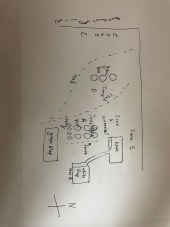
I’ve attached a map of the property divided into zones for explanation. For reference, I am in zone 4A, about 15-20” of annual precip. I’m *mostly* looking for help identifying which of the main species I plan to grow will thrive in which spot, however, I’m not limiting this to strictly species on my list of desired fruits. I plan to do some guilding as well, so helpful ideas for what to plant in the guild are also welcome, and if there’s a harvest of some sort from those plants, that’s great, but the top priority for the guild planting is support for my trees/shrubs.
I’m also doing this slowly, about 2-4 trees per year, for budget and time reasons.

The long list of species I would like to try is:
Apple, plum, cherry (I plan to try the hardy “romance series” from university of Saskatchewan), raspberry, strawberry, haskap, grape, hazelnut, and blackberry (variety selection help please…anyone has success with Doyle’s Thornless?).

Zone A will be the main “orchard” space. It is full sun except on the far south end which will receive some shade from the green shop, mostly in the morning. I believe it’s still considered “full sun” though going by the hours of sunlight received there in summer. It has a very moderate slope and clay soil. Our native soil also tends to be slightly alkaline. I’ve indicated on the map where the 4 apple trees, 2 plums, and 4 cherries will be located. Initially I had planned to build a fence at least on the east side, just past the trees’ mature diameter, and use it as a trellis for the grapes. However, I’m concerned that this may not be the best location for grapes, and it also may be too close to my trees to be planting them. The main goals for this space are 1) food production 2) windbreak, prevailing wind from the west. Although I want to be careful just how good of a windbreak I make so I don’t catch too much snow on the west side of the trees, right in a path that we occasionally need to drive. This zone can also be extended to the north along the west side of the house.

Zone B is the south side of a white heated shop. This soil should be the best drained. There is a small flat area right next to the shop and then a relatively steep drop. This space will receive significant extra moisture from the roof of the shop, and the area will warm much earlier in the spring and stay warmer later in fall due to the southern exposure, but it could get extremely hot there in the summer, so I’m not sure what would be best suited here. Maybe none of my main species of interest.

Zone C should function mainly as a windbreak. I’m thinking possibly of cottonwoods, with juneberry or hazelnut as a shrubby layer. I’m not sure if the hazelnut will thrive in my environment without some irrigation though, so perhaps that is best placed near the house where I can easily set up a water catchment? There is no option to irrigate in zone c.

Zones D and E are bonus zones. I’m not dead set on having any these plants there, but they are options if they are the perfect spot for something. Zone D would have some shade available from the afternoon sun via the grain bins. Zone E is the north side of the house so obviously the shadiest spot.

Thoughts on what to put where?

2 weeks ago
What is the permie take on ozone laundry systems? Have never used one, all I know about it is from about a 5 minute google search after seeing an ad. Are they actually permie approved or are they just claiming to be “eco friendly” while really hiding something? I don’t have a grey water system, and I haven’t ever used the alternatives that some of you are suggesting. Maybe those are just as good or better.

From my quick google search, it looks like the main complaint is that they’re not spectacular on stains/farm-level dirty clothes, but even if you still have to use detergent on maybe your jeans, but t shirts, towels, bedding, socks etc can go through without, you’re avoiding a significant amount of nasty detergent stuff.
1 month ago
I had an old broom laying around and used that. But I’m not wasting my time every single night of my life chasing chickens out of there. I bought an automatic coop door for a reason.
I have considered my chicken keeping a great success so far, much better than I expected. But I farm by the “if the animal doesn’t fit my system, it doesn’t belong on my farm” philosophy. If the chickens don’t have enough instinct to go in the coop with everyone else, natural selection is going to take its course and I’m ok with that. I’ll do a certain amount of modifying my system as I learn, but I don’t have time to be screwing around with chasing chickens out from under the trailer daily. As for the eggs, I can retrieve when I move the trailer, but they get extra dirty under there which makes washing annoying, so I’d just prefer to not deal with it.
2 months ago
Cecile—I have kept them locked in until later so that I can move the set up while they’re still inside. I don’t care to do that because I keep it basically as full of chickens as I realistically can, so they really need as much outside time as possible so they don’t get crabby and stop laying. Also historically the water has been located outside because the waterer I had, they would roost on top of it and poop in the water. I now have a different water system where that won’t be an issue.
Even in the deep cold of winter (-40 F at times), my first winter my chickens continued to lay nearly an egg a day. This winter there was slightly less but again, I was getting by for the winter with a coop that was a bit small, so when it got super cold and they wouldn’t go outside they felt a bit crowded. Next winter I will have a much more spacious coop which should help with that issue. Interestingly, I find that my chickens are consistently done laying by 2 pm every day, as during those extreme cold snaps I have to collect twice daily to keep eggs from freezing. If I collect at about 8 am and 2 pm, I get all the eggs without the first ones freezing before I can get to them.
2 months ago
I find it so interesting that everyone loves the feature of the birds hiding under the coop…that has been my biggest complaint with my trailer. They hang out under it, lay eggs under it instead of in the nest boxes, and the birds at the bottom of the pecking order tend to roost under the coop instead of inside for the night where it is safe. When I build my mobile yard I intend to make some changes such  that the birds no longer have access underneath the trailer.
2 months ago
I have a summer “tractor style” coop made out of an old horse trailer. Dolly wheels on the front allow me to pull it with the four wheeler easily to fresh grass daily, and for this summer I intend to make a mobile chicken yard out of electric net fencing mounted onto a drain tile footprint. This will be attached to the back of the trailer and dragged along with the trailer during moves. I have honestly not had any issues with hawks or owls, just the occasional raccoon, but I find that if I let them free range completely in the summer I lose too many eggs to the tree rows or haystacks. This is, after all, a business.
For the winter I am currently getting by with the old coop that was in the corner of the barn on my property. I appreciate living with it for a coupe of winters before building what I want, as I’ve done some trial and error to find out what works for me.
I wish I had thought of this sooner, but if I was starting over I would buy an old junky school bus that still runs and drives. Gut all the seats out of it and wall off the driver area so the chickens can’t poop all over it. Then mount roosts and nest boxes, an ibc tote for water. The slick floor could easily be scraped clean during daily chores. The windows, I would cover with chicken wire so they could be opened in summer to allow lots of ventilation. Probably some shade cloths over them that could be rolled up in winter, so you don’t get too much of a greenhouse effect in summer but all that sunshine in winter. Automatic coop door mounted off the back emergency exit with a ramp. Then in summer I would move it around as needed so keep the girls on fresh grass, in winter I would park next to the garden and set big round haybales against it for some insulation. This of course would be for a large flock.
2 months ago
As I read forums here on permies, and watch some of Paul’s videos, I notice that it seems like many permies are located in forested regions, and for that reason the ways they manage their homesteads take advantage of their natural resource of trees/wood.

Some of us, however, reside in the prairies (or desert), where trees are scarce and the climate is different. I thought it might be fun to start a thread all about prairie things, that might work differently than in more densely wooded areas. For example, it would make no sense for me to try to use a wood stove as my primary heat/cooking source. While I find round wood timber framing to be fascinating, it’s not exactly something that is practical in my environment.

Tell me about your distinctly prairie things. This can be really broad…gardening techniques, critters, building. Does anybody have an awesome heat/power/fuel source alternative? It seems like solar or wind is the obvious choice in the prairie, but there are aspects of those that aren’t exactly permie. Has anyone coppiced a caragana? Tell me all about your unique solutions that our woodland permie friends wouldn’t do!
2 months ago