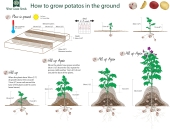
The point of this presentation Is diversity in the cover crop resulted in increased carbon in the soil over any one cover crop at the same density. Different plants feed different parts of the soil biome.
They started slowly adding more diversity but discovered that was not necessary, The process can be instituted very rapidly. Then they went to inter planting support plants with the potatoes so that the diversity would be there for beneficial predatory insects. Farmers are taught to fear root competition but in actuality more diversity of roots is complementary resulting in increased yield.
I have experienced being on a potato harvester where the driver was told to try a pass in this field and if the yield was to low to skip it and go to the next field which did not have the weeds. The field with the weeds had the better crop.
The diagrams of the interlocking cycles of chemical farming creating pest and disease problems contrasting with diversity without chemicals solving the same problems is worth watching the prresentation alone.
Great podcast, interesting information, insiring examples! Thank you Hans for sharing!
I started some experiments with cover crops this year, and I realise now that I am being way too carefull. Way too worried about the best combination, and the right crop for the right patch. Next year, I will put them all together and already next summer, i will sow some more!
"If you've never failed, you have not tried enough new things"
Hans Quistorff
gardener
Posts: 1991
Location: Longbranch, WA Mild wet winter dry climate change now hot summer
As long as this got resurrected I will add a current experience. Some soil organisms in my soil, if they do not get enough sugar exudates from plant roots attach to the potato tuber skins damaging the smooth protective surface for storage and use. As I covered in a different thread about potatoes: they develop the best tubers in loose inorganic substrate like sand but without soil that has lots of nutrients and water holding capacity they can't get very big.
To get an early crop last winter I placed a center ring from a plastic barrel on top of a shallow wicking bed of rich compost soil and filled it with sandy soil with the seed tubers just above the compost soil. most of the watering was from the tube under the compost soil which has a water barrier under it. The sandy soil has lambs quarters and other greens seeds in it so they came up and were harvested until the potatoes shaded them out and the soil was too dry for seeds to sprout. I got a harvest of very clean potatoes and preparing to do it again I discovered some small tubers lost in the sand hibernating in the dry conditions for this years seed.