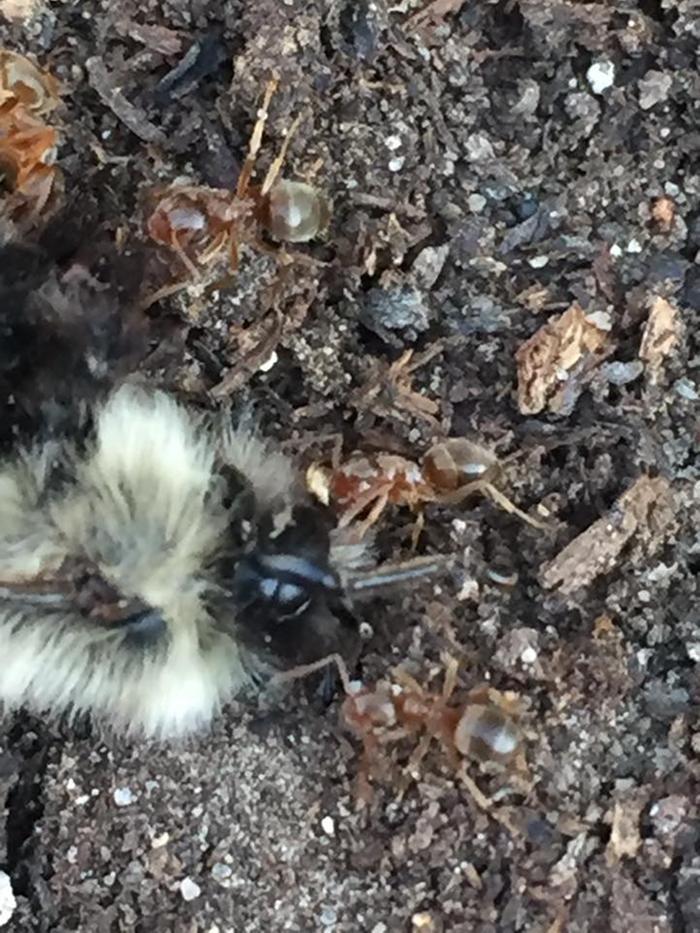
I have a garden bed with a giant yellow clover plant (volunteer) I've left alone for the bees.
On a couple different occasions, I have found dead bees under the clover.
A couple were half buried in the soil like they might have been burrowing.
I've never seen this before and I've never had dead bees like this.
I do not use any kind of chem spray in my yard and haven't for the entire 6+ years of living here.
I live in a town close to many many commercial greenhouses.
My immediate neighbors use herbicides on their lawns but they don't have many blooming plants.
Its been really windy but the temps have been above freezing.
There have been quite a few thunderstorms that included hail but I would think they know how to get out of a storm.
I have a water dish with stones and twigs in it for them under the plant in the shade.
I put the hose on it daily to refresh the water and clean it up.
So a few questions...
Why are the bees dying...
Could it be the clover?
Or could it be weather?
It seems unlikely but I don't know, what I don't know.
Are the bees burrowing or is it the ant creatures moving them?
These pictures show a dead one and some live ones most common on the clover (and the only type I've seen dead although there are other bee types here and there).
Thanks for any suggestions or advice you might have. I really don't like seeing dead bees in my yard.
I believe you have a sweet clover plant, Melilotus officinalis, not indigenous to USA.
This guy makes a toxin, coumarin, that people use as an anticoagulant medicine. Bees have a coumarin derivative, p-coumarin, that is important in regulating their immune function. There's a plethora of other possibilities of course.
If you rip out the clover (maybe replace it with a nice white or red clover) and the bees still die, I'll be happy to send you a replacement. I'm testing sweet clover here. My hope has been that our overplentiful deer will graze on it, nick themselves on a thorn, bleed profusely and drop dead. (Not really, I'm in it for the nitrogen.)
I think your plant ID is correct. I've just always known it as yellow clover.
There are a number of empty plots in town that are covered in this plant. I imagine mine was shared from a bird.
Most of my blooming plants are either finished (Peonies and Chives) or not yet blooming (marigolds and seeded wildflowers). I'm leaving a small patch of bindweed (I know, I know) that has flowered, and the clover, until the rest show up.
Then they will both be pulled up. I'm guessing in about a week from now.
The bed with the clover is being moved this year so I have nothing planted in it. Just this crazy huge clover plant.
There are bumble bees around here, who seem to go into a state of hibernation at night, as they cling to vegetation that they were feeding on. One particular bunch of oregano at a community garden, often has hundreds of them staying overnight. They always seem to leave in the morning. When they are in this state, I have been able to pick them up carefully, and they offer no resistance. I imagine they would be quite vulnerable to ants or other predators at this time.
This state seems to come on gradually and it may be some form of drunkenness. Near the end of the day, they sometimes stop flying, and instead they walk from blossom to blossom, and seem quite uncoordinated.
Sweet clover along with buckwheat and mustard are support crops offered to bees fighting colony collapse disorder. http://www.pbs.org/newshour/rundown/honeybee-decline/ Unlikely therefore for sweet clover to be toxic.
Bees are used as sentinels for air pollution according to Wikipedia.
hau Penny, those look to be mason bees in your photos, this part of your post "I live in a town close to many, many commercial greenhouses. My immediate neighbors use herbicides on their lawns but they don't have many blooming plants. Its been really windy but the temps have been above freezing. "
Sweet Clover or any clover for that matter is not going to be harmful to bees, it is one of their main food sources.
Air born pesticides and herbicides are main culprits in the current bee population demise, with the winds you mentioned, I would suspect drift of those poisons is the cause.
Greenhouses also use pesticides and herbicides (less herbicide than pesticide) and if those bees are going into the greenhouses before they come to your yard, well they are just succumbing to the poisons once they make it to your yard.
Bees die. And they usually die while foraging. They quite literally work themselves to death on the flowers.
I suspect that you are noticing it because your flowers are a good nectar source so you have more bees than normal working your garden, hence more bees than normal also dying.
I did check a couple of the plots covered in clover. I didn't see a lot of dead bees but I did see a few. Not enough to suggest it's killing them (in my unofficial opinion).
The greenhouses might be suspect but I know that at least three of them actually care for hives in the greenhouses (they have big warnings on their doors) so I wouldn't think they would be using harmful pesticides.
I have no idea about the rest, or about the fields of vegetables and crops that surround this area.
The clover is turning to seed and there are less bees, and I haven't seen a dead one in that raised bed for days now.
Quite a few of the marigolds are blooming now so I'll be cutting the clover down tomorrow.
Are we talking lots of bees or just a couple? Bees don't live long, especially when the nectar is flowing. The more bees fly, the shorter their life span. Generally speaking each worker bee only lives about 4 months. That means that for an average hive around 10,000 bees every month will die (of old age) during the spring/summer, so you're bound to come across a few of them.
Michael Cox wrote:Bees die. And they usually die while foraging. They quite literally work themselves to death on the flowers.
I suspect that you are noticing it because your flowers are a good nectar source so you have more bees than normal working your garden, hence more bees than normal also dying.
I think that is likely what's going on.
Unless others notice the same phenomenon, I wouldn't worry about it.
Post by:autobot
The first person to drink cow's milk. That started off as a dare from this tiny ad:
grow your own garden and build your own home in the gardening gardeners program