Austin Shackles

Apprentice Rocket Scientist
+ Follow
since Jul 26, 2012
Merit badge: bb list bbv list
Biography
Several sorts of engineer, driver, gamer, fairly crap musician 'cos I never practice enough.
For More
Portugal
Apples and Likes
Apples
Total received
In last 30 days
6
Forums and Threads

Recent posts by Austin Shackles

Mark Reed wrote:In my opinion the better half is sometimes right and in this case, I would have to agree. If you have the land and the finances for a septic system, it will almost certainly make your life easier and more comfortable. If the issue is toxic chemicals and the like getting into the rivers, all you have to do is not dispose of them in the drain, better yet don't buy them in the first place and you can also still pee outside if your so inclined. Pretty much the same rules as for a willow feeder, or so I assume without all the hauling, breathing and storing of feces or sourcing an ongoing supply of sawdust.


Ah well, finances are a big aspect in fact.  The smallest/cheapest "official" septic tank is north of €600 to buy before you add in the plumbing, any needed licensing and installation.  Even if I do all the installation myself, it's likely gonna be not far short of a grand to get it all done right.  It's possible to make a multi-chamber septic system using IBCs, but that's more work and more digging and the geography of the place requires it to be underground.  Plus IBCs don't grow on trees either.

The total cost so far is probably around €200 for materials plus about €15 for 2 oldish second hand barrels to match the 3 we already had.  If we end up buying new barrels (for lack of second hand ones the right size) then they're around €35 each.  We're hoping to avoid that but even if we end up buying, say, 10 that still beings the whole project in under the price of just buying the septic tank.  We can readily get wood shavings for not too much money which are what we use anyway in the current Jenkins system.
1 week ago
Update on the previous post:

Last night when the fire was pretty much dead, I did some more messin' with the oven door.  

Opening the door a couple of inches made the exhaust, which was quite warm, cool down within a few minutes.  If I shut the door again, it started to warm up again.  

Of note is that I want to check the bypass to make sure it's shutting adequately; if it isn't then heat could leak out from under the cooktop into the exhaust.  If I'd been on the ball when I was fixing the broken firebrick issue recently, I could've checked it then

As may be, having the oven door opened a bit caused the flue to stay cool so I left it like that, and before I went to bed I checked it again: the flue was quite cold and there seemed to be a slight cold airflow entering the oven and travelling across the bottom of the stove into the exhaust.  Cold air doing that can't really have much effect on the heat output, I don't think, since the hot part of the stove is all above that level.  

This morning when I went down and checked it, the cooktop was still a bit warm to the touch which I regard as a good sign.  As to how much difference this makes overall, that would hard to test - but any obvious heat going out of the exhaust once the fire is out can't be helpful.
2 weeks ago
In a recent podcast Paul mentioned his quest to shut down rocket stoves when you're done burning, so as to avoid the possibility of losing heat up the vertical exhaust.  

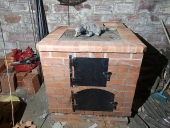
This got me to thinking about our Matt Walker stove.  I'd kind of assumed that without the fire driving it, the exhaust would fairly rapidly cool (after all most of it is outside, although insulated) enough to stop it drawing.  Recently however, on checking it some time after the fire was out, the stove was all nice and toasty warm and emitting heat into the room as it should, but feeling the base¹ of the exhaust it was still distinctly warm - and worse, there was a perceptible draft entering the air holes in the firebox door.  Clearly there was still some convection going on and heat was going up the chimney!

So, how to solve that?  I could make a cover for the air holes in the door which could be deployed once the fire was out to prevent air from entering.  But that seems a bit like work, and besides I kinda like the door as it is, aesthetically - a draft blocker would need some kind of slots to fit in which would detract from the appearance.

Now, today I had the fire on in the morning as it's a bit cold and damp.  I did 2 batches (initial lighting and one refill) and then let it die down, as without the bench I still haven't built it's prone to start wasting heat up the exhaust if you burn it 3 times in a row.  Once the fire was down to just a couple of small live embers I experimented with a handy offcut of plastic wrapping, and sure enough there was enough draft happening to suck that onto the air holes in the fire door.

At this point I had an Idea!

At the bottom of the stove is a black "oven" space although with the burning regime I've been doing it never gets all that hot.  I'd already noted that opening the door to that even slightly kills off the draft for the fire quite dramatically.  So, with the fire mostly out, I opened that door.  Immediately, the draft into the firebox ceased, and within a minute or so the base of the exhaust was significantly cooler to the touch.  Looks like I may have hit on a solution for stalling the flue so as to stop heat going up it after the fire is out.  Opening that door can only realistically let heat out into the room, which is no issue.  Unless somehow the exhaust were to reverse and suck cool air back down from outside, but I feel that's unlikely.

Later on I'll experiment with opening the door for some minutes and see what the effects are.  It might be that it can simply be left ajar until next time the stove is lit, or it might need to be shut again for some as-yet unknown reason.  


¹ the first bit off the stove isn't insulated, as it has no need to be and also that allows you easily to check if the flue is getting warm enough when lighting
2 weeks ago
Total flow should be OK, it's a 6" chimney so the outlet holes in the brickwork are made to be larger than that.  Counting the oven and the bench there are 2 such holes at the base of the flue.

I need to check on space available.  It should be do-able, especially with the proposed divider, to make the bench inlet a bit higher than the outlet.  The ports in the stove are at the same level but obviously the bench feed (from the stove) is nearer the "hot" end of the path, while the bench outlet is at the bottom of the flue.

It's also entirely possible that I'm over-thinking it
1 month ago
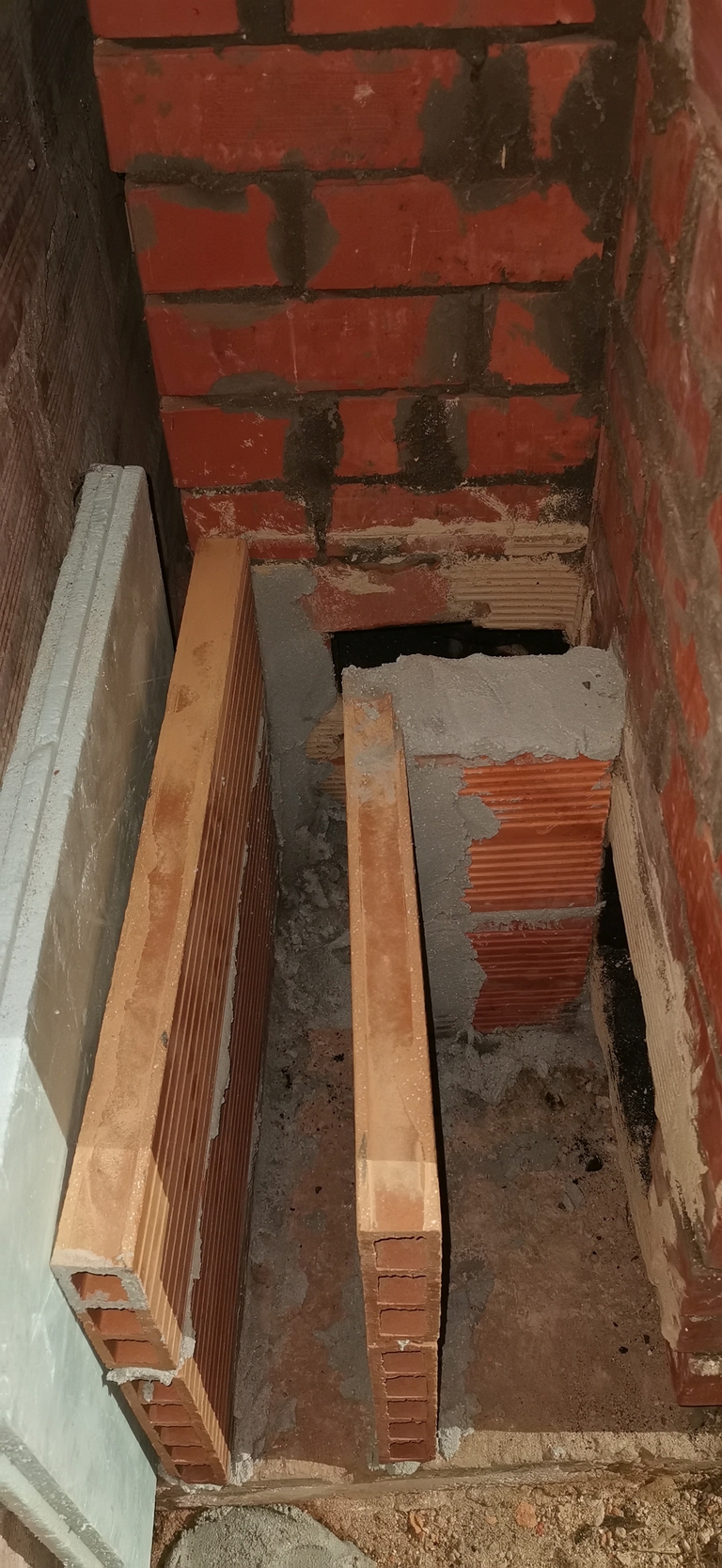
This picture shows the lower level of the stove.  


On the left side above this level is the descending passage from the top after the hot gases have gone under the cooktop.  Where Iggy (the grey dragon) is sitting is the exit from the bottom of that hot descending path which can be connected to the bench.  That exit is closed above this level by the outer wall.  There's an inner dividing wall between the core space and that descending path, as seen below.  The inner wall extends down until 2 courses above the base.  On the right of this pic is the exit from the oven space in the lower part of the stove, into the base of the flue.


There's another port which connects from the bench to the base of the flue, over on the back right.  As the base of the stove is above floor level by a couple of courses of brick, the top of those bench ports is not gonna be far off the height I want the bench strat chamber to be but will likely still be a little low.  I can close off or restrict the oven exit at the back right in order to bias the flow of gases more towards the bench outlet, if need be.

Seems to me that if I just build the whole bench as a cul-de-sac, the hot gases will scoot around the corner and head straight for the exit flue.  So I was contemplating dividing the bench at least part way down with a thin vertical wall, so the gases have to run along one side of the bench and back the other to reach the exit.  Here's a crappy sketch of what I have in mind, also showing the way the gases flow.  Matt assures me that it works if you connect it to a bench and I see no reason to disbelieve him.  
1 month ago
Ah well that I can't say.  Since the whole core is made from the same bricks, and only 1 or 2 have issues, I'm gonna optimistically assume that it was a bad brick.  The one that broke is in quite a hot place, but so are quite a few others which seem to be ok.
1 month ago
As I'm soon* going to embark on building the heated bench for our Matt Walker tiny cookstove a thought occurred to me.  

The bench will be a strat chamber rather than a mass, simply because that's easy to build and from what I'm hearing pretty similar in effect.  The question I have is about the bottom of the chamber.  As things stand at present the floor of the house isn't finished - it will eventually be an inch or so higher after putting some concrete screed and then tiles on it.  The stove, though, sits on a concrete slab I made for it which is sort-final floor level, and then the bottom of the stove is a solid layer of bricks as per the design.  

If I just build the bench on the floor as-is, the bottom of the chamber inside will be 5 or 6 inches (12-15cm) below the bottom of the outlet ports in the lower part of the stove body.  So the question is this:  is that extra space below the level of the stove going to adversely affect it?  Secondary question, is it actually going to do any good, or would I be better off filling it up to near-stove-base level with, say, some gravel or something?

* FSVO "soon"
1 month ago
Time for a stove update I reckon.  She's been running well this year, much easier lighting than last year.  I did have an issue recently with some of the firebricks in the core either getting loose (see another post about clay-sand mortar) or in a couple of cases breaking.  

Now, the core gets pretty hot.  However, I would expect fire bricks to cope with that. A bit of the clay mortar that was filling a gap fell out and it's semi-fired the clay so it's almost like stone.

Anyway, lifted the cooktop off and removed enough of the core top to get at the broken/displaced brick which was the top rear one in the firebox which defines the far end of the flue path.  That brick turned out to be in about 3 pieces.  As I didn't have a spare one that size to hand, I glued it back together with "massa refrataria" which is 1500°C-proof stuff in a tube, used to join chimneys onto stoves etc. and glued it back into place with the same.  I also found a couple other cracked bricks to fix while I was in there.  Mostly, though, it's all stayed together.

Next job is to build the bench, when I have time, then we can burn it more than 3 firebox-loads at a time and harvest some more heat.  Without the bench, by the end of the 3rd firebox of wood there's what I consider an unacceptable amount of heat going up the chimney.  3 fireboxes of good wood burnt leads to the whole stove body being nicely hot, so tend to do 2 or 3, then leave it for a few hours so the heat gets used up some, and then burn it again later in the day.
1 month ago
I'd sort of thought it might be the sand.  In the UK we had "sharp sand" used for bricklaying and such, and "soft sand" which you used for rendering or base coat for plaster.   Here in Portugal there's river sand (areia do rio) which is only really good for making concrete floors, normal sand "areia" which one supplier told me when I asked was "made from brita" (brita is screened crushed hard stone, in various sizes, like you'd use as aggregate in concrete) and then there's yellow sand "areia amarelo" which is the same as what I call soft sand.

It so happened I had a couple of bags of yellow sand available when I was doing the stove, so I used that.  I'll probably build the bench using cement mortar but the plan is to used some nice granite slabs which were originally kitchen worktops, with suitable support, for the top of the bench and those I would like to be able to remove in case of need for inspection or cleaning.

The other thing I can easily get is gun-tubes of "massa refrataria" which is I believe mainly for sealing steel chimney sections or for sealing the chimney to the stove.  I've used that to re-stick the fancy corners I made on the stove top, which look cool but are prone to fall apart :D
1 month ago
As I'm about to attach a bench to our Matt Walker stove, this thread contains invaluable information.

On my stove, I built in a bypass at the back of the core direct into the chimney for easy lighting, and also for the possibility that some day I may want to cook on the stove without heating the whole thing and the bench.  Yes, it does require thought and discipline not to leave the bypass open and waste heat up the chimney, but it's well worth that in my view for the ease of lighting.  We live in a fairly warm climate with only 2-3 months of not super-cold weather.

1 month ago