John Weiland

pollinator
+ Follow
since Aug 26, 2014
Merit badge: bb list bbv list
For More
RRV of da Nort, USA
Apples and Likes
Apples
Total received
In last 30 days
11
Forums and Threads

Recent posts by John Weiland

Thanks, Eric, for posting your build here as it provides not only good detail and education for those like me looking to do the same, but also inspiration to take the plunge.  As you noted, it seems like new sources of (vendors) of components are coming online daily and although one needs to be cautious with fidelity of vendor an'd quality of product, it's nice to have options.  

I think it was Larry K or someone elsewhere noting that the BMS, under proper circumstances, *could* be mounted outside of the box....something I've been considering for batteries that will be largely stationary and indoors.  One thing I'm wondering about in this regard that may also address your 'extra cells' issue:  Can an external BMS that is designed for, say, 16s be used externally across two boxes of cells, each containing 8 cells?  It appears that most builds attempt to ensure that the series terminal connections are all of the same length and 'resistance'....but can this rule be broken to have two different packs.  Would the wires from the BMS still be able to reach all of the cell terminals necessary or does it need to be a pretty tight fit?  Again, thanks for posting your efforts here......very helpful!
10 hours ago

larry kidd wrote:

John Weiland wrote:...... Is there some reason that for such a system I should go with 48V instead?  Thanks!


Amperage and wire size / expense!


So the extra cost of wire size is undertandably a factor.  It also seems like there are fewer offerings for 24V inverter combos that are in the 10 kW output range and perhaps the higher amperage is a factor here as well?  If the wiring run from the PV panels to the MPPT controller and batteries is kept to a minimum -AND- the inverter is within a few feet as well, it's then 120/240V AC beyond this point and now can use the smaller wire, correct?  Certainly, there are many pros with just focusing on 48V systems, but as an aging amateur I'm also inclined to the purported increased safety of 24V and the lighter weight and size of the LiFePO4 batteries being installed.  Don't know if this makes sense or is really just unfeasible or not so logical in the end.....?  Thanks!
1 day ago

larry kidd wrote:I was really excited about Sodium ion until I realized the way they work all the way across the voltage. Where as most equipment is set for the small voltage range of lead acid cells. LifePO4 also uses a fairly small range L-ion uses a larger range and sodium uses almost the entire voltage from 2 past 12 on a 12 volt system. To put this further in context a lead battery at full charge 12.7V down to about 12 volts if you want any kind of battery life. While the system can go down to maybe 10 volts it will kill a lead battery quick fast and in a hurry. Look at the range on sodium to see what I'm talking about. This will require largely different equipment for sodium from lead acid.


Yes, this seemed to be an aspect of sodium ion batteries that was not receiving as much attention.  Certainly it **seems** from several sources that the battery industry is gearing up a lot of sodium ion battery production, .... but are they waiting for the roll-out to drop the other shoe??--- That a buyer will have to re-tool much of their whole system to adapt to the power curve of sodium ion batteries?  Would be curious to know other's thoughts here...

Also, my impression is that 48V battery systems are winning out in the popularity battle for alt-energy based systems for home, cabins, etc.  Yet I can see advantages of 24V systems...especially with LiFePO4 batteries....when considering weight and safety.  In my case, I'm potentially looking at a 10 kW hybrid inverter/charger with solar, but initially only for a few critical items like well pump and propane furnace and a few light circuits. Only rarely would the batteries be drawn down to 50% with ample anticipated time to recharge before needing again.  The inverter system and batteries would be wall-mounted in a basement ranging from 50F to 65F winter to summer and ~2 kW of solar PV capacity used for charging. About 30 ft of cabling would separate the PV panels from an MPPT charge controller. So to be clear, this would be an introductory backup system for when grid power failure occurs.  Is there some reason that for such a system I should go with 48V instead?  Thanks!
2 days ago
This must be the warm-up spell as it was near 40F today.  Good thing about the previous stretch of cold was the very solid freezing of the river near the house.  So much dead elm along that river that it's unlikely for us to run out of firewood.  On days like this, I can tow a decent size sled pretty easily across the flat snow and ice in search of felled trees.  A few cuts usually reveals the dry stuff and the sled fills quickly.  This allows me to get some much needed extra exercise and helps to top up the woodpile in the event that winter decides to overstay its welcome.
2 days ago

Nancy Reading wrote:.....
The titbit about beet liking salt was especially interesting and may explain why the beet did so well for me - apparently the sodium in common salt can replace potassium in the plant metabolism. I daresay my soil is lacking in potassium, but gets salt spray everytime we get a strong 'souwesterly' gale!


Yes, the evolution of the genus 'Beta' around seaside estuaries likely impacted the salt tolerance of beet.  It's one of the reasons that California's Imperial Valley, just north of the Mexico border and south of the Salton Sea (inland, highly saline lake) was such a good location for growing record yields of sugar beet.  Alas, that industry has now ended in California for the time being due to so many economic and land-use pressures in that state. >>> https://civileats.com/2025/12/08/after-150-years-californias-sugar-beet-industry-comes-to-an-end/     From a Permie Perspective, I suspect beet will figure as a strong survival food item due to its health properties, storability, and wide climate tolerance, although I hear tropical regions are difficult for beets.  
2 days ago

Christopher Weeks wrote:We've had a foot or two -- depending on drifts, since November.


Yeah, just west across the state from you.  Although we do have several weeks of winter left to produce storms and blizzards, the local fields are not as deeply covered as they should be and this makes the farmers nervous.  That snow cover when melted provides important moisture for planting and beyond.  The 'warmer' snap right now is outside of what was predicted at the start of winter so I'm not complaining and have a good firewood supply to round out the season.  But adding to Thomas R. comments, a relative in Boise Idaho was mentioning that even snowpack in surrounding mountains is way down, so concerns there for sure.
2 days ago
Nancy R.,   Just an added link with relevence to your location.  Base on the map included in the article, it should not be too difficult to find 'sea beet' near you if you wanted to try that eco-type as a native 'survival crop' well adapted to your climate:  https://botsocscot.wordpress.com/2021/08/22/plant-of-the-week-23rd-august-2021-sea-beet-beta-vulgaris-ssp-maritima/


2 days ago
Aronia and Juneberry?.... Both doing well outside of Fargo, North Dakota with high water table and heavy clay.  Aronias are least attacked by predators, are a fall-bearing species, but not good for fresh eating.  Makes tasty and healthy jam/jelly.  Juneberries yield in accordance with their name, are heavily predated by waxwings, robins, and jays, but are a good blueberry substitute for non-acid soils, even if not as strongly flavored.  For driveway, Aronia has very colorful fall foliage.
4 days ago
i've posted on this machine in different threads but don't recall if it was regarding winter use.  You will see them around commercial and municipal crews for lawn mowing and snow blowing.  A bit of a splurge in retirement and definitely not purchased new as quite expensive, but used ones can be found if poking around the want ads.  I had used a tractor + rear-mount snowblower for many years...no cab....and just tolerating the North Dakota-Minnesota mid-winter 'breezes'.  Decided I'd had enough, so purchased the base unit with cab and added better windows along the way.  Having a heated cab is pretty nice and having the maneauverability of rear-wheel steer is awesome.  Blower is ~48" which is just a hair shy of the wheel-spread, but not enough of a hindrance to be an issue.  With a 37 hp diesel Yanmar engine, it is a reliable champ.   Elsewhere under the "Gear" category here I showed the build of a front lifting unit that Deere does not make, but allows for some light lifting for summer use.  We don't use the mower deck...it's stored away for the day when re-sale is necessary.  With the blower, it makes quick winter clean-up of long driveway stretches and some pretty packed, massive drifting where the driveway meets the county road.
1 week ago
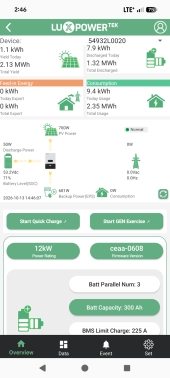
Our rural electrical power cooperative offers "off-peak" electrical rates although it does come with some extra service charge that is supposed to be minimal.  I need to look further into this....not just talking to the cooperative, but to real users and what their experiences are especially as we compare usages and lifestyles.  Irrespective of the off-peak plan possibilities, I will be looking into a 24V battery system for a 10kW hybrid inverter/charger that includes an automatic transfer switch and solar-priority charging.  Most immediately, the system would function as back-up to replace years of starting and maintaining petro-fueled generators....and those generators were directed primarily to the deep well pump and sump pumps as well as furnace and lights.  With having just converted to propane for the furnace, we may swap out the electric hot water heater for a tankless hot water system (2 member household, minimal use).  With this approach to whole house energy at this point in our later years, the batteries should not be cycling too much and will remain topped up by a mix of grid-tie charging and solar charging.  As needs/costs require, we may introduce circuiting to judiciously transfer more loads to the batteries, reducing dependence on the cooperative/grid....possibly eliminating it altogether depending on changes in alt-energy market and cost of grid power.
1 week ago