

|

|
|
|
|
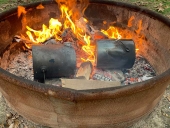
Mike Farmer wrote:At a small scale for animal feed, making biochar can be as easy as throwing a (clean/new) metal paint can with a few holes punched into it full of wood chunks into a backyard fire pit (or wood stove) while you have the fire. I've fed biochar to my chickens when I make it (I also add it to their bedding) and I think it's a great use for biochar (and the chicken's guts are great at inoculating biochar).
Phil Stevens wrote:
This is a big part of why I have chosen to use the IBI terminology. I don't want to give the impression that you can take low-grade charcoal full of tars and gunk (or something at the other end of the scale that's practically graphite), soak it in compost tea or whatever, and suddenly have something that will do your soil a whole lot of good for the long haul...because it won't work. This is not to say that "accidental" biochar is worthless...most of it is good, because the temperatures reached in a wood fire are conveniently in the sweet spot for decent pyrolysis.

Bonnie, can you share the approximate dimensions of the garden and fences? What type of fence is it?
I currently have a large (175' x 200') garden that I inherited. I had great success with a 3D electric fence (two wires on the inside and a 3rd wire 4ft away in the middle) for deer, but I'm struggling with grass on the edges and other animals like ground hogs.
I don't have chickens currently, but had great success with them keep areas cleared in the past.
Julia Schmoyer II wrote:This is cool to see. I think many jumping animals need a particular "runway" or visual clearance in order to make the jump, and this might just trick the deer's instinctual sense of physics into believing it's not possible to make the jump. Out here in Georgia, people talk about using a 2-fence system - installing 2 parallel fences about 4 ft apart. The deer can figure out how to clear one fence, but the small in-between space makes them think twice because they wouldn't be able to position themselves to clear the second one.


Kevin Olson wrote:
Know of anyone who's building a soddie? They need a bunch!
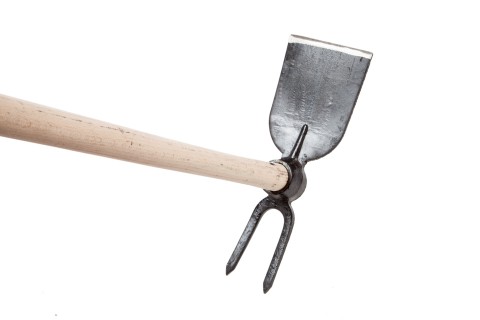
As a possible alternative to the sod cutter, for small plots, I've used a knock-off version of the Falci Magna Grecia hoe - a mattock on one end of the head, and fork tines on the other. To be clear, the one I have is NOT a Falci, and is much lighter duty, but I found it used at the right price - a couple of dollars. Because it's smaller, it takes smaller bites, but between the hoe blade and the three-tined fork, I can pull up sod fairly quickly.
When pulling up sod to relay (when I was fixing drainage issues around the stone foundation of my house), I used a square nosed shovel, and cut blocks that would fit on the blade of the shovel; so, first cut the edge(s) of the strip to the width of the square nose blade, either with a spade or the square nose, then sever the strip into short pieces, just the lengths of the shovel blade. Then, slip the square nose blade under the roots, parallel to the ground surface, to remove a block of sod. I slid the sods onto a tarp that I'd spread out adjacent to my excavation, trying to maintain some semblance of order for the relaying operation, but for your purposes, it could just be higgledy piggledy, I guess.
I'm sure the sod cutter would be better than either of my suggestions. There are "kick" style manual sod cutters (I think Lehman's or somebody carries them), but I've never used one of those, either. Too thrifty, I guess, so I used what I had. But, for cutting a lot of sod, the proper sod cutter is probably just the ticket.