Melissa Ferrin

pollinator
+ Follow
since May 31, 2020
Merit badge: bb list bbv list
Biography
In the Mixteca Oaxaqueña in Southern Mexico.
For More
Apples and Likes
Apples
Total received
In last 30 days
6
Forums and Threads

Recent posts by Melissa Ferrin

Bumping up this old thread because I am a nopal evangelist!

So we might, or might not, who knows these days, be facing a food crisis.

I totally agree with Paul that everyone has got to grow all the food they can, and eat the food they grow and that feeding yourself does not have to be expensive.

Paul loves sunchokes because, apparently, you can just dig them up and eat them whenever, even after a freeze. Apparently it's even better, after a freeze?
I wouldn't know as I live in a place with only an occasional frost and certainly no ground freezes.

If you are like me, and live in an area free from freezes, join me in saying No, Paul, the best plant to plant is nopal.

Even if you do get a freeze, there are varieties that peole say can come back after going dormant, or you could try what my grandma used to do with her roses in northern Iowa, cut back to 10 inches above the ground, cover with an old styrofoam cooler, put a bick on top, then pile hay all around.

Because nopales, with a bit of watering, can produce tasty food continuously, or can live through dry spells and only produce their tasty food when it rains.
People growing nopales for food do not let them get tall, so 30 to 40 days after planting a mature pad there you can start cutting young tender pads if you so desire.

The key to cooking them it so give them a salt/baking soda rub to help pull out the slime.  Use a coase mineral salt or a salt/baking soda mix. You can later rinse them if you are limiting the sodium in your diet.
Cut them up, or if roasting whole (a campasino steak!) score the surface so the salt can pull the slime out. Rub all over then let stand until they seem really slimy (10 minutes) If boiling, boil in the slime--no water needed. or you can char them on a griddle/grill
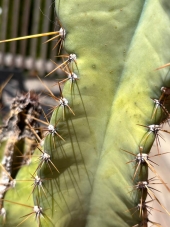
The photo shows growth two weeks after planting.

2 weeks ago
I missed this thread as I've been doing other things for a while now that seriously cut into my internet time.
But I AM A NOPAL EVANGELIST.

Melissa is to nopales as Paul is to sunchokes.

Everyone living anywhere without a hard freeze should be planting and eating nopales.

Preparation is everything. Nopal fajitas are a good start.
You pick a tender nopal pad, or if you are like my family, 40 or 50, then you slice off the nubby bits that will eventually become the spines.
Then cut into strips.
The next step is the most important.
Put the nopales in a sauce pan and toss in mineral salt, if you don't have mineral salt, you can use baking soda. Keep tossing for a couple of minutes, then let stand for about 10 minutes. The salt or baking soda will pull out the water, so now your nopales should be standing in their own slime.

Do not drain this away. Put the saucepan on the stove without adding any water, oil, or anything but the nopales and their slime. Cook on medium heat for about 10 minutes, moving frequently. You will know they are cooked through when they have evenly changed color.

Now remove from heat and rinse.

Proceed to make fajitas as you would otherwise sauteing onions and pepper and if you like, beef or chicken strips, season to taste, towards the end of the cooking process toss in your cooked nopal strips and move allowing them to absord the seasoning you've used.

A yummy variation of this, instead of bell peppers, use sliced chipolte peppers in adobo and sliced sundried tomatoes in even amounts.
2 weeks ago
Standy-uppy cacti, like the Peruvian apple or pitaya here in Mexico, have a woody middle. There's a variety of nopal that is called nopal de vaca, which has spines that cows (vacas) can eat without getting poked. Other forms of cactus are used as fencing to keep cows out, so that implies they don't like eating it.
2 weeks ago
Soapy water.
We use the most basic white washing powder, which is very common and cheap here in Mexico. Like the brand Roma. Mix that in some water and (carefully) slather suds on the cactus. Maybe consider wearing gloves.
I teach English (as a second language) to engineering students in southern Mexico.
9 months ago
If you live in a place where they can grow--prickly pear or nopales. This year we planted cuttings, and in 3 weeks we were eating young pads. Two weeks after that, we cut more. Now three months in, we can cut young pads weekly, and I suspect we will be able to for many years to come. Last week we had a special treat and ate our first 3 prickly pear fruit (tunas). One red, one orange, and one yellow. Not all types give fruit or good fruit
9 months ago
I'm really suprised by some of the responses!
In the 80s in the midwest a lot of people would make the fruit versions, I can't imagine one laden with nutella and candy!

My mom always used her pie crust recipe, A cream cheese spread made by thinning and whipping cream cheese. Then topped with whatever fresh fruit was in season.  If it was made the day before she'd also do a thin plain gelatine layer on top to keep it from browning.
1 year ago
I'm on the salt-is-a-mineral-so-clearly-not-a-spice team.
I absolutely love black peper--ground over the dish. So that's my vote, but haven't seen anyone mention my second favorite--oregano. That wins for versatility.
1 year ago
It sounds pretty sound to me. If you are starting mesquite from seed make sure to treat the seeds by scarring and or a vinegar soak. Mesquite normally germinates AFTER it has gone through the digestive system of a cow or a goat. As in cows and goats eat the pods then poop out the seeds which sprout up in the cow pie--goat dropping.
I'd like to second Liv and say that all over Mexico, people eat field corn fresh.
Having grown up in Iowa--granddaughter of a farmer, I was VERY skeptical at first.  But it is actually much tastier--not "sweet" but has a much fuller flavor. Now when I return to the midwest of the USA and eat sweet corn I find it just that--sweet, and lacking other flavor.
Of course, we are making tortillas, pozole, and tamales so the vast majority of the corn is left to fully mature, but stalks with two or three ears, have one or two removed to eat as fresh corn to allow the other ear to get all the nutrients from the plant.