Mike Farmer

+ Follow
since Dec 19, 2023
Merit badge: bb list bbv list
For More
Rhode Island, USA
Apples and Likes
Apples
Total received
In last 30 days
5
Forums and Threads

Recent posts by Mike Farmer

I was back at the farm today planting some hops rhizomes around the chicken composter, and dug around a bit in the compost to expose some worms for the chickens. The little piles of biochar I had dumped in a week before had completely mixed in by the chickens...in less than a week you'd never know the piles were there. Pretty cool.

The plan is to harvest a bunch of the compost (and inoculated char) in a few weeks and put it on some garden beds.
2 weeks ago
I've read this before and it's interesting if you're producing at scale in a controlled environment, with uniform inputs. You can adjust for whatever your particular situation and goals require.

For us folks doing it at the backyard or farm level, I suspect we're getting a bit of the "best of both worlds" with varying feed stocks, sizes, and temps, we're getting some "now" biochar and some "later" biochar, maybe with a little mineral-rich ash mixed in. The imperfect process may just make the perfect biochar mix.
2 weeks ago
The "fluffing up" must reposition things in a way that makes additional passes more effective. Makes sense that after driving over a bag of biochar it gets "mushed" together in a way that more pressure just doesn't help. Moving around the pieces creates nice fresh edges and angles for more crushing.
3 weeks ago

John Suavecito wrote:That sounds very efficient in an unusual sort of way!

John S
PDX OR


Yes, the "harvesting" was really quick. The 10-12 buckets probably took me maybe 30 min of going back and forth between water source, fire pit, and chicken run in a little circle.

I'm sure this mixed a bit more ash in than many other methods, but up here in the northeast our soil is very acidic so getting it into the mix will help even out the soil a bit, while adding plenty minerals.
3 weeks ago
I was at a local non-profit farm where I'm on the board today doing some odds and ends. I knew their fire pit was a bit full of char, so was planning to clean it out. Folks had put more wood and sticks in there, and it's been damp lately. I started a fire to clean it out, but it was obvious that if I was going to burn through the residual char I'd be there a while.

So, instead, I found a metal bucket and filled it with water. I scooped out hot char and quenched it. Once it was cold out and fully saturated, I repeated the process. Probably did about 10-12 of those small metal buckets full to get the char in the fire pit down to a reasonable level.

The wet char then got added to the compost chicken dome to get charged in advance of the compost harvest in about a month. The compost/char will get worked into garden beds across the property.

As I was wrapping up, it started to rain pretty hard, so I  felt extra safe adding the char to the chicken system since everything was going to continue to get a good soaking at least through tomorrow AM.

Maybe a non-traditional way of making char, but it worked and stacked functions in that it cleaned up one area to soak up nutrients in another (chicken compost system) to eventually share those nutrients with a third space (garden beds)


4 weeks ago
Yes, lots of methods is the way.

Making lots of biochar is better than making a little biochar, but making a little biochar is better than making none.

Making a little biochar every day doing something you do anyway (like running a wood stove) is great!
4 weeks ago
I think the original video that David refers to is on the "Live On What You Grow" Youtube channel. The two crimped cans.

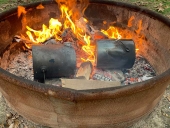
I've also had had good luck in a fire pit or wood stove making biochar with metal paint cans (with a few holes poked in them) or hotel pans.
1 month ago
As others have said, the high moisture content of seaweed would suggest that composting may be better than char.

I've also read about potential heavy metal and other contaminants...so batches would need to be tested first, especially if it was to be used on food crops.
1 month ago
Could be another good argument to include bones in your biochar. Also, as a chicken owner, I happen to have 40 lb bag of crushed oyster shell right near where I make biochar. Might have to throw a scoop into the next batch!  
1 month ago
Any char I make goes right into my chicken coop or run. The flock has free choice of if they want to consume any or not. We compost right in the run, so it get inoculated in place, crushed by my footsteps, and eventually gets harvested with the chicken run compost.
9 months ago