Kevin Hotton

+ Follow
since Jun 08, 2026
Merit badge: bb list bbv list
For More
Apples and Likes
Apples
Total received
In last 30 days
1
Forums and Threads

Recent posts by Kevin Hotton

Hi Jay, I agree about shutting down the greenhouse between Nov-15 and Feb-15. The day-lengths are too short for much plant growth, and the minimal solar gain during this coldest period just does not make sense to try and keep a greenhouse warm under those conditions.

I have not started greenhouse construction yet.  The total budget is about $8000 (with free labor).  The glazing is dual 8mm twin-wall with 3.5" and 5" air gaps this nets an R-4.3 and solar-transmission 65%.  This high glazing R-value is what really brings the heat-loss rate down.
2 days ago
That Wofati greenhouse look to be designed for low-light cool weather crops.  It also seems similar to the Deep Winter Greenhouse design from Minnesota University.  That greenhouse only works well in the coldest months and is not any good for growing in the normal growing season. I am designing for high-light warm-season crops.  I am not wanting to over-winter crops but just have a highly productive 9-month growing season.  In Pagosa Springs, CO, we have a large temperature swing day-to-night of 35F or more. I need to smooth out those temperature plunges that can approach freezing in June and September.
3 days ago
For growers looking to extend their season or cultivate year-round in cold climates, choosing the right greenhouse architecture is a critical crossroad. The debate typically comes down to two philosophies of climate control: passive solar design and active solar systems. While both leverage the sun, they manipulate thermal energy in fundamentally different ways.

The Passive Approach: Harmony with Thermodynamics

A passive solar greenhouse relies entirely on natural thermodynamics—convection, conduction, radiation, and buoyancy—to regulate its microclimate. It features a strict architectural layout: a glazed, south-facing wall to maximize winter solar gain, heavily insulated north and side walls to prevent heat loss, and high thermal mass (such as water barrels or masonry) inside the structure.
During the day, the thermal mass absorbs radiant heat. At night, it radiates that heat back into the space. Ventilation is handled via non-electric, wax-filled piston actuators that mechanically open roof and wall vents as the air expands with heat.
   • Pros: Zero operational energy costs, immune to grid failures, and virtually no moving parts to break.
   • Cons: Less precise temperature regulation, manual microclimate management, and reduced efficiency during prolonged, multi-day overcast spells. Open water tanks can cause humidity problems.

The Active Approach: Engineered Environmental Control

An active solar greenhouse uses mechanical and electrical components to forcefully move, store, and distribute thermal energy. While it still utilizes solar gain through glazing, it does not rely on passive radiation alone to balance the diurnal cycle.
Instead, active systems employ automated exhaust fans, motorized intake dampers, and dedicated solar thermal collectors. A prime example is a climate-battery system, or subsurface thermal battery. When the greenhouse peak overheats during the day, high-CFM fans pull that hot, humid air down into a network of perforated pipes buried deep beneath the soil, actively charging the earth with heat to be pumped back up at night.
   • Pros: Precision climate and humidity control, automated fail-safes, and the ability to store massive amounts of thermal energy for later use.
   • Cons: Higher upfront capital costs, reliance on electrical components (fans, sensors, dampers), and increased operational complexity.

The Verdict: Choosing Your Infrastructure

The distinction between passive and active is no longer a strict binary; modern technical designers frequently build hybrid systems. These structures use passive insulation and orientation as the baseline armor, but introduce low-wattage, automated fans and dampers to optimize heat capture and prevent crop scorching.
For a low-maintenance backyard setup, pure passive is unmatched. However its less precise thermal operation requires more gardener intervention. With an active (automated) greenhouse, The growing conditions can be tightly controlled.  This control relieved the gardener of being “tethered” to the greenhouse as is the case with most passive solar greenhouses.
Investing in active thermal engineering is the key to unlocking truly optimal plant growth and gardener freedom.

The TerraPoniK greenhouse is a hybrid design that embraces active control to achieve remarkable thermal efficiency and stable climate regulation for rapid healthy plant growth. It uses a shallow (2-ft deep) fully insulated diurnal-climate-battery with air super-heater to deliver dramatic improvements in the rate of soil-thermal charging and discharging.  It behaves more like a Thermal-Capasitor than a Thermal-Battery. 3-5 day autonomy is also part of the design so long weekends away are possible.

TerraPoniK – “Engineered for Growth” (these are greenhouse DIY plans that I am finalizing with more information to come.)

4 days ago
All small greenhouses suffer from the geometric reality of a high surface area to volume ratio.  To understand this a simple geometric sequence is useful.  The sequence is analyzing ever larger cubes and the ratio of their exterior surface area to the enclosed volume.  For example:

1-ft x 1-ft x 1-ft =   6-ft2 surface area;     1-ft3 volume  =  6   ratio of surface area / volume
2-ft x 2-ft x 2-ft = 24-ft2 surface area;     8-ft3 volume  =  3   ratio of surface area / volume
3-ft x 3-ft x 3-ft = 54-ft2 surface area;   27-ft3 volume  =  2   ratio of surface area / volume
4-ft x 4-ft x 4-ft = 96-ft2 surface area;   64-ft3 volume  =  1.5 ratio of surface area / volume

Further, regardless of greenhouse size, construction materials are typically the same.  Hence the insulating value of an exterior square foot of a “standard” greenhouse of any size is equal. This leads to the unavoidable conclusion:  
The smaller the greenhouse, the quicker it losses heat.  The only way to combat this is through better insulation and reducing air leakage.
These are examples of a small 8-ft x 16-ft greenhouse size using various levels of construction to show the impact of improvements in insulation and air-leakage have on heating load on cold nights. The last column is a 15-ft diameter cold-climate geodesic dome greenhouse as another common option. The ACH (air changes per hour) factor covers the fact the greenhouses are not fully air-tight.  High-tunnel plastic sheet covered greenhouses tend to leak more air (hence ACH 2).  It is possible that the other two greenhouse models leak less than 1-ACH, but using this value is not unreasonable.

GH heat-loss comparison

                                                                 High-tunnel             Quality poly-glazed                 15-ft  dia. Dome
Glazing                                              6-mil plastic sheet  8mm twin-wall polycarbonate 16mm 5X-wall polycarbonate
ACH (air change per hour)                         2                                 1                                                 1
Glazing R-value:                                        0.9                                1.7                                               2.7*
Heat loss: Btu/hr-F                                  667                             352                                               155
Interior temperature F  steady-state   15 + 8 = 23F               15 + 15 = 30F                               15 + 33 = 48F
Final row: temperature inside greenhouse on 15F night using 1500W heater running continuously.
*condensation on glazing overnight reduces R-value (2.3 for dome yields lower in-dome over night temperature of 44F).
The above table clearly shows why trying to keep a standard (fully-glazed) greenhouse heated in cold weather is impractical and electrically expensive (if electric resistance heat is used).  The dome is much better for two reasons: 1) lowest surface area to volume ratio and 2) better glazing.

I have designed a 8.4' x 16.4' 138-sqft greenhouse with a heat-loss-rate of just 102 Btu/hr-F (using the same ACH = 1).  On a 15F night the 1500W heater will warm the greenhouse interior to 65F.  Full design DIY plan are in the works. from: TerraPoniK greenhouses, "Engineered for Growth"
4 days ago
That's Why growing in winter is more of myth than reality.  If you must grow in Winter do it inside a grow tent with lights indoors.
4 days ago
Hi Mike,
Very nice greenhouse you built.  I am new to Permies and have enjoyed reading your saga.  I live in Pagosa Springs, Colorado, so cold but much sunnier in the winter months.  Pagosa Springs is the home of Growing Spaces geodesic dome greenhouses.  I am a retired Mechanical engineer with extensive thermal-science experience.  What you were attempting to do was very difficult.  Cloudy weather in winter just kills the solar energy that you need to have any chance at keeping the greenhouse interior above freezing.   You did the best you could with the climate and budget you had to work with.  Thanks for sharing. Kevin
4 days ago
Hi Tom,
If you are in SW Washington, aren't your winters very gray and cloudy?  I think light might be the limiting factor for you (more than heat).  Plus for plants to grow and not just hibernate you need more than 10-hour day-lengths. To reach 11-hr days in your area you need to wait till March to plant.
4 days ago
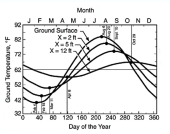
Traditional climate-batteries are deep and large with multi-layered piping. They offer great heat storage capacity but at a rather low temperature level. This is because the soil volume where the heat is being stored is not insulated underneath. Most of these system use a 4-ft depth. The chart below shows in the winter months (at 5-ft) the ground temperature is about 52°F. Hence when you begin heating the soil up to temperatures above 52°F, heat begins to be lost through conduction downward.
If the goal is quick plant growth, a 40°F greenhouse overnight temperature is not optimal. It is better to target 65°F, but in a standard climate-battery system, soil temperature in February/March will not be much above 65°F. It takes a temperature difference for heat to transfer, so the exit air flow will not be heated up to 65°F, leaving the greenhouse interior temperature colder.

The TerraPoniK greenhouse is different. Its DCB system is shallow and fully insulated. It acts more like a rapidly charging-and-discharging capacitor than a large, high-capacity but sluggish battery.
The key design features that elevate the DCB above typical climate-batteries are:
1) Fully-insulated soil volume (perimeter and underneath): This allows the soil bulk temperature to rise significantly above the lower earth temperature (approx. 50°F) and thereby makes possible climate battery discharge air temperatures above 70°F. Without the under-soil insulation as heated soil climbs above the deep soil temperature, stored energy is bled away to the lower soil layers lost to being useful for anything other than just keeping a greenhouse above freezing and not warmed to plant-growth-supporting temperatures.
2) The air super-heater: The amazing DCB performance is made possible by an integrated air super-heater that ingests the warm greenhouse air and infuses it with solar energy to elevate its temperature significantly before pumping it underground to warm the soil mass below. Inlet greenhouse air can be a plant-friendly 80°F and the air after super-heating will be +120°F. This drastically widens the temperature difference (the driving force for heat-transfer) between the air and the "climate-battery" soil. If a standard climate battery delta-T is (90-55)°F = 35°F, with the super-heater it becomes: (125-55)°F = 70°F and heat-transfer DOUBLES.
3) Dense high-efficiency under-soil piping network: Heat-transfer also needs adequate surface area and air flow. Common climate-batteries use a generic piping layout that is mediocre but simple to replicate.
The standard design is one-inlet and one outlet at diagonally opposite corners of the greenhouse. The inlet is usually in the N-W corner of the greenhouse near the roof peak and the discharge is in the S-E corner and lower. Flow manifolds run N-S at each end to distribute and then recombine all the parallel pipes traversing E-W across the greenhouse. The parallel pipes branch-off at 90-degree angles and are made by pushing the pipe through the manifold pipe wall. This type of branch connection is about the worse possible and generates pressure-drop and reduced pipe flow rates. Finally, to make an effort to equalize flow rates across the parallel pipe runs, the discharge manifold is required. It uses the same sub-optimal branch-to-manifold connections thereby increase pressure-drop still higher. Now let's contrast this layout with the vastly better DCB design.
The DCB starts with a single pipe centered on the East wall of the greenhouse flowing downward. A fully-optimized flow distribution pipe network then divides the flow evenly into 6 parallel pipe runs without abrupt 90-degree turns (only efficient Wye fittings and long-radius elbows). Because the flow is now evenly divided, it is unnecessary to recombine them and introduce added pressure-drop.
Starting with such a low-pressure loss piping network, allows increased flow velocity which directly improves heat-transfer-rate and charges the soil mass quicker. This is due to two effects; increased air-mass flow-rate and improved heat-transfer-coefficient.
A final heat-transfer enhancement is the pipe run geometry. Instead of straight parallel pipe runs, the DCB use straight-loop-straight runs. The middle loop introduces Dean vortices which up heat-transfer-rate further.
With all of the benefits of the DCB over common climate-batteries, the performance difference is dramatic. The solar energy captured in a single day can easily be twice or more larger than what a generic climate-battery is capable of.
TerrraPoniK greenhouse: "Engineered for Growth"
I will be releasing fully-engineered plans for the TerraPoniK greenhouse later this year (it is a 8.4-ft x 16.4-ft greenhouse that includes much more than just the DCB explained above.
4 days ago