posted 4 months ago
Traditional climate-batteries are deep and large with multi-layered piping. They offer great heat storage capacity but at a rather low temperature level. This is because the soil volume where the heat is being stored is not insulated underneath. Most of these system use a 4-ft depth. The chart below shows in the winter months (at 5-ft) the ground temperature is about 52°F. Hence when you begin heating the soil up to temperatures above 52°F, heat begins to be lost through conduction downward.
If the goal is quick plant growth, a 40°F greenhouse overnight temperature is not optimal. It is better to target 65°F, but in a standard climate-battery system, soil temperature in February/March will not be much above 65°F. It takes a temperature difference for heat to transfer, so the exit air flow will not be heated up to 65°F, leaving the greenhouse interior temperature colder.
The TerraPoniK greenhouse is different. Its DCB system is shallow and fully insulated. It acts more like a rapidly charging-and-discharging capacitor than a large, high-capacity but sluggish battery.
The key design features that elevate the DCB above typical climate-batteries are:
1) Fully-insulated soil volume (perimeter and underneath): This allows the soil bulk temperature to rise significantly above the lower earth temperature (approx. 50°F) and thereby makes possible climate battery discharge air temperatures above 70°F. Without the under-soil insulation as heated soil climbs above the deep soil temperature, stored energy is bled away to the lower soil layers lost to being useful for anything other than just keeping a greenhouse above freezing and not warmed to plant-growth-supporting temperatures.
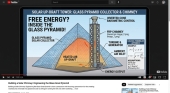
2) The air super-heater: The amazing DCB performance is made possible by an integrated air super-heater that ingests the warm greenhouse air and infuses it with solar energy to elevate its temperature significantly before pumping it underground to warm the soil mass below. Inlet greenhouse air can be a plant-friendly 80°F and the air after super-heating will be +120°F. This drastically widens the temperature difference (the driving force for heat-transfer) between the air and the "climate-battery" soil. If a standard climate battery delta-T is (90-55)°F = 35°F, with the super-heater it becomes: (125-55)°F = 70°F and heat-transfer DOUBLES.
3) Dense high-efficiency under-soil piping network: Heat-transfer also needs adequate surface area and air flow. Common climate-batteries use a generic piping layout that is mediocre but simple to replicate.
The standard design is one-inlet and one outlet at diagonally opposite corners of the greenhouse. The inlet is usually in the N-W corner of the greenhouse near the roof peak and the discharge is in the S-E corner and lower. Flow manifolds run N-S at each end to distribute and then recombine all the parallel pipes traversing E-W across the greenhouse. The parallel pipes branch-off at 90-degree angles and are made by pushing the pipe through the manifold pipe wall. This type of branch connection is about the worse possible and generates pressure-drop and reduced pipe flow rates. Finally, to make an effort to equalize flow rates across the parallel pipe runs, the discharge manifold is required. It uses the same sub-optimal branch-to-manifold connections thereby increase pressure-drop still higher. Now let's contrast this layout with the vastly better DCB design.
The DCB starts with a single pipe centered on the East wall of the greenhouse flowing downward. A fully-optimized flow distribution pipe network then divides the flow evenly into 6 parallel pipe runs without abrupt 90-degree turns (only efficient Wye fittings and long-radius elbows). Because the flow is now evenly divided, it is unnecessary to recombine them and introduce added pressure-drop.
Starting with such a low-pressure loss piping network, allows increased flow velocity which directly improves heat-transfer-rate and charges the soil mass quicker. This is due to two effects; increased air-mass flow-rate and improved heat-transfer-coefficient.
A final heat-transfer enhancement is the pipe run geometry. Instead of straight parallel pipe runs, the DCB use straight-loop-straight runs. The middle loop introduces Dean vortices which up heat-transfer-rate further.
With all of the benefits of the DCB over common climate-batteries, the performance difference is dramatic. The solar energy captured in a single day can easily be twice or more larger than what a generic climate-battery is capable of.
TerrraPoniK greenhouse: "Engineered for Growth"
I will be releasing fully-engineered plans for the TerraPoniK greenhouse later this year (it is a 8.4-ft x 16.4-ft greenhouse that includes much more than just the DCB explained above.
Screenshot-2026-06-10-154246.png
![[Thumbnail for Screenshot-2026-06-10-154246.png]](/t/376842/a/291838/Screenshot-2026-06-10-154246.png "Filename: Screenshot-2026-06-10-154246.png
Description:")






.jpeg)


 2
2