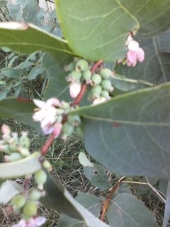
Welcome to permies Joshua The photo's not detailed enough for me to try IDing it, although I'm unfamiliar with many native American plants anyway.
I'd try for a clear shot of the plant growing in place
Also medium-range of stems and leaves to give an idea of plant growth
Close-up of a leaf, also any flowers, seed heads etc
I'd give some detail in words, eg "leaves purple tinge, soft, 'snappy' stems, smells a bit like wees"
Or whatever!
"If you guys know a better way to identify unknown plants I would love to know about it."
I have purchased a field guide for the new region I moved to. I found it helped me ID several items growing on the property that were new to me. I also got a couple other reference books on how to ID trees, wild flowers, herbs that answered most everything else. I cross reference that with an encyclopedia on plant properties to find how each item can be used; and, if something is poisonous with out known benefits I remove it.
Field guides are great for wild and naturalized plants, but for newbies a lot of common cultivated plants can be puzzling too, and books on how to identify them are scarce. A visit to a local arboretum, botanical garden....or even a good nursery with well-labeled plants can be a big resource, as well as making friends with some plant people....
Cortland Satsuma
Posts: 319
Location: (Zone 7-8/Elv. 350) Powhatan, VA (Sloped Forests & Meadow)
Adler,
Good Point! As I have spent so much time in nurseries and botanical gardens my entire life, I forgot a lot of people do not. Anyone just starting into gardening can definitely benefit from starting there. As to finding local experts aka "plant people", some times that helps sometimes not. Many people think they know more than they do. I had several life long locals try to educate me on what was what...they had an over 50% failure rate on their ability to correctly ID common trees, flowers, weeds, grasses, vines and ground cover. Thankfully, I verified their information against resources (starting with internet sources like Wikipedia). Having the wrong information can help one find the right, particularly if they are either physically similar or in the same family (Just follow the reference trail). As to the field guides, I would disagree. While not comprehensive, mine do include many of the common cultivars that do grow in my zone. I do feel strongly that having them is very valuable to anyone interested in plant life, new to gardening or the outdoors or not. As to the availability of books on common cultivars, I find one has to think outside the box a bit. Most illustrated landscaping or gardens books for the region will provide a lot of help in ID of cultivars; I would not buy them, just take my picture and notes to the library...only after swinging by the local nursery and asking there.








![[Thumbnail for Picture-1.png]](/t/23448/a/8491/Picture-1.png "Filename: Picture-1.png
Description:")


![[Thumbnail for IMAG0123.jpg]](/t/23448/a/8535/IMAG0123.jpg "Filename: IMAG0123.jpg
Description:")
![[Thumbnail for IMAG0125.jpg]](/t/23448/a/8536/IMAG0125.jpg "Filename: IMAG0125.jpg
Description:")
![[Thumbnail for IMAG0126.jpg]](/t/23448/a/8537/IMAG0126.jpg "Filename: IMAG0126.jpg
Description:")
![[Thumbnail for IMAG0128.jpg]](/t/23448/a/8538/IMAG0128.jpg "Filename: IMAG0128.jpg
Description:")
![[Thumbnail for IMAG0129.jpg]](/t/23448/a/8539/IMAG0129.jpg "Filename: IMAG0129.jpg
Description:")


 2
2