• Post Reply Bookmark Topic Watch Topic
  • New Topic
permaculture forums growies critters building homesteading energy monies kitchen purity ungarbage community wilderness fiber arts art permaculture artisans regional education skip experiences global resources cider press projects digital market permies.com pie forums private forums all forums
this forum made possible by our volunteer staff, including ...
master stewards:
  • Carla Burke
  • Nancy Reading
  • John F Dean
  • r ransom
  • paul wheaton
  • Jay Angler
  • Timothy Norton
stewards:
  • Pearl Sutton
  • Tereza Okava
  • Nicole Alderman
master gardeners:
  • Christopher Weeks
gardeners:
  • M Ljin
  • Megan Palmer
  • Pete Podurgiel

Palette Grey - how to stop wasting oil paint

 
steward & author
Posts: 48182
Location: Left Coast Canada
20061
10
art trees books chicken cooking fiber arts
  • Likes 4
  • Mark post as helpful
  • send pies
    Number of slices to send:
    Optional 'thank-you' note:
  • Quote
  • Report post to moderator
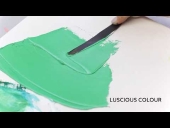
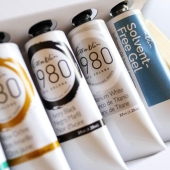
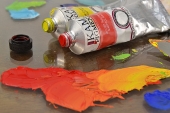
Oil paint is lovely, except that it's almost impossible to know the exact right amount of oil paint to put on the palette.  Too little, and the painting suffers for being skimpy with the right colour.  Too much and we are throwing away money.  Oil paint can be expensive and some colours could easily be $10 for half an inch of paint.  

If only there was a better way.

But before I get to that, let me tell you the story of Torrit Grey, one of the rarest and most sought after paint colours in the last few years.  Even more amusing, is it's a different colour every batch.  Torrit grey is made from pigment and dust caught in the air filter of one of the paint companies (the company that makes the filter is called Torrit, thus the name of the colour).  They clean out the filter and make a small batch of paint with whatever random shit was in the air that year.  (given they are on the West Coast of the USA, wildfire smoke is a thing).  Apparently, it's always a beautiful colour and sells out extremely fast.  People collect tubes from different years like famous baseball cards and the resell value of one of these is exceptional.

Let's combine these two things into one awesome, home made version of Torrit Grey.

Palette Grey


It's not my idea but I embrace it with passion.  It's also an idea I don't see mentioned very often which I don't understand why.  It's absolutely fantastic!  

At the end of a paint session, so long as I haven't used any medium, I pile the remaining paint at the center of the palette and give it a good mix.  Then I put it in one of these tiny Tiger Balm (or any other small, air tight container) jars.  Mine is the 18g size which is something like 15-20ml size jar which seems to be perfect.  Sometimes I'll avoid adding white as I like a darker palette grey and instead put the white in a clove box as I know I'll be using it again in a day or so.

One of the advantages of palette grey is that each painter has their favourite paints and this influences the colours palette grey produces.  Although, it always seems  a little bit different as one never knows how much paint is going to be left over.
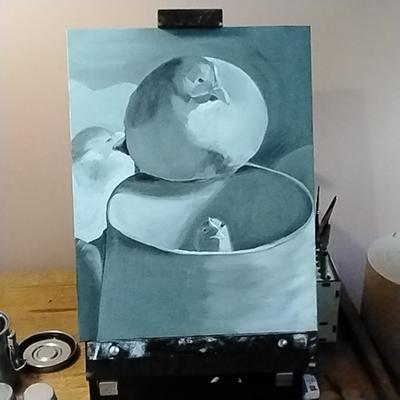


Although it's a nice colour to pop on the palette for desaturating and greying down colours.  I mostly use palette grey for underpainting.  Although I do like to let it dry a bit longer than normal so that it has more time to cure before putting on the next layers - in keeping with Flexible over less flexible.   Either that, or avoid earth colours in the top layers to prevent cracked paint.

this one I gave it an extra month after it was touch dry.
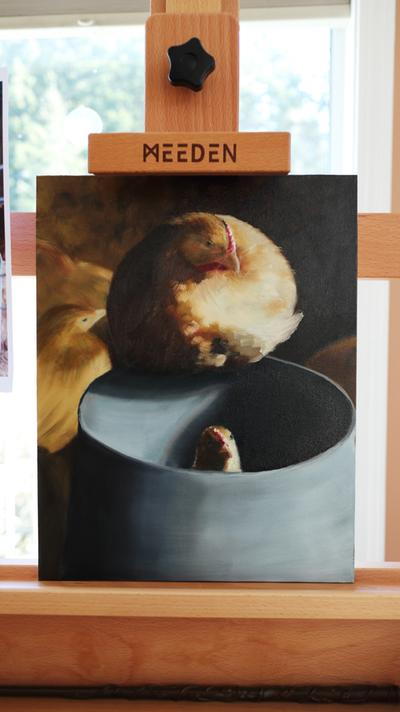


So does it work?

I've been keeping this jar of palette grey on the go for a little under a year and I'm still enjoying it.  The jar is small enough there's very little air in there to cause the paint to stiffen or cure.  I think keeping a jar of Palette Grey has merit and will keep going with it another year and see how I like it.  

 
r ransom
steward & author
Posts: 48182
Location: Left Coast Canada
20061
10
art trees books chicken cooking fiber arts
  • Likes 2
  • Mark post as helpful
  • send pies
    Number of slices to send:
    Optional 'thank-you' note:
  • Quote
  • Report post to moderator
I was working with palette grey and thinking about what I've learned since last I reported in.

Most important is drying time - some pigments dry faster.  Some people use fast drying mediums.  

If the paint is fast drying, it's a poor choice for palette grey... unless it's going to be used right away.

Today I was doing a study in raw umber (dries in about 2 hours) and white so the paint left over was very fast drying oil paint.  I made a kind of gesso/ground for putting over failed painting so I can reuse the panel for future studies.  This turned out to be quite good because it's pretty opaque but fast drying.  

I made a big pile of the leftover paint and added some coarse marble dust to the pile so it was equal by volume to the paint pile.  This marble dust isn't needed, but it is useful.  It make the paint layer less slippery for the next layer to stick to - like regular gesso and oil grounds.  I think real painters call this "tooth".  

Mix it all together and I find it's a bit stiff, so I get a bit of walnut alkyd (fast drying) or linseed oil (normal drying speed) and add about 2 drops per large fava bean size of paint.  This is a good texture now.  So I use a stiff brush and apply it to my failed painting.  The brush is stiff and I use mechanical action (aka, I scrub really hard) to apply as small an amount of paint possible to as large a surface as possible.  A cloth also works but I find it less pleasant than a big brush.  I make sure to use a brush I don't love or is expensive.  A fava bean pile easily does a 12x12 in or more.  

I like to let this dry quite a while before painting on the panel as fat over lean and all that jazz... basically, since we have earlier layers of oil paint, we either need to care about Fat over Lean (far too stressful) or let it cure a good chunk before painting the next layer.  Cure is more than drying to the touch.  A month seems to be ample, but I usually forget and it goes in the back of my pile and it waits about a year.  By that time, there's no need to care about fat over lean (oversimplifed, but since these are only studies and not-for-sale paintings, oversimplifed is good enough).

 
r ransom
steward & author
Posts: 48182
Location: Left Coast Canada
20061
10
art trees books chicken cooking fiber arts
  • Likes 3
  • Mark post as helpful
  • send pies
    Number of slices to send:
    Optional 'thank-you' note:
  • Quote
  • Report post to moderator
So, lately, I'm doing 2 hour studies.  I set up a still life box next to my easel and spend an hour or two painting whatever is in there.  Sometimes people in the house add random objects if it's empty so I don't have to decide what to paint next.

These studies are to help improve my observation skills and try different colour combinations to nail down a limited palette that can capture the mood I seek.  

But since I'm changing objects daily, the colours I mix the day before aren't so useful tomorrow.   It makes for a lot of palette grey.

But, it also provides an opportunity to use up palette grey as it makes a good foundation for background colours and shadow mixes.
gift
 
Native Bee Guide by Crown Bees
will be released to subscribers in: soon!
reply
    Bookmark Topic Watch Topic
  • New Topic