Hi, i have a big problem with my irigaton water, every plant and grenhouse is covered in rust due to the high iron concentration in the water.
The nitrate concentration is also through the roof, so it's actualy killing the plants.
I had a well driled at 22 meters and i use it to irigate my garden with sprinklers instead of drip irrigation which would require kilometers of pipe.
I've asked around and a filter for iron and nitrates would cost over 1000 euros and driling a deaper well at 80+ meters that would have cristal clean water would cost over 5000 euros, and those nr are way more then i can afford. (max budget is 300 euros)
If anyone has a sugestion please let me know cause i have no idea how to irigate my garden this summer.
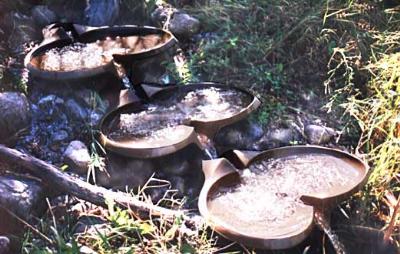
Do you have an inclined spot you could turn into a quick-and-dirty bio-remediation filtering marsh? Dump the water in at the top end, filter it downhill through a series of gravel beds planted with stuff whose only job is to eat the surplus nitrates and accumulate the iron? (Willows will eat iron, I believe.) You should also get quite a bit of iron/rust deposition on the surfaces of your rocks, accumulating in your gravel beds. Then feed now-cleaner water out the bottom end into your irrigation system.
You're not looking to turn toxic runoff into drinking water (which a well-engineered phytoremediation complex can do); you just want to burn some nitrates and clean out the gross iron levels. It shouldn't be that hard if you have the space.
I would suggest putting in some type of algae scrubber in a holding tank right out of the wellhead, so that the algae can use up a good deal of the nitrate before you use it to water. They will also consume some of the iron as an added benefit.
This can be as simple as a 200-liter barrel with a feed tube from the well to the bottom of the barrel, and then set the flow so that it slowly fills up and then spills into a catch barrel. In the first barrel, you put some high surface area material to increase the area of contact between the growing algae and the water. Excelsior pads, also known as "wood wool" would be the best material. You are also going to need a small aquarium pump (smallest you can find should be sufficient) and a diffuser stone, so that the water is well aerated (don't want this algae tank going anaerobic!). To get really good efficiency at removing nitrate, it is better to have more than one filter stage. Two 200-liter barrels staged one after the other are going to remove more nitrate than one 400-liter barrel. The catch barrel at the end can then be connected to your sprinkler system.
I'm going to assume you don't have a chemistry lab at your disposal, so how do you know that the filter system is removing nitrate? By the green color of the excelsior pads. You are going to have to monitor the color from day to day as it gets greener and greener. The pads in the first filter should green up faster than the pad in the second filter (which will be greener than the third stage, and so on). Once the pad in the first filter is an even shade of green and is not getting any greener, then it is saturated with algae and can be disposed. These used pads will make great mulch, as they will release nitrate much slower than they picked it up.
I hope this is an idea that can fit within your budget. One more point, the filter barrels will have to have good sun exposure, as the algae need sunlight to do their magic.
@Dan
I do have a hill close by but i would rather use an electrical pump, cause the sprinklers need pressure.
I did start to make a pond, but it's kinda small, for this i would need a really big pond cause i'm guessing the algae and willow would require at least a week to filter the water. In the summer i use ~ 30-50 cubic meters of water /day (i think so anyway)
@John
That is a very good idea but the sprinklers work 8 hours a night (in the summer) and an algae scrubber wouldn't keep up with the huge debit of water.
Last year i had a tiny pond (400 liters) and when i filed it up with this water it looked clean, but over night the surface became greasy like i pored petrol in it.
If i left it for 1 or 2 weeks and it became full of algae, i didnt test it but does that mean the the water was cleared of nitrates ?
The garden is on a sand hill, so i could make a very deep pond, but would that actually solve my problems ?
remi willis wrote:
Last year i had a tiny pond (400 liters) and when i filed it up with this water it looked clean, but over night the surface became greasy like i pored petrol in it.
If i left it for 1 or 2 weeks and it became full of algae, i didnt test it but does that mean the the water was cleared of nitrates ?
That algae was growing because of the nitrate, so when you filter the algae out of the water, yes, the nitrates should be significantly reduced.
Two possible sources for the oily sheen: (1) organics in the water, that overnight rise to the surface or (2) organics that come from the lysis of dead algae cells and rise to the surface. Either way, running the water through a bed of wood chips that are inoculated with fungi should clear up the problem.
I still think the algae scrubber technology would work, but from your description of the size, I think it is going to have to be upgraded to a 1000-2000 liter holding tank. Maybe your tiny pond needs to be enlarged to a medium size pond?