
• Post Reply Bookmark Topic Watch Topic
  • New Topic
permaculture forums growies critters building homesteading energy monies kitchen purity ungarbage community wilderness fiber arts art permaculture artisans regional education skip experiences global resources cider press projects digital market permies.com pie forums private forums all forums
this forum made possible by our volunteer staff, including ...
master stewards:
  • Devaka Cooray
  • Carla Burke
  • John F Dean
  • Nancy Reading
  • Timothy Norton
  • r ranson
stewards:
  • Jay Angler
  • Pearl Sutton
  • paul wheaton
master gardeners:
  • Christopher Weeks
  • M Ljin
gardeners:
  • thomas rubino
  • Eino Kenttä
  • Jeremy VanGelder

What were your biggest misconceptions of off-grid living?

 
Posts: 9
4
  • Likes 7
  • Mark post as helpful
  • send pies
    Number of slices to send:
    Optional 'thank-you' note:
  • Quote
  • Report post to moderator
Ryan Mitchell, author of Off Grid Living, has put together a thoughtful list of common misconceptions of off-grid living.

I think the laundry issue is one that folks don't really think about when starting an off-grid journey. Sure, washing clothes is easy, but when space is limited and it's raining outside (or winter), then drying becomes the bigger issue.

What do you all think of his list?

Harbor Freight Solar Kits Is All I Need!

I hear this all the time from folks, “I’m going to get one of those Harbor Freight solar kits to power my house”.  These kits are great, if you only need 45 watts, which really is only good for changing a laptop (30 watts) and cell phone (5 watts), maybe some power drill batteries; all of these things are insanely lower power consumption.  If you need to run much more, these system will leave you very disappointed, cold, hungry, and in the dark.

Clothes Washing Is Easy … Right?

Time and time again people geek out over various contraptions for washing your clothes.  I’ve seen them all, the plunger looking things, fancy peddle powered spinning ball gyros, and  hand crank counter top tumblers.  The truth is hand washing clothes isn’t terribly difficult; sure a normal washer is easier, but barring that, I’ve found a tub or large sink really works great.  You can always spot the people who’ve never actually done it because they talk about washing clothes while true off gridders talk about drying clothes.


Drying clothes in an off grid setting in a tiny house is a royal pain.  It’s fine if the weather is nice out, but if it’s really humid, or freezing cold, or worse, raining, you can forget about having dry clothes.  What it really means is for about half the year you get dry clothes, the rest of the year you’ll have mostly dry clothes that you’ll give up and put on because everything is still damp and you need to leave the house.

Drying racks are great if you have just a few things to dry because you can rig something in your shower.  But when you’re talking about a full load, it means you have to setup your drying rack inside your tiny house, which takes up most of your living space, then you need to let it dry in a day or two.  This typically translates into perpetually having your drying rack out, which makes the tiny house much less livable.

The ideal option would be to have a small outbuilding where you could setup a clothes line and have a wood stove in the corner.  You could also do what I do, head to a laundry mat or pay a laundry service.  After doing laundry by hand for 3 months while living in Croatia, I’ve since transitioned to doing my laundry in a normal washer and dryer.  Here in Charlotte I can have my laundry washed, dried and folded for $2.50 a lb, which as someone who loathes folding clothes, is so worth it.

Roof Top Mounted Solar Panels

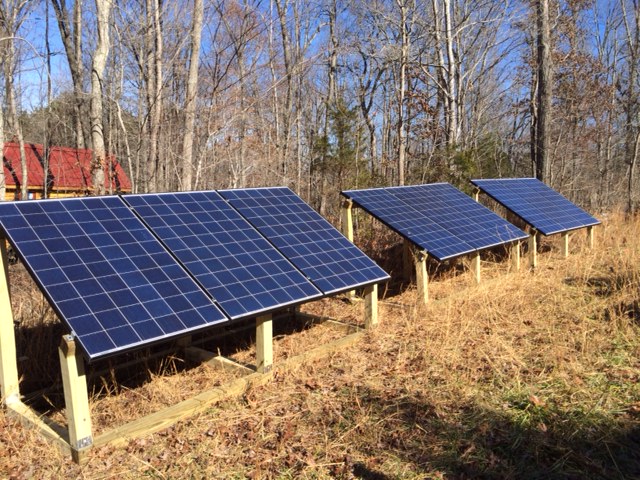
ground mounted solar panelsThe weird thing about solar is mounting on the panels on the roof is one the worst places you could put them.  By their nature roofs are hot, which heat decreases the efficiency of solar panels.  They are high up, so they are hard to get to in order to maintain, brush off snow and clean grime that builds up over time.

Finally, on a tiny house the space you have to deal with is very small, because tiny houses have tiny roofs.


If you’re going to be traveling a lot with your tiny house, roof top is very practical, but you’re going to be hard pressed to do any sort of heating or cooling with that few panels.  The best option is ground mount if you can swing it.  You can access it easily to clean off snow and grime, you can easily inspect it and fix things for maintenance.

Read the rest here.
 
steward
Posts: 18083
Location: USDA Zone 8a
4609
dog hunting food preservation cooking bee greening the desert
  • Likes 5
  • Mark post as helpful
  • send pies
    Number of slices to send:
    Optional 'thank-you' note:
  • Quote
  • Report post to moderator

Jason said, for Ryan Mitchell, Time and time again people geek out over various contraptions for washing your clothes.  I’ve seen them all, the plunger looking things, fancy peddle powered spinning ball gyros, and  hand crank counter top tumblers.  ... You can always spot the people who’ve never actually done it because they talk about washing clothes while true off gridders talk about drying clothes.


If folks are hand washing and hanging clothes out on a drying rack, why is solar needed?
 
steward and tree herder
Posts: 11652
Location: Isle of Skye, Scotland. Nearly 70 inches rain a year
5733
5
transportation dog forest garden foraging trees books food preservation woodworking wood heat rocket stoves ungarbage
  • Likes 7
  • Mark post as helpful
  • send pies
    Number of slices to send:
    Optional 'thank-you' note:
  • Quote
  • Report post to moderator
On the link they also suggest you need backups for everything (redundant systems), that he uses propane, doesn't have a wood stove (because sourcing the fuel is too much work) it's better to have an extra solar panel than add tracking, better to have an extra panel than have more efficient DC appiances....
I agree about adding redundency for resiliance.
I must admit I'm not off grid here. Unless you need to be, it is cheaper to be on grid than off grid in the UK if you can be. We are starting to approach the point where we pay more in standing charge for connection than for the electricity we use though.....
Using fossil fuels instead of wood fuel; rocket mass heater anyone? and a laundromat instead of a clothes line or airer doesn't fit with my dreams of self resiliance (let alone I'm not sure where the nearest laundromat would be? Possibly one of the tourist camps sites?) but if it suits Ryan, fair enough.
 
out to pasture
Posts: 12962
Location: Portugal
3970
goat dog duck forest garden books wofati bee solar rocket stoves greening the desert
  • Likes 12
  • Mark post as helpful
  • send pies
    Number of slices to send:
    Optional 'thank-you' note:
  • Quote
  • Report post to moderator
If you have free-standing solar panels like the ones in the first post, they would provide an excellent place for drying clothes. In the summer, the sun here is too strong to want to dry them outside during daylight hours so the shade the panels provide would help protect them. In wet weather, the panels will give protection from rain. Win-win in my books!

I agree that fancy contraptions are a waste of time for washing clothes - a suitably size tub at an appropriate height, with another one with holes in so the clothes can drain while you change the water in the main one, are all that you need. If you soak them for an hour or three before washing them most of the dirt just lifts out without any effort too.
 
pollinator
Posts: 1144
310
5
tiny house food preservation cooking rocket stoves homestead
  • Likes 11
  • Mark post as helpful
  • send pies
    Number of slices to send:
    Optional 'thank-you' note:
  • Quote
  • Report post to moderator
I find "off grid living"    for most is moving from the electrical grid to the propane / gasoline grid.

It seems you move from one grid to another grid....


Through the years I moved up to 5,000 watts of solar,  with propane/wood as my back up means.       There are cloudy days,  and there needs to be plan B for power when the clouds take over...

The advantage we have today is there are thousands of videos on youtube that show how to be off grid and one can learn from the mistakes of others before they go out and waste time energy money on things that do not work.

I don't have a dryer, I found that a powerful fan on my clothes works great for drying them.      I also use a dehumidifier  to remove that moist air from the room....    This has worked for me...      

I think of it as a learning curve, when you do something new, you have to experience the problems to know how to cope with the problems.   So perhaps going out camping may help get a good dose of reality of what it is to be  making your own power.       It can be done, but the learning curve is included.
 
master pollinator
Posts: 1140
Location: East of England/ Northeast Bulgaria
439
6
cat forest garden trees tiny house books writing
  • Likes 13
  • Mark post as helpful
  • send pies
    Number of slices to send:
    Optional 'thank-you' note:
  • Quote
  • Report post to moderator
I'll start by saying up front we're not off grid and don't ever intend to be, so my opinion is just that, my opinion, not based on actually living off grid. We are however in a situation with our Bulgarian house where utilities are unreliable and we need to have robust backups. I do completely agree with that part of what he says -- back-ups are essential, and back-ups to the back-ups!

To me, the bulk of the post is what works for the author, in his particular situation living in a tiny house, working off site, and wanting to have as much leisure time as possible. What he's saying is accurate for him, but it's not all going to be the best choices for everyone, especially his heavy dependence on propane for back-ups. Also, someone with a homestead on some land is going to have a different set of options to someone in a tiny home, as he is.

I'd rather launder my clothes at home than pay someone to do it, and between a clothesline, an undercover drying area, and a clothes rack, I'm sure we'll succeed in getting our clothes dry. As we've managed that in the UK for over twenty years without a clothes dryer, I'm sure we'll manage it in a semi-off-grid house, too. I can see the issues living in a tiny house are different.

I'm surprised at his level of negativity toward wood heat, though it's probably not all that practical with a tiny house. For our situation, I'd far rather put in the work of managing wood heat and cooking than be dependent on buying in propane. We can provide at least some of our own firewood (cut from our own coppice using a rechargeable battery chainsaw) and easily get wood delivered, but without a vehicle have no way to access propane. Cutting wood is good exercise and also comes with a degree of satisfaction. His set of assumptions here again are based on his own situation, presumably needing to go out to work a "day job" and wanting to maximise his leisure time when he's at home. Personally I love the quality of heat from a wood stove, and watching the flames is far more enjoyable than TV!

Seems to me the author has made the choices that are right for him, but are far from right for many homesteaders.
 
pollinator
Posts: 4176
Location: Tennessee 7b
334
  • Likes 8
  • Mark post as helpful
  • send pies
    Number of slices to send:
    Optional 'thank-you' note:
  • Quote
  • Report post to moderator
“Seems to me the author has made the choices that are right for him, but are far from right for many homesteaders.”

THIS!

My biggest list of misconceptions—I’m just going to do it just like _____. Even if said influencer isn’t just faking it for the camera, the chances of your situation being the same are slim.  

I am guessing it takes me an average of three iterations to get a working system, but sometimes it is six or seven or more.

 
Posts: 8
  • Likes 10
  • Mark post as helpful
  • send pies
    Number of slices to send:
    Optional 'thank-you' note:
  • Quote
  • Report post to moderator
Thanks for sharing this, Ryan! I completely agree with you on the drying issue it’s something many people underestimate when planning off-grid life. Washing clothes is manageable, but having a reliable way to dry them, especially in winter or rainy seasons, is a real challenge.

I’ve been experimenting with off-grid living myself in a rural area in China. I built a solar setup with a couple of 16kWh energy storage systems, which gives me freedom with electricity and makes running small appliances, lights, and even heating easier. With that in place, I can focus on other aspects like building a fish pond and planting around it, instead of constantly worrying about power availability.

I also agree about the roof panels for small setups, ground mounting is much more practical for maintenance and efficiency. It’s interesting how these details make a huge difference in day-to-day off-grid life
 
pollinator
Posts: 829
Location: Illinois
180
  • Likes 13
  • Mark post as helpful
  • send pies
    Number of slices to send:
    Optional 'thank-you' note:
  • Quote
  • Report post to moderator
2 years off-grid, in a humid tropical area. Drying clothing was miserable since nothing dried, never, during the rainy season. Boots and belts, any leather goods molded. I rubbed alcohol into them periodically to kill mold. Clothing always smelled of mildew.

I guess it depends on your local climate. Dry places, no problem. Damp places, problem.

These days we are solidly on-grid, but the climate is such that drying clothing is rarely a big problem. So we have a dryer and have maybe used it 10 times in 19 years, for pillows and such.

Personally I enjoy cutting wood and use a fireplace throughout the winter. But I am 60+ years old and can clearly see the day coming when that won't be practical. People who dislike physical labor would probably find using wood impractical now. A nice solar system running a few space heaters might be an answer.
 
Thom Bri
pollinator
Posts: 829
Location: Illinois
180
  • Likes 14
  • Mark post as helpful
  • send pies
    Number of slices to send:
    Optional 'thank-you' note:
  • Quote
  • Report post to moderator
A few big problems with off-grid living, alluding to the post above. It generally requires more physical work, something most people these days are unfamiliar with and find uncomfortable.

Learning to use an axe or a shovel is harder than you might think, and is very inefficient until you do learn, and causes a lot of muscle pain for a few weeks. Not a lot of people are willing to put up with ANY pain or even mild discomfort.

So from my perspective, the main drawback of off-grid is mental unpreparedness. You have to be willing to put up with a lot of uncomfortable situations and annoyances until you figure out how to overcome them, or just become used to them. Having a lot of money to spend starting up, so you have lots of solar power or a tractor with lots of gadgets, might be the only fix for many people. Being young and fit too.

At my age I wouldn't want to go back to off-grid, and I'd never convince my spouse in a thousand years of trying!
 
pollinator
Posts: 5812
Location: Bendigo , Australia
518
plumbing earthworks bee building homestead greening the desert
  • Likes 11
  • Mark post as helpful
  • send pies
    Number of slices to send:
    Optional 'thank-you' note:
  • Quote
  • Report post to moderator
In my opinion, I believe the biggest misconception about living off grid, is that people think its just as easy and living on grid, without the bills.
WOW what a misconception.
If off grid was easy, everybody would be doing it.

I am off grid because there is no electricity supply anywhere near me, but I knew I had the skills to deal with
the situation. So it was nothing fancy or overwhelming for me.
 
Posts: 9864
Location: a temperate, clay/loam spot on planet earth, the universe
3012
4
  • Likes 11
  • Mark post as helpful
  • send pies
    Number of slices to send:
    Optional 'thank-you' note:
  • Quote
  • Report post to moderator
We were 'off grid' from '73 until '89.

No solar other than the sun...no appliances, no phone until a land line in '86, no screens at all...just a cabin, a wood cook stove and kerosine lamps and our sons, a couple horses, goats, chickens, rabbits, an occasional hog, dogs, cats...and a network of like minded folks that saved us repeatedly.

I suppose the biggest all encompassing 'misconception' was that we could do this with no money or very little.
I mean very little cash flow.

Couple that with inexperience and naivete somewhat balanced by young bodies and enthusiasm...lots of life's lessons learned during those years.


Jane Mulberry
master pollinator
Posts: 1140
Location: East of England/ Northeast Bulgaria
439
6
cat forest garden trees tiny house books writing
  • Likes 10
  • Mark post as helpful
  • send pies
    Number of slices to send:
    Optional 'thank-you' note:
  • Quote
  • Report post to moderator

Judith Browning wrote:
I suppose the biggest all encompassing 'misconception' was that we could do this with no money or very little.
I mean very little cash flow.


The author of the web post says he spent $20,000 on his system. There's a big difference between that type of off grid and pioneer-style off-grid.

All respect to you for living so many years on a low-cash flow the way our great-grandparents did, Judith. They would have grown up learning the necessary skills and had a community to support them, you would have had to learn it all for yourselves.
 
Judith Browning
Posts: 9864
Location: a temperate, clay/loam spot on planet earth, the universe
3012
4
  • Likes 11
  • Mark post as helpful
  • send pies
    Number of slices to send:
    Optional 'thank-you' note:
  • Quote
  • Report post to moderator

All respect to you for living so many years on a low-cash flow the way our great-grandparents did, Judith. They would have grown up learning the necessary skills and had a community to support them, you would have had to learn it all for yourselves.


Well, we did have foxfire books and the whole earth catalogs...plus one straw revolution, and farmers of forty centuries, rodale, etc....lots of books with good information and a network of like minded folks with more info available from local 'old timers'.

Sometimes I wonder if such easy access now to 'how to do things' gets in the way of actually trying things for some?

Our area of the Ozarks is unique in that there was a revival of craft work in the early 60's here as a way for some in a very poor county to make money...by the time we moved here there were many excellent craft people to learn from and some opportunity for marketing things.
 
Jane Mulberry
master pollinator
Posts: 1140
Location: East of England/ Northeast Bulgaria
439
6
cat forest garden trees tiny house books writing
  • Likes 10
  • Mark post as helpful
  • send pies
    Number of slices to send:
    Optional 'thank-you' note:
  • Quote
  • Report post to moderator
You had books and an environment where the old ways hadn't been forgotten (one of the many things I love about our patch of Bulgaria). And you also had the courage to step out and do it!
 
gardener & author
Posts: 3568
Location: Tasmania
2130
8
homeschooling goat forest garden fungi foraging trees cooking food preservation pig wood heat homestead
  • Likes 13
  • Mark post as helpful
  • send pies
    Number of slices to send:
    Optional 'thank-you' note:
  • Quote
  • Report post to moderator
I agree about needing to think about washing and drying clothes (although I’d never use a laundromat). I can never wring out clothes as well by hand as a front-loading washing machine could, so it’s important to allow more drying time and drying space for hand-washed clothes.

We use a typical 40 litre/10 gallon laundry tub. Works fine. A good thing about washing clothes by hand is that you don’t end up accidentally shrinking woollens by getting them mixed up with the machine washing, we can just throw everything in together.

In Australia there’s a kind of outdoor clothesline called a hills hoist. We have two of these for our family of 9, and it’s almost enough. In winter, we have a big clothes rack that goes near the woodstove, so we just bring the almost-dry washing in from outside and finish it up inside, takes a while to get it dry enough to store, so sometimes I think maybe a third line would be great, and then we could possibly wait until a very dry day to bring it all in.

I think it’s important in house design to plan ahead for the space to dry clothes indoors. There are roof-mounted “pulley-maid” type things that would work well when space is limited, because they don’t take up floor space, plus, being up in the warm air, they will dry clothes more quickly than a normal clothes rack.

This washing and drying clothes stuff were things I didn't really think of when we moved off-grid (electric clothes dryers are not that common here). I figured our washing machine would work with the system we started with, and it either broke when we moved house, or would not work with the system, I'm not sure what happened, but the end result was the same, and switching to hand washing was not the end of the world.

Firewood is also something I didn't put huge amounts of thought into. It takes time, and effort, but it's worth it.

I am not quite sure what to make of the OP’s claim that tiny solar electrical systems will leave you “very disappointed, cold, hungry, and in the dark.”. IMO it’s never a wise idea to rely on solar electrical for cooking or heating. There are way more efficient ways to heat and cook, using homegrown wood, solar passive design, or electricity-free solar cooking. Once you get rid of the need to heat water, heat the home, and cook, you don’t need electricity for much. We have 1300 watts of panels and that is enough for two chest freezers, laptops, grain mill, stereo, and lights.

We have not brought in any propane or butane for years. Wood is the best fuel source and it’s possible to rely on it 100%.
 
Anne Miller
steward
Posts: 18083
Location: USDA Zone 8a
4609
dog hunting food preservation cooking bee greening the desert
  • Likes 8
  • Mark post as helpful
  • send pies
    Number of slices to send:
    Optional 'thank-you' note:
  • Quote
  • Report post to moderator
My biggest misconception was that after talking about this and owning land for over 20 years, building a place to live ... dear hubby just could not adapt and pull the plug on TV ...
 
Nancy Reading
steward and tree herder
Posts: 11652
Location: Isle of Skye, Scotland. Nearly 70 inches rain a year
5733
5
transportation dog forest garden foraging trees books food preservation woodworking wood heat rocket stoves ungarbage
  • Likes 8
  • Mark post as helpful
  • send pies
    Number of slices to send:
    Optional 'thank-you' note:
  • Quote
  • Report post to moderator

Kate Downham wrote:I am not quite sure what to make of the OP’s claim that tiny solar electrical systems will leave you “very disappointed, cold, hungry, and in the dark.”. IMO it’s never a wise idea to rely on solar electrical for cooking or heating. There are way more efficient ways to heat and cook, using homegrown wood, solar passive design, or electricity-free solar cooking.


I thought this too (and I'd still go for wood heat in my circumstances) but 'Maximus Ironthumper' apparently uses electricity for hot water, cooking, and a few appliances quite successfully in the UK with a moderate PV array and battery banks video link off this thread. I've been looking into it a bit, since using the hot water as a useful load dump for the excess PV could be an alternative to batteries or grid feed-in in summer.
 
pollinator
Posts: 368
41
  • Likes 10
  • Mark post as helpful
  • send pies
    Number of slices to send:
    Optional 'thank-you' note:
  • Quote
  • Report post to moderator
It's superb to hear tales of homesteading from various sources

My wife grew up in an off grid family, they only started cooking with propane when she was about ten.  My path was preordained in a sense, as our family camped in the backcountry extensively. From what I discern, I would insist on tearing off my diaper, and later all clothes, on camp outs.   While at home our parents included planting, harvesting and wood crafting as everyday chores.

 As an adult I set up an off grid lifestyle for a decade....when 175 watt panels weren't from China and cost 1k each.  It was great fun and educational,  but after meeting my wife a change transpired
I learned to cheerfully compromise , the love of my life encouraged me to adapt.  Now we are content with some rooms on solar, heating with our home grown wood ,growing lots of food, etc. I guess we are half grid these days.  
 
pollinator
Posts: 606
Location: Finland, Scandinavia
443
trees
  • Likes 18
  • Mark post as helpful
  • send pies
    Number of slices to send:
    Optional 'thank-you' note:
  • Quote
  • Report post to moderator
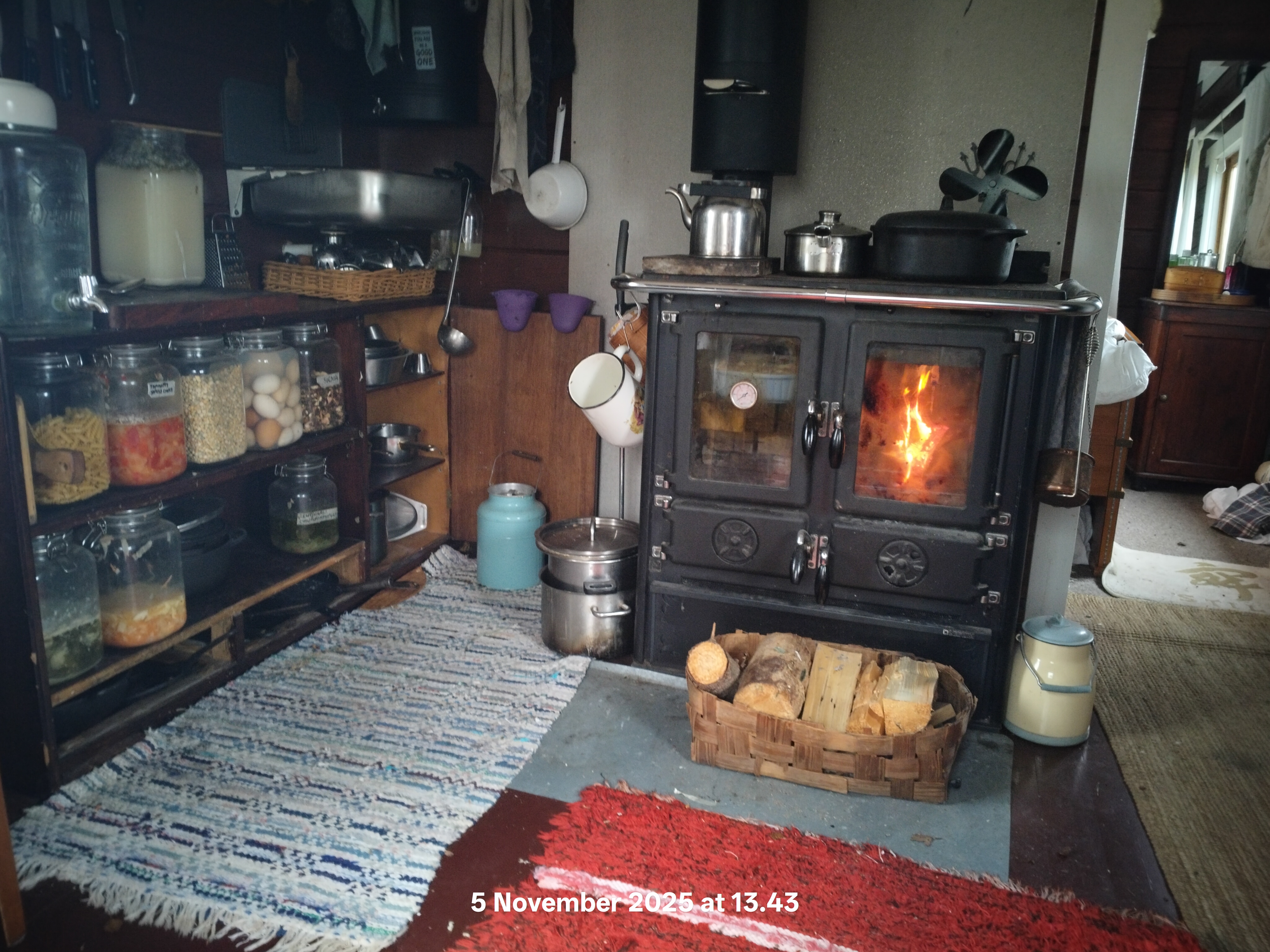
I made a pretty drastic move. I have no running water at all, no sewage system, only have wood heating, no car and a very small house.. In a way, I jumped back a hundred years living wise. My mobile being the only modern gadget.

I think the hardest thing has been loneliness. Some people are intrigued by my living style but even they say they could never give up modern conveniences. So I am doomed to be a lonely wolf, something I don't always fancy.

Clothes are easy - I have s sauna for heating water, running my manual washing machine and drying the clothes.

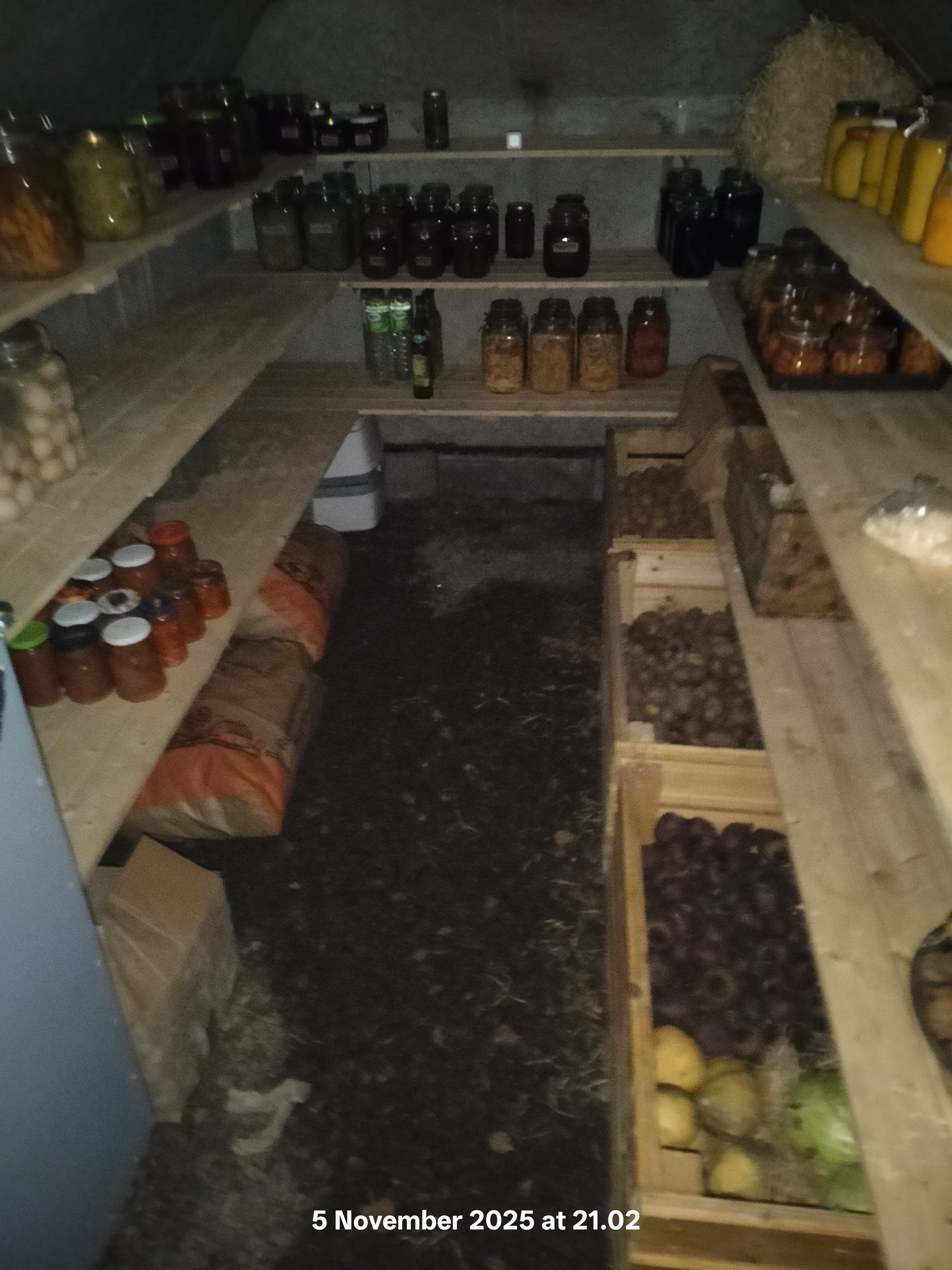
Solar doesn't work in the Arctic winters so I judt don't use electricity. Charge my mobile in the library. I adore my root cellar, which keeps all foods perfectly.

I have my river and my chickens for protein, and vegetable gardens for veghies. Orchard will start producing soon.

So yes. Loneliness.
IMG_20241028_150603.jpg
Sauna, washing machine and water heater
IMG20251105210216.jpg
Food storage without electricity
IMG20251105134356.jpg
Tiny home
Tiny home
 
Rico Loma
pollinator
Posts: 368
41
  • Likes 2
  • Mark post as helpful
  • send pies
    Number of slices to send:
    Optional 'thank-you' note:
  • Quote
  • Report post to moderator
Kaarena, you have a gorgeous place in the snow. I understand how Finland is a world leader in education and happiness levels.  One person's loneliness is also another person's solitude.  

I am wondering if your river could generate a little electricity?  Is it a tidal river, with flow going in both directions?  Have you looked at small quiet generators, for emergency power....
 
Jane Mulberry
master pollinator
Posts: 1140
Location: East of England/ Northeast Bulgaria
439
6
cat forest garden trees tiny house books writing
  • Likes 5
  • Mark post as helpful
  • send pies
    Number of slices to send:
    Optional 'thank-you' note:
  • Quote
  • Report post to moderator
Rico, nice idea about a small hydro system on the river.

Or maybe for a homesteader like Kaarina with a woodstove burning much of the time in winter, a little thermoelectric generator might work to generate enough power to charge a mobile phone at least enough for emergency use.  

I bought but haven't yet tested an old never-used PowerPot, basically a TEG in a cooking pot. The cooling comes from water in the pot. It doesn't generate much power, 5 watts an hour at best, but it's the back-up to my backup for if when the mains electric is out. It could trickle power into a phone (or a power bank that could then charge the phone) and be no extra work apart from topping up the water in the pot during a cloudy winter period where the woodstove will be burning all day but solar panels won't work.

The basic concept was good but it was a commercial failure, mainly because they marketed it to backpackers not homesteaders and it needs the heat source burning too long to be useful for backpackers, affordable lithium battery banks went on sale much the same time, and the next generation of mobile phones needed higher wattage input so wouldn't charge directly from the pot.

I intend to test it when I'm at the house next week.
 
She's out of the country right now, toppling an unauthorized dictatorship. Please leave a message with this tiny ad:
Learn Permaculture through a little hard work
https://wheaton-labs.com/bootcamp
reply
    Bookmark Topic Watch Topic
  • New Topic